
The line between traditional finance and blockchain is blurring. By 2025, more than 1% of the US money supply will circulate as stablecoins, while RWAs attract billions of dollars of institutional investment. A transformation that promises to redefine the global economy and crypto in 2026.

In brief
- RWA (tokenized real assets) will revolutionize finance in 2026, becoming the standard for global payments.
- Financial institutions are massively adopting RWAs for their stable returns, liquidity and transparency.
- Ethereum dominates the RWA and yield stablecoin market, with projects like USDY (Ondo) and sDAI (MakerDAO).
RWA: when blockchain seduces Wall Street
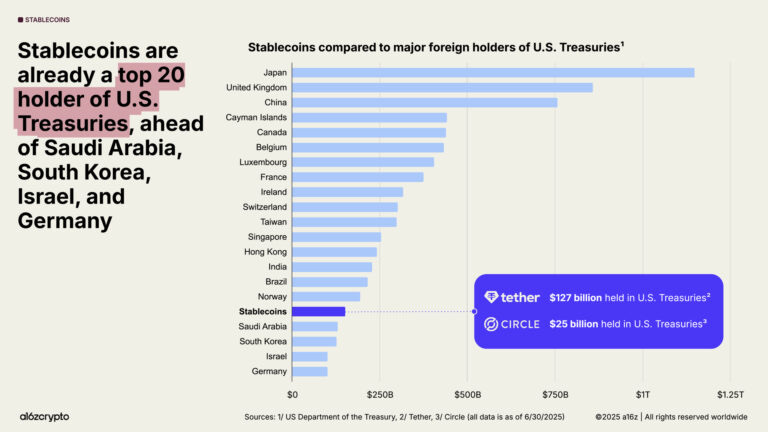
Tokenized government bonds, or “tokenized Treasuries”are sovereign bonds (like US Treasuries) converted into digital assets on a blockchain (RWA). This market is experiencing exponential growth, driven by institutional adoption. Indeed, stablecoins represent 1% of the American money supply and have become the 17th largest holder of Treasuries in the United States with more than $150 billion invested in 2025.
Giants like BlackRock, with its BUIDL fund, or Fidelity, via its OnChain project, are leading this transition. These institutions see it as a way to optimize the management of their collateral and reduce the costs linked to clearing houses.
However, challenges remain, such as the fragmentation of regulations between the United States and Europe, or the concentration of reserves among a few issuers. Despite this, projections remain ambitious, with the market for tokenized real assets estimated at $18.9 trillion by 2033.
Next-generation stablecoins: the programmable currency of tomorrow
Stablecoins are no longer limited to replicating the dollar. In 2025, assets like USDe or USDY, backed by tokenized government bonds, offer high annual returns. These programmable stablecoins attract institutions: 49% of financial companies already use them for cross-border payments or cash management. As Ignacio Aguirre, CMO of Bitget, points out:
Yield-bearing stablecoins are emerging as programmable “digital dollars,” driving broader blockchain adoption and financial innovation, while providing a low-risk, high-return alternative.
Their advantage? Reduce transaction costs by 50-80%, while providing ongoing liquidity. Additionally, transaction volumes exceeded $19.4 billion this year, illustrating their growing adoption. The regulatory framework, notably the GENIUS Act, played a key role in legitimizing these assets! Thus allowing players like Circle or JPMorgan to develop innovative solutions.
Ethereum: the playground for tokenized assets
Ethereum dominates the tokenized asset ecosystem, with many tokenized government bonds and yielding stablecoins issued on its blockchain. Projects like Ondo Finance, with its stablecoin USDY backed by government bonds, or MakerDAO, with its sDAI generating a lot of annual yield, illustrate this dynamic.
However, challenges persist, particularly in terms of scalability. Layer 2 solutions, like Arbitrum or Optimism, reduce costs, but competition from blockchains like Solana is intensifying. Despite this, Ethereum remains the undisputed leader, with a projected 75% share of the RWA market by 2026.
RWAs and next-generation stablecoins are no longer fringe concepts. Driven by institutional demand and clearer regulatory frameworks, these innovations are redefining the rules of finance. The question is no longer if traditional assets will migrate to blockchain, but when your portfolio will include them. So, would you be ready to integrate these assets into your crypto investment strategy?
Maximize your Tremplin.io experience with our 'Read to Earn' program! For every article you read, earn points and access exclusive rewards. Sign up now and start earning benefits.


