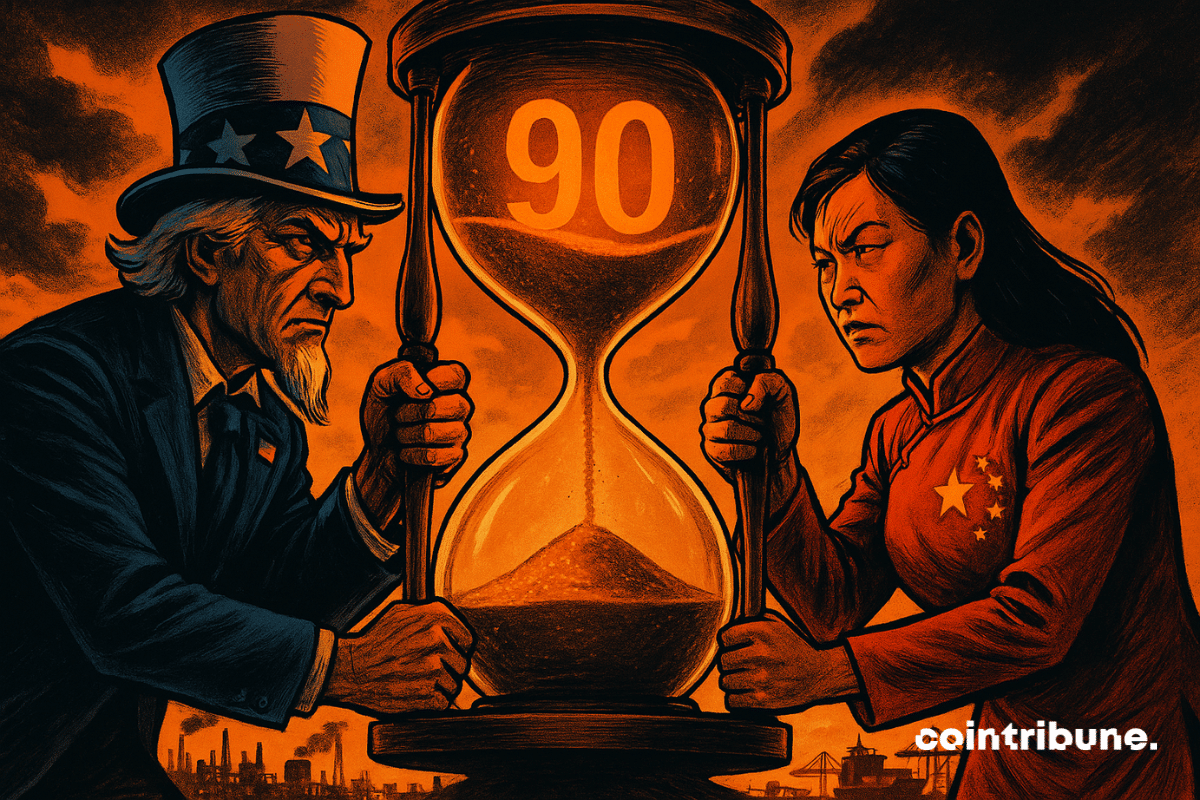
The United States is extending the price truce concluded with China by 90 days. The American president signed, on August 11, a decree fixing the new deadline for November 10. The surcharges in place are maintained. This measure avoids an automatic increase in customs duties and leaves an additional period to continue negotiations.
In short
- Washington and Beijing extend the 90 -day commercial truce, until November 10, with maintenance of current surcharges.
- Discussions continue, Washington requesting more agricultural purchases from China
- Gold remains exempt from taxes, but other existing surcharge are maintained.
Content and scope of the extension of Washington
On August 11, the United States announced, by presidential decree, the extension of 90 days of the commercial truce concluded with China. As a result, the end of the suspension of customs duties increases was rejected on November 10.
This measure suspends the application of the increases provided for in the initial deadline and maintains current rates: 30 % on Chinese imports and 10 % on American exports. It extends the May agreement in Geneva, which had established a 90 -day break to reduce tensions.
China confirmed, via the Xinhua agency, that it applied the same extension, aligning its position with that of Washington.
The two parties retain the dialogue mechanism implemented since spring. This made it possible to freeze the tariff climbing while maintaining the pressure on the subjects of disagreement. No modification has been made to the existing tariff conditions, which offers a certain degree of short -term commercial stability.
State of negotiations and consequences for markets and companies
Since May, several discussion cycles have taken place in Geneva, London and Stockholm. Washington says That China has taken measures deemed significant to respond to American concerns about economic and national security. Thus, exchanges continue with the aim of finding common ground before the new deadline.
The American president indicates that negotiations are constructive. Also, he insists on the need to obtain concrete concessions. Among these is the increase in Chinese purchases of agricultural products, especially soybeans. And Beijing for his part declares that he wants a positive outcome, based on equality and mutual benefit.
In fact, this extension provides visibility to importers and exporters. Trade flows can be planned at current rates until November 10 to reduce short -term uncertainty. The exemption from the gold of new rights, confirmed by Washington, dissipated market concerns and contributed to the stabilization of courses after rumors of taxation.
However, the other surcharge decided in recent months, notably on steel, aluminum and certain industrial goods, remain in force. New taxes could be applied if no agreement is reached before the deadline. Companies must therefore anticipate several scenarios and adapt their supply strategies.
Maximize your Cointribne experience with our 'Read to Earn' program! For each article you read, earn points and access exclusive rewards. Sign up now and start accumulating advantages.