

The development of the Ethereum blockchain reaches a major historic milestone. In a message published on X on July 4, 2026, its founder Vitalik Buterin unveils a new roadmap called “Lean Ethereum”. This strategic plan will guide the evolution of the crypto protocol over the next 3 to 4 years.

In brief
- Vitalik Buterin unveils the “Lean Ethereum” roadmap, which sets the network's priorities until 2029.
- The three priority areas are quantum resistance, confidentiality and scalability.
- Experts welcome the ambition of the plan, but doubt the announced timetable.
A roadmap for rethinking the Ethereum network
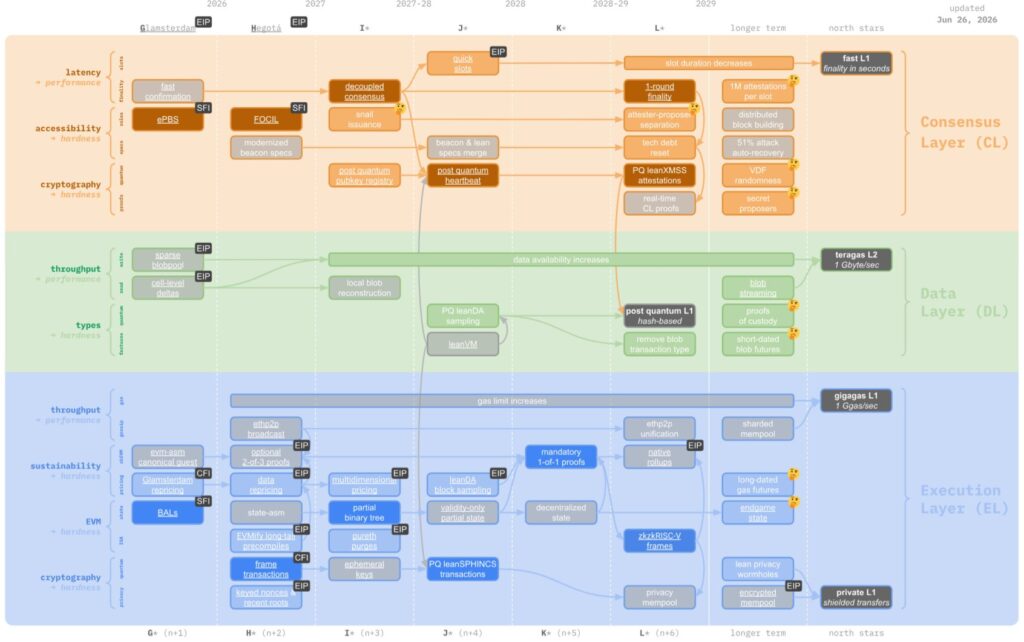
Available on Strawmap.org, the new roadmap “Lean Ethereum” announced by Vitalik Buterin sets the technical course of the crypto network until 2029. Concretely, the deployment will therefore be spread over three to four years.
According to Buterin, the upcoming changes will affect almost every layer of Ethereum. The founder of the crypto blockchain even goes so far as to say that the transformation will be comparable to that of Merge. Dating from September 2022, the crypto network Ethereum had abandoned energy-intensive mining for proof of stake or PoS.
Crypto analysts agree on one point: this comparison is not trivial. The fact is that it situates the ambition of this new stage in the history of Ethereum. Indeed, the strawmap is not limited to a simple list of features. Above all, it prioritizes the current priorities of the crypto network. That's not all! It also gives unprecedented visibility to developers and investors on the technical trajectory of Ethereum for the second half of the decade.
Thus, three axes clearly emerge from this roadmap:
- quantum resistance;
- confidentiality;
- scalability
According to Vitalik Buterin, these three pillars will therefore structure the next updates of the Ethereum protocol.
The subject at the heart of the Ethereum network's priorities: quantum resistance
Vitalik Buterin states it bluntly:
Quantum security has gained enormous priority.
According to the founder of Ethereum, the development of a quantum computer resistant solution for blobs constitutes an absolute emergency. Note that these data spaces were introduced with the Dencun update.
The development of the new roadmap thus reflects a growing awareness of the crypto industry regarding progress in quantum computing. Indeed, the latter is capable of threatening the cryptographic signatures which protect Ethereum transactions. To mitigate this risk, the crypto network replaced classic signatures with robust algorithms in March 2026.
Certainly, Ethereum anticipates a still distant risk by integrating quantum resistance at the heart of its roadmap. The latter, however, constitutes a potentially systemic threat to the entire ecosystem. This includes both individual crypto wallets and the most used DeFi protocols.
For some crypto analysts, the upcoming restructuring also illustrates a change in method at Buterin. It would seem that the founder of Ethereum now favors a proactive rather than reactive approach to emerging threats.
Confidentiality and scalability, the other major projects of Ethereum
Beyond quantum resistance, road map Lean Ethereum sets two other priorities:
- confidentiality
- scalability
In this sense, Vitalik Buterin now considers privacy a “primary objective” for the crypto network. Gone are the days when it was a simple option left to third-party applications.
To achieve its objective, theEthereum ecosystem is considering the introduction of a new virtual machine with two main candidates under study:
- leanISA
- RISC-V
The objective: to guarantee programmable confidentiality.
Concretely, this new technology should allow crypto developers to build applications capable of hiding certain data while remaining verifiable by the Ethereum network.
This new architecture should also strengthen the scalability of Ethereum. This is a sine qua non condition to ensure the growing adoption of crypto blockchain without degrading its performance or transaction costs.
By combining confidentiality and scalability, Ethereum thus seeks to simultaneously respond to two strong expectations of its users:
- protection of sensitive data;
- the development of the crypto network's capabilities to process an increasing volume of operations.
This change of direction comes in a context of profound transformation at Ethereum Foundation
Ethereum Foundation cut about 20% of its workforce last month. The goal: to reduce its budget by 40% and become a lighter structure. This reorganization follows several notable departures in recent months. We refer in particular to Hsiao-Wei Wang and Tomasz Stańczak, two executive figures of the foundation. Historical contributors to the crypto protocol Tim Beiko and Barnabé Monnot also left their positions in May.
This wave of departures raises questions about the capacity of Ethereum governance at a pivotal moment in its technical development. However, it is part of an assumed logic: refocusing the organization on the essential (namely the execution of the “Lean Ethereum” roadmap).
For many crypto experts, the announcement of the new roadmap is no coincidence. It remains to be seen whether this crypto lite foundation will have sufficient human resources to carry out a project as large as that announced by Vitalik Buterin. Note that in May, Ethereum relaunched the recruitment of developers.
Buterin's timeline divides crypto experts
Dankrad Feist, a researcher involved in the Tempo payment blockchain, welcomes the ambition of Buterin's project. However, he considers the timetable of three to four years too slow. According to him, artificial intelligence could allow developers to deliver these updates in just one year.
Crypto analyst Ignas Fiodorovas also shares this enthusiasm in substance. He nevertheless doubts the Ethereum Foundation's ability to meet the announced deadlines. To support his fears, he recalls the foundation's history of delays on its previous roadmaps. That's not all! Fiodorovas also believes that the “Lean Ethereum” plan is missing a key element. He alludes to the improving tokenomics of ETH whose price continues to decline amid a broader bear market.
Decryption: the Ethereum technical roadmap does not alone respond to investors' concerns about the valuation of the token.
In any case, Ethereum has just charted an ambitious trajectory until 2029. It remains to be seen whether the crypto network will be able to combine technical innovation and market confidence in a crypto sector in full restructuring!
Maximize your Tremplin.io experience with our 'Read to Earn' program! For every article you read, earn points and access exclusive rewards. Sign up now and start earning benefits.


