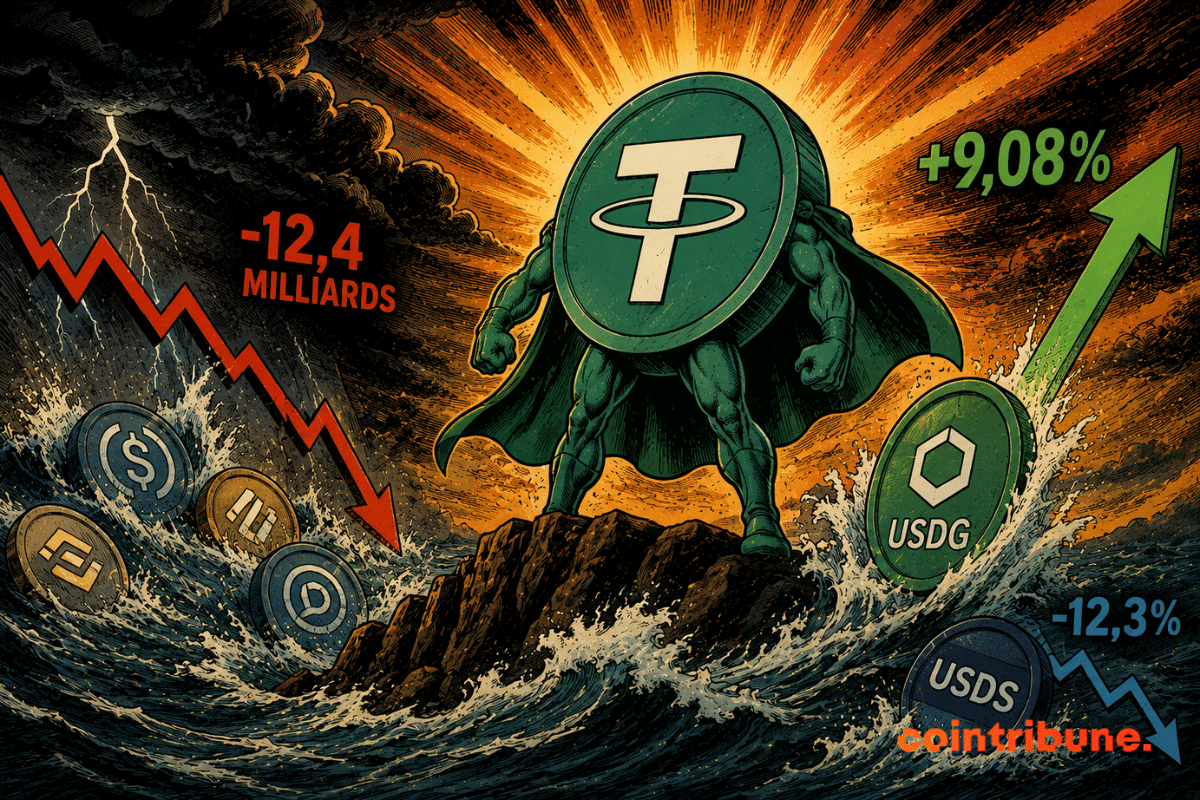
Stablecoins have suffered a historic hemorrhage for two months now. Guess which crypto-stable emerges victorious from this financial chaos? More than $12 billion has left the sector, the biggest contraction since 2022. Tether holds strong, Sky Dollar collapses and Global Dollar explodes. The stable crypto market is changing.
In brief
- 12.4 billion dollars have left stablecoins since mid-May, a contraction not seen since 2022.
- Tether and USDC resist, Sky Dollar collapses 12%, Global Dollar explodes 9%.
- Hyundai carries out international stablecoin transfers in 7 minutes compared to 4 hours.
- Visa sees stablecoins dominating micropayments in the AI agent economy.
12 billion evaporated: the hemorrhage of stablecoins hits the crypto market
Since May 17, 2026, stablecoins have lost $12.4 billion, their biggest contraction since 2022. Last week alone, $1.5 billion flew out of the sector. The total stablecoin market capitalization has now fallen to around $311 billion, down 0.61% over seven days.
Yet, this decline is not a classic panic. Bitcoin and major altcoins have held strong throughout this period. If fear truly dominated the markets, digital assets would have unraveled together.
This is not the case, which raises questions about the real causes of this movement. The current contraction seems less linked to fear than to a profound structural evolution in the sector.
Stablecoins no longer play the simple role of dollar parking. They now compete on performance, functionality and utility. Capital migrates towards assets that offer attractive remuneration.
Those who only offer stability are losing ground. The market is recomposing itself in silence.
The giants hold on, the challengers jostle
Tether (USDT) resists with $184.055 billion, down just 0.06% for the week. Circle (USDC) follows at 73.376 billion, down 0.04%. These two heavyweights now dominate 82% of the stablecoin market.
However, behind this apparent stability, a silent war rages. Sky Dollar (USDS) collapsed by 12.30%, a dizzying fall that took it below the $7 billion mark. World Liberty Financial (USD1) lost 4.59% of its capitalization. BlackRock BUIDL fell 8.68%, a significant drop for an institutional player.
Conversely, Global Dollar (USDG) explodes by 9.08%, reaching $3.164 billion. PayPal (PYUSD) climbs 1.60% to $2.877 billion. This striking divergence reveals a fundamental antithesis in the market.
Yielding stablecoins attract capital seeking remuneration. “Parking” stablecoins are losing ground. The market no longer rewards simple stability. It now demands performance and utility.
Hyundai in 7 minutes, Visa sees the future: institutions enter crypto
Hyundai became the first South Korean conglomerate to use Avalanche to international transfers in stablecoins. A transfer of $20,000 from Hyundai Motor America to Hyundai Motor Mexico was completed in just 7 minutes. Compared to 3 to 4 hours via traditional banks, the difference is striking.
Hyundai plans to extend this system to its European subsidiaries, with Circle (USDC) and Visa as partners. Institutional adoption of stablecoins is significantly accelerating.
Meanwhile, Visa released a report with Artemis on the economics of AI agents. According to this report, the cards will remain suitable for macro transactions. Stablecoins will dominate micropayments, especially those under $1, in the automated economy. Visa believes that cards and stablecoins are not rivals, but parts of the same system.
The heavyweights of traditional finance are now entering the game. This institutional movement could upset the balance of the stablecoin market.
The end of “dollar parking”: the stablecoin market enters the era of maturity
The contraction of 12 billion does not signal weakness, but a transition towards unprecedented maturity. Hyundai and Visa are just the first signs of structural adoption that transforms stablecoins into payment tools, not simple stores of value.
However, the path is strewn with pitfalls: regulation, with the CLARITY Act or the MiCA in Europe, could redefine the rules of the game for stablecoin issuers. Players like Tether, who dominate thanks to their liquidity, will have to adapt to an environment where performance and transparency become decisive criteria.
The success of Global Dollar and PayPal PYUSD proves it: capital now rewards innovation and utility. The stablecoin market is no longer a calm ocean. It becomes a battlefield where only the most agile will survive.
The question is no longer who dominates today, but who will be able to evolve tomorrow. The recomposition is only just beginning.
Key brewing figures:
- 12.4 billion evaporated in two months;
- USDT dominates at 184 billion;
- USDS falls 12.3%;
- USDG explodes 9.08%.
The United States can pride itself on its dominance over stablecoins. But on the European side, cloudy skies are ahead with this rain of digital money. The BIS warns of a creeping dollarization of emerging economies, driven by the expansion of stablecoins.
Maximize your Tremplin.io experience with our ‘Read to Earn’ program! For every article you read, earn points and access exclusive rewards. Sign up now and start earning benefits.