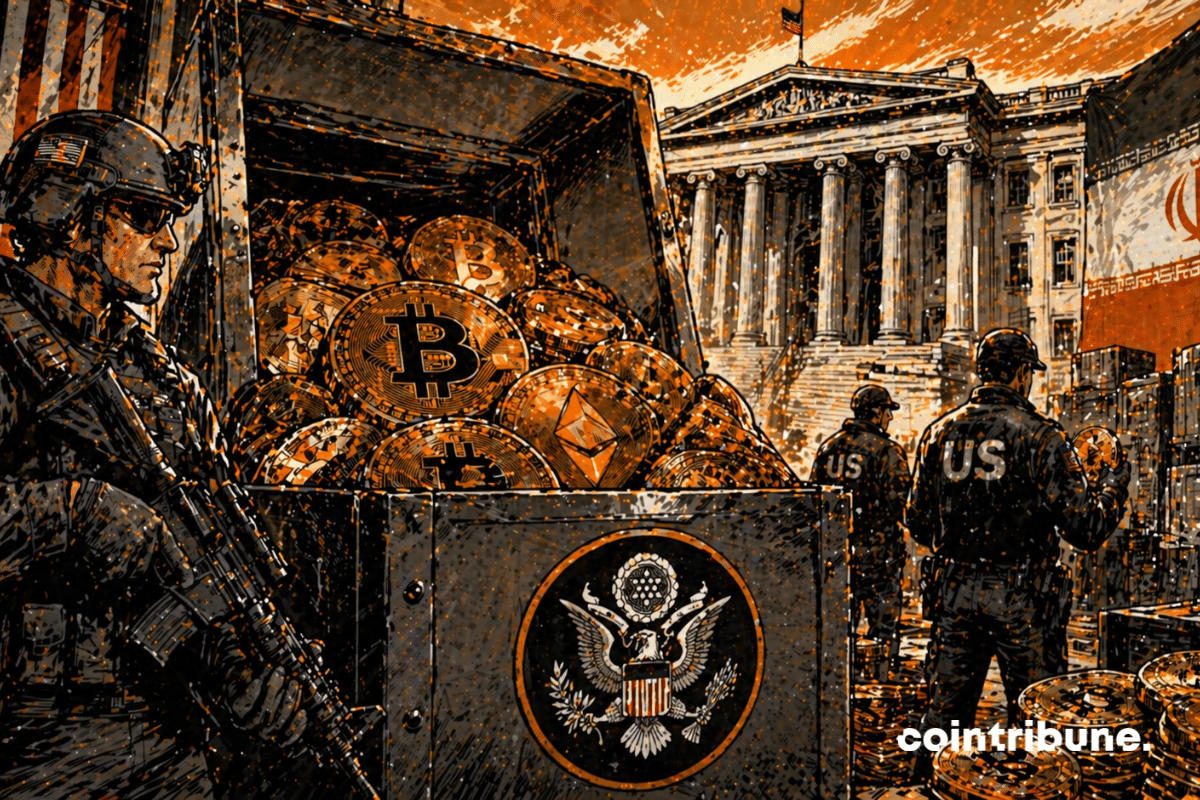
Tensions between Washington and Tehran cross a new threshold, now on crypto territory. The United States announces it has seized nearly $500 million in crypto linked to Iran, revealing the scale of an ongoing financial offensive. Thus, the Secretary of the Treasury, Scott Bessent, inserts this operation into a strategy aimed at cutting off the regime's economic flows. Behind this announcement, a reality is emerging: crypto is establishing itself as a central tool in contemporary economic confrontations.
In brief
- The United States announces the seizure of nearly $500 million in crypto linked to Iran.
- This operation is part of a broader strategy aimed at weakening the financial resources of the regime.
- Washington is increasing the pressure by extending its sanctions to several economic players and international networks.
- The Iranian economy is under severe strain, particularly with a marked fall in its currency.
A record seizure at the heart of the American offensive
While Trump has just rejected the offer relating to the Strait of Hormuz, Scott Bessent announced that the United States has seized “nearly $500 million in crypto assets linked to Iran” as part of an economic campaign directly targeting the Iranian regime.
During an intervention on Fox Business, he specified : “We are freezing bank accounts everywhere. Above all, we make actors less inclined to deal with the regime”. This declaration is part of an offensive strategy structured around several levers :
- A seizure of cryptos linked to Iranian entities;
- Freezing of international bank accounts;
- Increased pressure to dissuade the regime's economic partners;
- The extension of sanctions to assets held abroad, including real estate.
All of these actions fall under “Operation Economic Fury”launched in March 2025 to weaken Tehran's financial circuits. The announced amount exceeds the $344 million previously identified, notably in USDT blocked with the cooperation of Tether.
No clarification has been provided on this discrepancy, which leaves questions about the real extent of the seizures and the exact nature of the assets concerned.
Global economic pressure where crypto becomes a strategic lever
Beyond this seizure, the American operation is part of a strategy of global economic pressure. Scott Bessent spoke about a critical situation in Iran, saying: “they are in the middle of a monetary crisis”. The Iranian currency is said to have lost between 60 and 70% of its value against the dollar, while a major bank in the country collapsed in December.
At the same time, the American authorities have intensified sanctions, targeting 35 entities linked to the Iranian parallel banking system, as well as a Chinese refinery and around forty maritime companies involved in oil transport.
Other measures have targeted military supply chains, with sanctions against 14 actors involved in drone and missile production. Since February 2025, more than 1,000 Iran-linked entities, vessels and aircraft have been sanctioned. In this context, crypto also appears in more unexpected uses.
Reports suggest an Iranian plan for bitcoin tolls in the Strait of Hormuz, while fraudulent actors are exploiting the situation by demanding payments in BTC or USDT to allow the passage of ships.
This rise in power of crypto in sanctions and circumvention mechanisms linked to geopolitical conflicts such as the war in Iran, underlines a profound transformation in the balance of economic power. These assets become both targets and tools in state strategies. As these practices develop, they could accelerate debates on regulation, traceability and the role of private actors in the execution of international policies.
Maximize your Tremplin.io experience with our 'Read to Earn' program! For every article you read, earn points and access exclusive rewards. Sign up now and start earning benefits.