
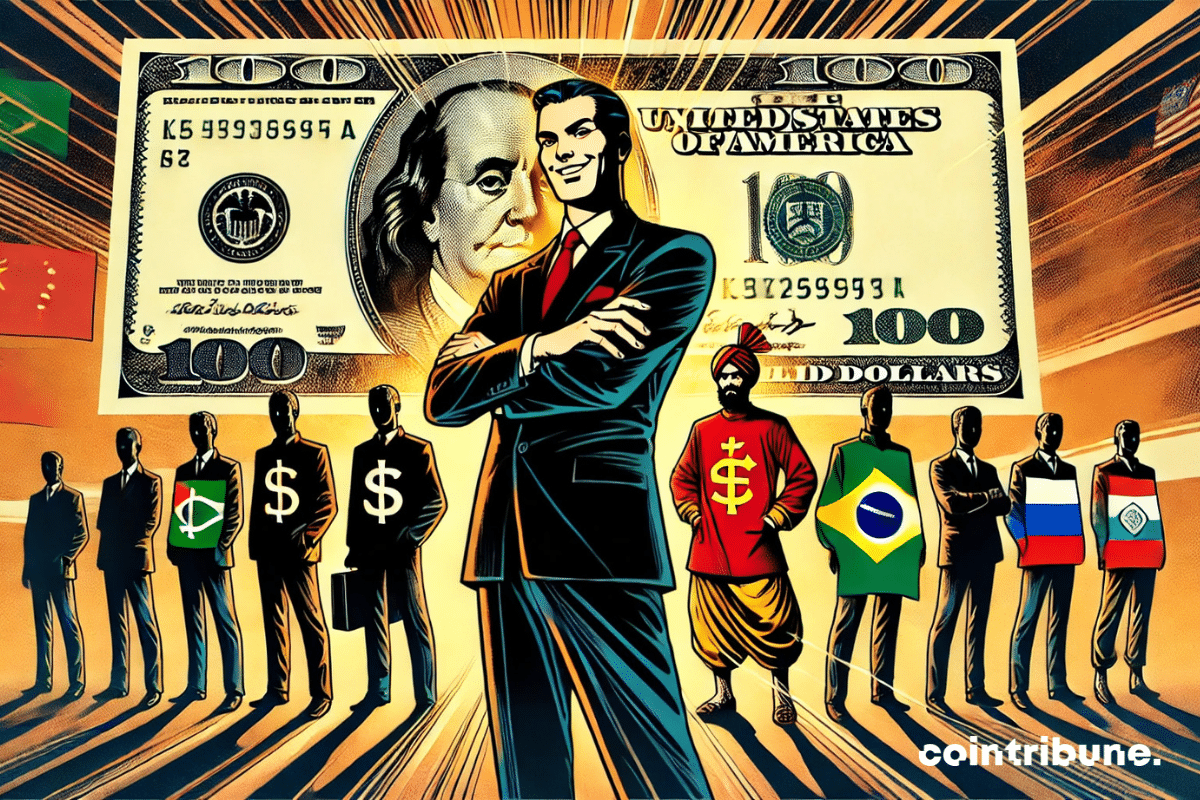
The status of the US dollar in the world economy once again causes tensions. While the BRICS seek to get rid of his hegemony, Donald Trump has swept away any possibility of dedollarization. “There is no chance that the BRICS will replace the US dollar in international trade or elsewhere,” he said. This declaration comes at a time when China, Russia and their allies intensify their efforts to limit their dependence on the greenback, in particular through exchanges in local currencies and the establishment of alternative financial infrastructure. Behind this exit from the American president, a question is essential: is the dollar really unbeatable, or are we witnessing the beginnings of a new monetary order?
The non -affected domination of the dollar according to Donald Trump
Donald Trump's statements are part of a climate of growing economic tensions between the United States and emerging countries, where the battle for monetary hegemony is intensifying. Indeed, the American president, known for his positions torn in matters of financial policy, firmly reaffirmed the supremacy of the dollar in the face of the initiatives of the BRICS. “There is no chance that the BRICS will replace the dollar as a global currency,” he insistedand categorically reject the idea of a weakening of the greenback on the international scene.
For Trump, several structural factors make any alternative unrealistic. The dollar remains the dominant reserve currency, and represents almost 58 % of international transactions, according to the IMF. It also serves as an essential reference for the fixing of strategic raw material prices, in particular oil and gold. The economic and military power of the United States plays a key role in this hegemony, which strengthens the confidence of investors and consolidates the stability of the global financial system. According to him, no currency from the BRICS has sufficient liquidity, such a developed banking network or an equivalent level of confidence to claim to compete with the greenback. The BRICS ambitions, although asserted, would therefore only be an unfinished site in the face of the solidity of the American monetary pillar.
The BRICS and the dedollarization strategy: an unequal fight?
Despite the significant domination of the dollar, the BRICS actively continue their efforts to build a financial system which depend less on the United States. For several years, these nations have multiplied initiatives to reduce their exposure to the greenback. Among the strategies implemented, the growing use of local currencies in trade is a priority. In parallel, the creation of alternative payment platforms to the Swift network, widely controlled by Washington, is accelerating.
China and Russia, in particular, appear on the front line of this approach. Beijing encourages the adoption of the Yuan in international transactions, while Moscow favors ruble regulations to limit the effects of American sanctions. This approach aims to strengthen the monetary sovereignty of the block countries and to reduce their vulnerability to the financial restrictions imposed by the West. However, despite these advances, the dedollarization process encounters several major obstacles.
The absence of a single reference currency complicates the adoption of a credible alternative to the dollar. Each BRICS motto has its own level of volatility, which makes their acceptance on a large scale difficult. In addition, the lack of common financial infrastructure slows down the implementation of an ecosystem capable of competing with the dominant institutions, such as the IMF or the World Bank. Investors' distrust is another important obstacle: the markets remain cautious in the face of emerging economies, often perceived as less stable and less transparent.
If the BRICS wish to impose a new monetary order, they will have to go beyond these limits by consolidating robust financial institutions, and ensuring sustainable economic stability by strengthening international trust. At this stage, the ambition to dethrone the dollar is more based on political intentions than on a tangible economic reality.
Donald Trump's statements rekindle a background strategic debate: can the BRICS really question the supremacy of the dollar? If their economic and diplomatic influence is strengthened, the greenback remains supported by a network of solid alliances and powerful financial institutions, which guarantee its central role in international trade. However, the rise in geopolitical uncertainties, the progressive weakening of confidence in American institutions and the rise of new monetary technologies, including digital currencies of central banks, could ultimately rebatter cards. Between ambitions of dedollarization and resistance of the current financial system, the monetary battle between Washington and the BRICS has only just begun.
Maximize your Cointribne experience with our 'Read to Earn' program! For each article you read, earn points and access exclusive rewards. Sign up now and start accumulating advantages.


