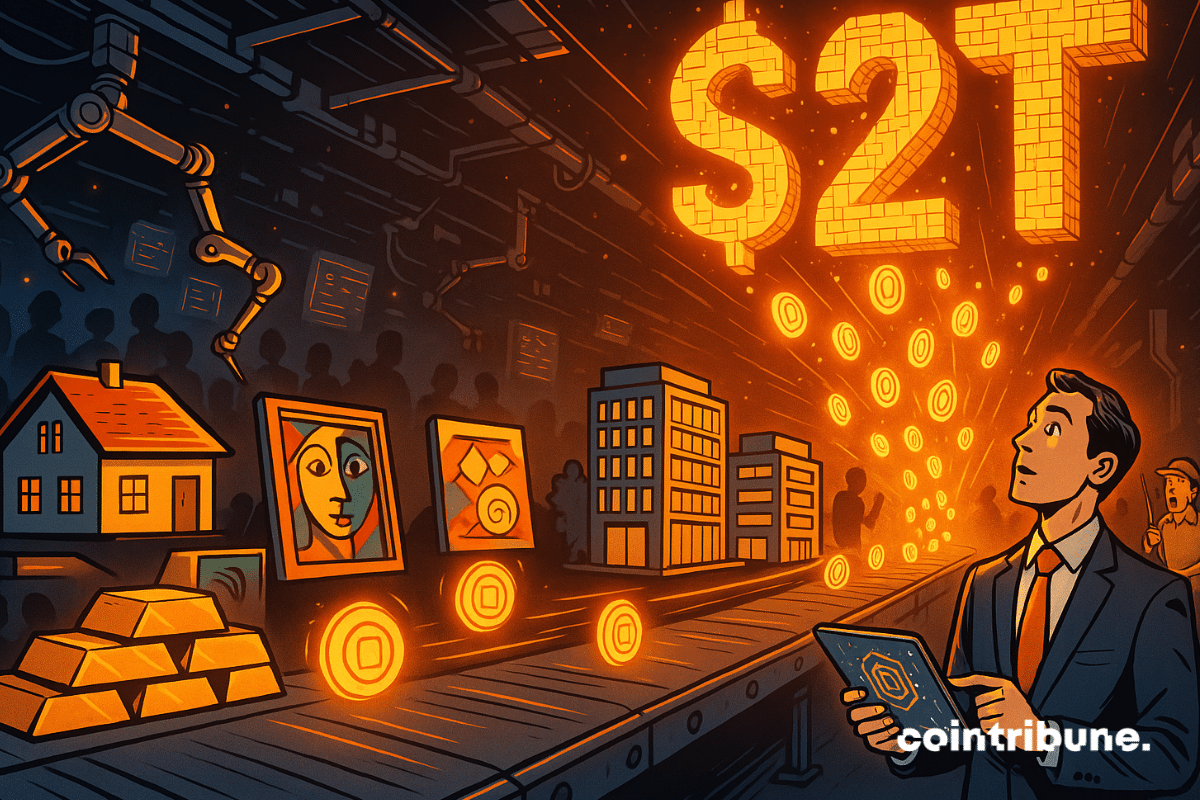
The market for tokenized real-world assets (RWA) is poised for a major boom. Currently valued at around $35 billion, excluding stablecoins, these assets could reach $2 trillion by 2028, according to a report from Standard Chartered. This would represent an increase of more than 5,600%, illustrating the tremendous growth potential of on-chain finance.
In brief
- Standard Chartered forecasts the market for tokenized real-world assets to grow from $35 billion to $2 trillion by 2028.
- Tokenized money market funds and tokenized listed stocks are expected to represent the two largest segments, each at $750 billion.
- Ethereum should concentrate most of this activity thanks to the reliability and stability of its infrastructure.
Stablecoins, the cornerstone of tokenized assets
According to Geoffrey Kendrick, head of digital assets research at Standard Chartered, stablecoins laid the foundation for other asset classes to migrate to blockchain. By improving transparency, facilitating access to funds and enabling on-chain lending and borrowing, they have paved the way for the rise of tokenized money market funds (MMFs) and tokenized stocks in the digital ecosystem.
Kendrick described how the tokenized RWA market projected at $2 trillion could be distributed between different segments:
- Tokenized money market funds, supported by corporate adoption of stablecoins, are expected to be worth $750 billion.
- Tokenized listed stocks could contribute an additional $750 billion, depending on regulatory clarity in the United States and the continued growth of DeFi solutions.
- Tokenized funds are expected to add $250 billion to the market.
- Less liquid assets, including stakes in private companies, commodities, corporate bonds and real estate, are expected to make up the remaining $250 billion.
Ethereum Reliability and Stablecoins Fueling DeFi Growth
According to Kendrick, Ethereum is expected to remain the leading tokenization platform, thanks to its proven reliability. In operation for more than ten years without interruption of its mainnet, the network focuses on stability rather than the speed or cost of transactions, unlike other blockchains. This solidity has made it the basis for the development of stablecoins and decentralized finance (DeFi).
On this basis, stablecoins are already influencing traditional finance: they are transforming payment systems, savings mechanisms, and driving the growth of DeFi. Initially limited to crypto-native users for trading and financing digital assets, DeFi has expanded thanks to the increased liquidity of stablecoins, opening access to a wider range of assets and setting the stage for mass adoption.
Kendrick notably identifies credit and real-world assets as the segments where DeFi could compete with traditional finance. He points out that if tokenized RWAs become tradable on decentralized platforms, they could provide an alternative to traditional stock markets.
A changing regulatory framework
Despite these promising prospects, Kendrick cautions that the main risk remains the lack of regulatory clarity in the United States. A delay in reforms, particularly before the mid-term elections in November 2026, could slow down the development of the sector, even if this scenario is not considered the most likely.
Recent advances, however, provide a more solid foundation. The GENIUS law, adopted in July, established a clear legal framework for stablecoins, favoring their adoption by individual and institutional users.
In addition, the Digital Asset Market Clarity Act, expected between late 2025 and early 2026, should encourage tokenization, DeFi lending and on-chain exchanges. With these rules in place, borrowing, lending and trading digital assets should become more secure and reliable, strengthening the foundations of the market.
Maximize your Tremplin.io experience with our 'Read to Earn' program! For every article you read, earn points and access exclusive rewards. Sign up now and start earning benefits.