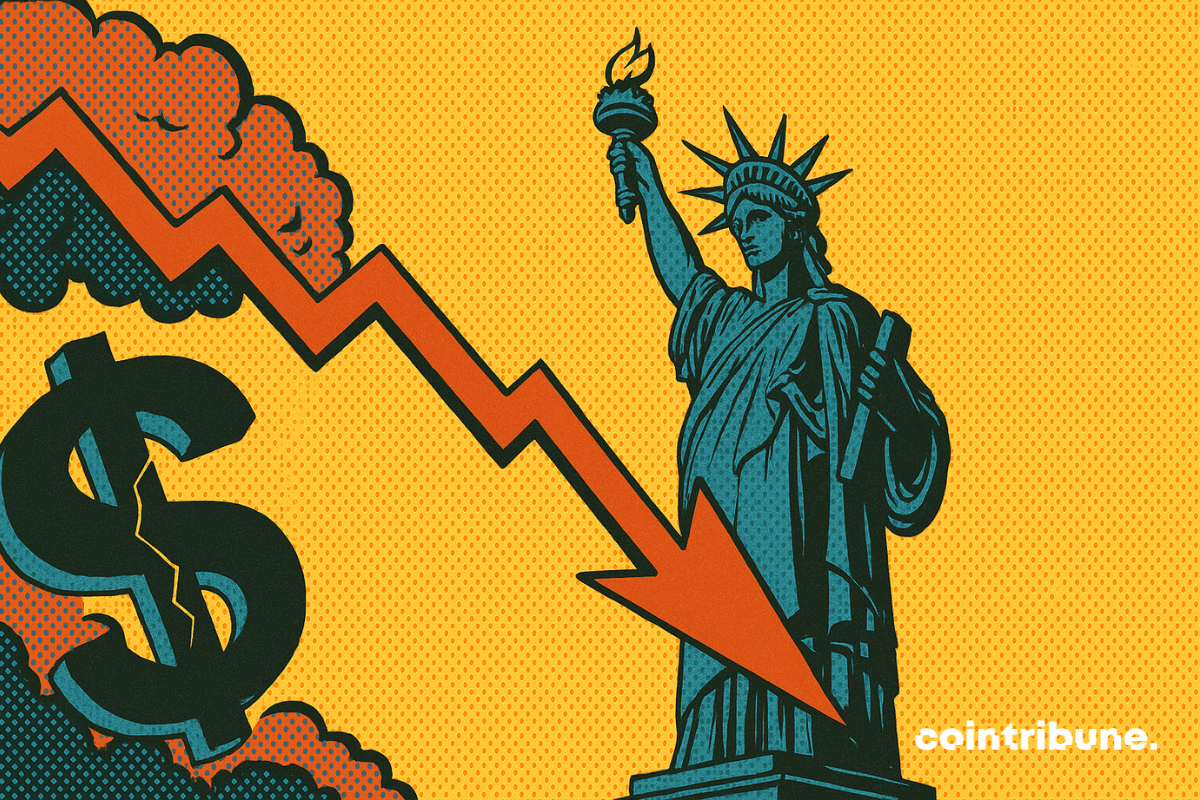
While the American federal debt has just crossed the dizzying threshold of 36,000 billion dollars, Larry Fink, CEO of Blackrock, warns: without a significant rebound in growth, the most powerful economy in the world is likely to hit a tax wall. Behind this alert, an explosive equation combines chronic deficits, political inertia and increased dependence on foreign investors.
In short
- Federal debt has crossed $ 36,000 billion, quadrupling in 25 years and posing a systemic risk according to Larry Fink, CEO of BlackRock.
- Growth less than 3 % would provide the service of debt uncontrollable, especially since new tax reforms could add an additional $ 2,400 billion to debt.
- Relaunching private investment, simplifying infrastructure permits and building an industrial strategy are the three levers identified to straighten the situation.
- Some offer a bold strategy of accumulating bitcoin to generate, in the long term, budgetary surpluses, an idea still marginal, but revealing a paradigm change.
A debt trajectory deemed unbearable by Wall Street
In the year 2000, American public debt amounted to $ 8,000 billion. Twenty-five years later, it has more than quadrupled to reach 36,000 billion. To this structural pressure is added a cyclical threat. The congress is currently considering a new tax reform which could inject between $ 2,300 and $ 2,400 billion in additional debt.
Larry Fink, at the head of the BlackRock giant, alerts the viability of this budgetary trajectory. It warns that at the current rate, economic growth less than 3 % per year would render the service of debt uncontrollable.
Blocked reforms, restrained growth, shaken foreign confidence
To avoid a solvency shock, three levers are identified by Larry Fink. First, relaunch private investment, currently hampered by regulatory blockages. Second, accelerate license procedures for major infrastructure projects. Third, to engage a real industrial policy around strategic sectors such as artificial intelligence.
On this last point, human needs are glaring: there are around 500,000 electricians to support the infrastructure necessary for digital transformation. But these ambitions come up against a slow bureaucracy and a polarized political climate. However, time is running out: the more debt increases, the more the interest service reduces budgetary room for maneuver.
Another point of fragility: the structure of creditors. Almost 25 % of US Treasury bills are held by foreign investors. In a context of trade and geopolitical tensions, this dependence on the United States could become a double-edged sword. A loss of confidence of these creditors would mechanically increase interest rates, further weighing the weight of the debt.
Faced with the impasse of traditional solutions, certain voices, such as that of the entrepreneur Michael Saylor, advance a daring alternative: using Bitcoin as a strategic active ingredient to strengthen the budgetary position of the United States in the long term.
In this environment where conventional solutions are struggling to contain debt excavation, some actors, like Michael Saylor, suggest that the United States could capitalize on its financial power to accumulate BTC, then take advantage of its long-term valuation in order to generate budgetary surpluses. If this approach is still prospective, it reflects an evolution of mentalities: to consider cryptocurrency no longer as systemic threats, but as full economic levers.
Maximize your Cointribne experience with our 'Read to Earn' program! For each article you read, earn points and access exclusive rewards. Sign up now and start accumulating advantages.