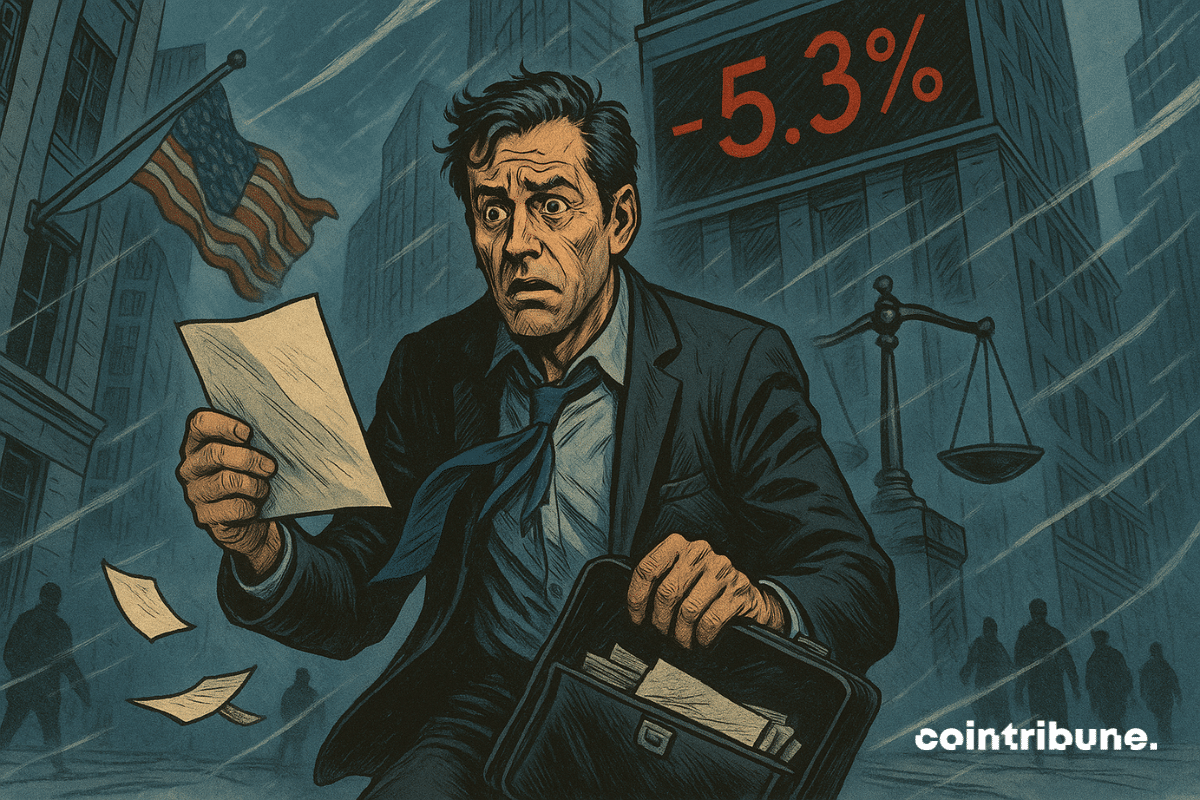
The already fragile balance of the world economy has just taken over a new blow. The 1er August, Donald Trump signed an imposing decree of heavy customs duties at seventy countries, with an entry into force scheduled for August 7. This announcement immediately shaken the financial markets, amplifying tensions against a background of global instability. Behind this commercial offensive is an assertive protectionist strategy, with potentially massive consequences for international trade, diplomatic relations and the economic trajectory of the coming months.
In short
- Donald Trump signs a decree imposing new customs duties on 70 countries, with an application scheduled for August 7.
- This announcement triggers an immediate fall in the main world stock markets, notably in Paris, Frankfurt and Seoul.
- The markets react violently to economic uncertainty, in a context already weakened by unemployment in the United States.
- These new tariff measures accentuate the imbalances in international trade and revive demondialization fears.
A black day for scholarships
While the EU and the United States have combined around customs tariffs, the signing of a decree imposing new customs duties by US President Donald Trump immediately shaken the world markets. These taxes, aimed at 70 business partners up to 10 % to 41 %, will “Restructure world trade for the benefit of American employees”.
Although their entry into force is postponed to August 7their only formalization was enough to trigger instability in the major global financial centers. On the Wall Street Stock Exchange, the term contracts on the three flagship indices announced a clear opening, translating the general concern for investors in the face of this protectionist orientation.
In Europe and Asia, the scholarships immediately reacted downwards as soon as the meeting was opened on Friday morning. Here are the main variations observed at midday:
- Paris: -2.17 %;
- Frankfurt: -1.85 %;
- Milan: -1.86 %;
- London: -0.60 %;
- Seoul: -3.88 %;
- China and Japan: moderate drops.
The pharmaceutical values and large groups exposed to exports were among the most affected on the stock market. In the short term, this instability feeds marked nervousness on the markets, nourished by the unpredictability of American decisions. Investors remain expectant, especially since several affected states are still trying, in an emergency, to negotiate exemptions before the maturity of August 7.
Diplomacy under tension
Faced with this unprecedented wave, the reactions of the countries targeted were quick. Several governments have expressed their disapproval or requested adjustments. China, engaged in a commercial truce with the United States running until August 12, firmly denounced a “Protectionism that harms all parties”.
Canada, for its part, has been informed that its customs duties would increase from 25 % to 35 % from 1er August, except for products covered by the North American free trade agreement. A sanction which, according to Donald Trump, stems from the intention of Ottawa de “Recognize the state of Palestine”a decision deemed incompatible with American commercial interests. Brazil has seen its exports targeted up to 50 %, in reaction to legal proceedings against ex-President Jair Bolsonaro, perceived as a strategic ally by Washington.
In other regions, governments are trying to save time or negotiate exemptions. Mexico thus obtained a 90 -day stay before the possible implementation of pricing increases. In South Africa, customs duties of 30 % imposed by the United States would threaten, according to the local central bank, up to 100,000 jobs.
Its president, Cyril Ramaphosa, spoke of “Intensive negotiations” To alleviate the effects. Taiwan, affected at 20 % despite the strategic importance of its semiconductor industry, said it “Would try to obtain a reasonable level of customs duties”. Switzerland, on the other hand, has been struck by an unexpected surcharge of 39 %, far beyond the threshold applied to the European Union, causing the consternation of its government, which continues to “Find a negotiated solution”despite his “Great regret”.
In this climate of growing distrust of traditional assets, certain refuge values find a central role. Bitcoin, in particular, sees its attraction reinforced with investors looking for alternatives disconnected from national monetary policies. The crypto, often perceived as an active assistant during periods of turbulence, could benefit from a new wave of interest if geopolitical and economic tensions were to worsen.
These measures are a little more fragmented by international trade balances, with potentially sustainable consequences. In the short term, they may disrupt supply chains, increase diplomatic tensions and weaken economic alliances. They ask the question of a lasting change towards a medium -term orchestrated demondialization.
In this context of uncertainty, some analysts already evoke a renewed interest in the assets linked to decentralized finance, perceived as refuges in the face of geopolitical and monetary instability. The negotiation window until August 7 could, however, make it possible to partially alleviate the scope of these measures, provided that a dialogue settles between the powers concerned.
Maximize your Cointribne experience with our 'Read to Earn' program! For each article you read, earn points and access exclusive rewards. Sign up now and start accumulating advantages.