
We know that the traditional markets as well as that of cryptos are more and more dependent and addicted to global liquidity. What about now? And what are the next forecasts?
What is Global Liquidity?
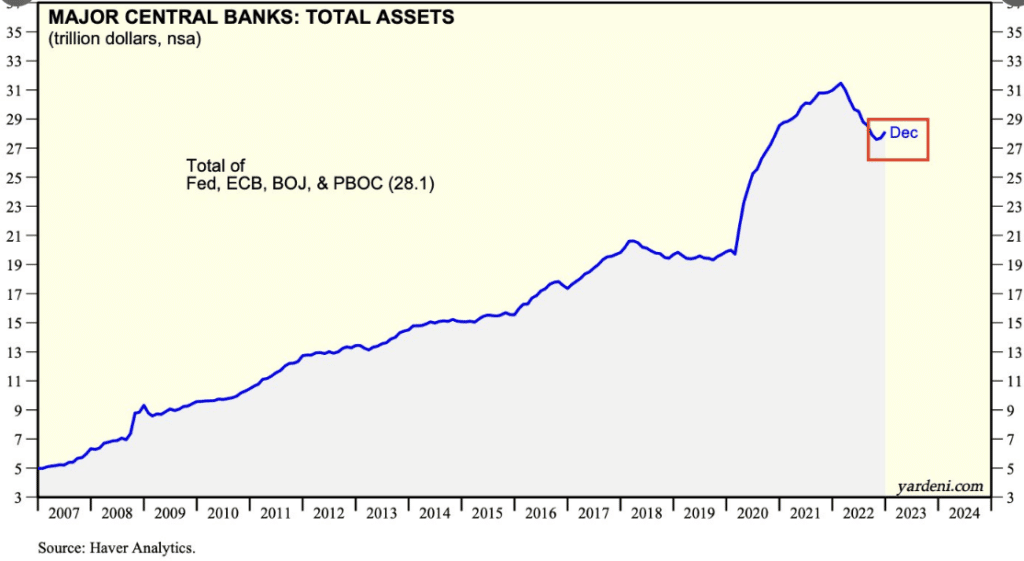
When we talk about global liquidity, we are generally talking about the balance sheets of the central banks of the world’s largest economies. By this we mean the FED, the European Central Bank, the Central Bank of China and the Central Bank of Japan. It is important to follow the interventions of each since they can be in harmony in terms of monetary policy or completely out of step. For example, the Central Bank of China may become dovish while the FED is still applying tight monetary policy. This is why it is important to follow everyone’s instructions.
Here is a graph highlighting all the balance sheets of each of them. We can see the slight rebound in December, which eased financial conditions temporarily.
The most common central bank measures
Central banks are not lacking in imagination when it comes to applying certain measures. They apply these measures in order to respect the objectives of the 2 mandates of the FED, that is to ensure inflation around a target rate and to ensure full employment.
The most common measures are:
- Lower rates : This is one of the main tools of central banks in general. They can raise or lower the rates depending on the objectives of the main mandates. For example, the Fed lowered its rates from 2019 to 2020 to try to stimulate inflation. And on the contrary, it raised its rates in 2022 to bring inflation down to the target rate.
- The quantitative easing program or (QE): Quantitative easing was primarily tried by the Bank of Japan in the late 1990s. It is a way of injecting liquidity into the markets through banks. It became quite common afterwards, the FED initiated this program in 2008 following the financial crisis. The principle of QE is simple, central banks buy long-term government bonds to increase liquidity in the financial system. Hence, it increases the money supply. The QE program is effective when rates are close to 0. It is a kind of second monetary tool to relaunch growth and inflation. During the COVID crisis, many central banks injected liquidity via QE.
- The marginal lending rate (discount window) is the interest rate that commercial banks pay when they borrow liquidity from the central bank. These loans are very short term loans. The banks will reduce the lending rate and will also increase the duration of the loans to ensure adequate liquidity with the banking institutions.
- Swap lines are agreements between central banks to exchange the currencies of their countries with each other. They keep a reserve of currency available to trade with the other central bank at the prevailing exchange rate. Banks use swap lines only for overnight and short-term loans.
The counterproductive effects of monetary policy
Of course, there may be counter-productive effects in the long run from an overly accommodating monetary policy. If we take the example of 2020, excess liquidity can propel economic growth quite quickly. But then, the rapid growth effect can also propel inflation beyond the target. Therefore, central banks must act quickly to absorb liquidity and control inflation. A reverse or restrictive practice to control inflation can have consequences for the economy and the markets, especially if growth slows down at the same time.
The Impact of Global Liquidity on Crypto
As the traditional markets and cryptos are quite addicted to liquidity, this is going to have an impact on the assets. Here is below the evolution of the cryptos compared to the variation of the liquidities:
We can see that an increase in liquidity makes it possible to have a sustained upward movement. And a drop in liquidity can generate more volatile periods. A drop in liquidity is often significant and we must remain vigilant because drawdowns can be higher.
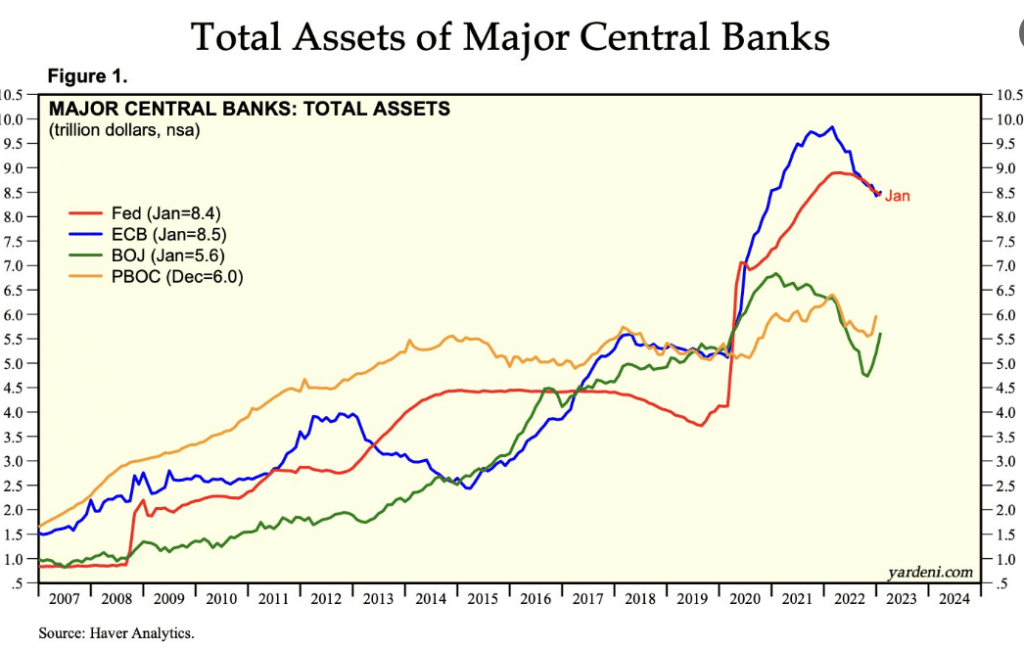
Financial conditions temporarily eased slightly as central banks in China and Japan were more accommodative. This can be seen in relation to the other two central banks (the Fed and China).
The American Central Bank – The Fed
As the FED is the most important central bank in the world, its monetary policy can have more impact than other central banks. Even if the Central Bank of China has revived the printing machine, it is still too weak to offset the effects of the FED. This can currently be seen with the graph below:
In an ideal world, to relaunch global growth, central banks would also have to be in harmony. By harmony, we mean applying a dovish policy together or a hawkish policy together. In this way, it can have an impact on the economy on a global level but also on the crypto market.
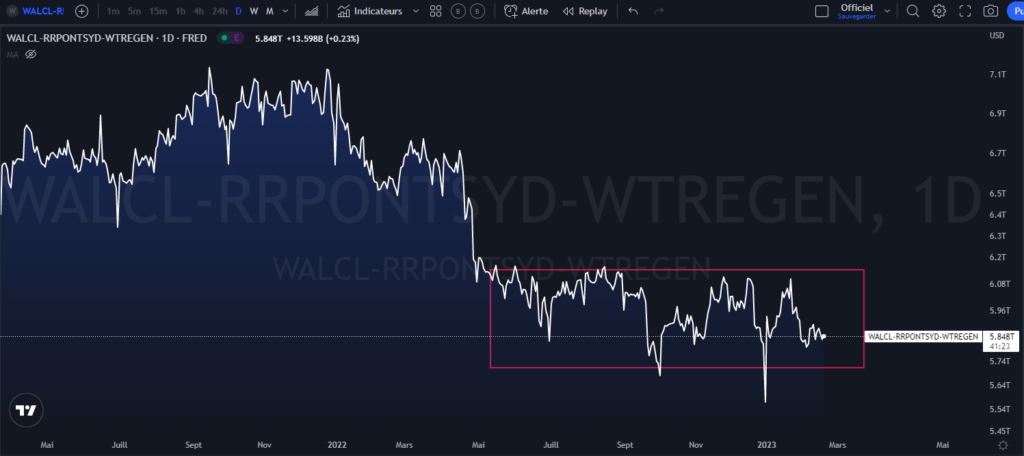
Independently, we can also monitor the FED’s net liquidity by taking into account the following three data: FED balance sheet – (Repo market + Treasury account).
Forecasts/outlook for 2023
There are two major factors that can be taken into account for a sustained bullish movement towards ATHs, it is both:
- growth and/or
- global and local liquidity.
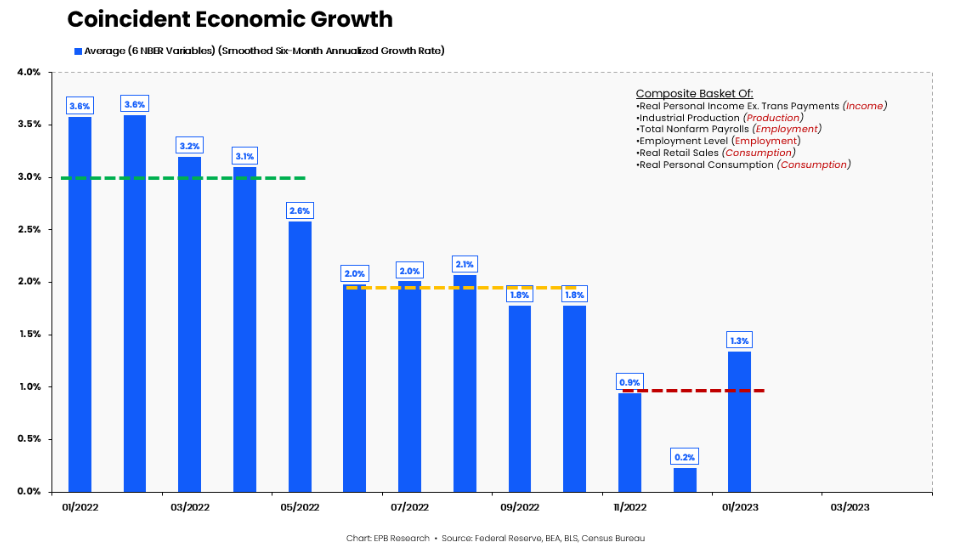
A sustained rebound would require either a level of growth around or above the average. For now, if we take the example of the US, the level of growth remains around 1%, ie below the long-term average of 2%.
The other possibility remains a major change in liquidity. It is therefore important to listen to the various speeches of the major central banks. The FED has maintained the fact that it will remain restrictive and maintain high rates for the time to bring inflation back to the target level. The ECB will continue with rate hikes but it will also start the QT program in March. It is also important to listen to the Central Bank of Japan and see if it will continue to raise rates as well. The fact that all central banks are still in restrictive mode reduces growth potential.
Conclusion
Understanding the role of central banks for the global economy is essential for financial markets in general. Ideally, we would like a certain harmony between them. If this is not the case, it will be necessary to monitor the one with the greatest weight. Yes, because if the most important central bank is restrictive, this can limit the potential for a rebound in growth.
Receive a digest of news in the world of cryptocurrencies by subscribing to our new service of daily and weekly so you don’t miss any of the essential Tremplin.io!