In 63 days, at block number 840,000, the issuance of bitcoins will decrease by half. What impact on the price and profitability of miners?
Bitcoin Halving
We are at the dawn of the fourth halving which should go hand in hand with a significant appreciation of bitcoin if history repeats itself.
The price of bitcoin increased 100-fold in the year following the first halving. The second halving was not to be outdone with a multiplication by 40. It was much less during the third with a factor of 7x.
Some explain this downward trend by the fact that the impact of halving on supply is twice as small each time. Going from 50 bitcoins per block to 25 bitcoins is in fact more impactful than going from 6,250 BTC to 3,125 BTC.
Certainly, but demand has more than doubled over the past four years if we rely on volumes. The reduction in the multiplier effect is mainly due to the growth of bitcoin. The heavier an asset is, the more money it requires to appreciate.
That said, the appreciation potential of bitcoin ($1,000 billion) remains far greater than that of gold, which already weighs $13,500 billion. Same for the S&P500 and its 42 trillion market capitalization. That’s 110,000 billion for all global stock markets. It took six years for the S&P to double in value. It was less than a year for bitcoin.
Another difference that we observe from one halving to another: the increase in time between day D and the peak of the cycle. It was 367 days after the first halving, then 502 days and 548 days. In short, this bull run could be slower, but longer.
What about minors?
During the first halving, on November 28, 2012, miners were still using FPGAs. ASICs arrived three months later with the Avalon A1 and its efficiency of 7 W/GH. That’s an efficiency more than 400 times lower than today’s models…
At that time, the total network hashrate was less than 30 TH/s, a fraction of what it is today. At $0.05 per kWh, the Avalon A1 breakeven was profitable as long as bitcoin remained above $0.1!
In 2016, the Antminer S7 displays an efficiency of 274 W/TH (25 times better than that of the Avalon). The hashrate then being around 1.6 EH/s, the break-even point rose to 293 dollars from the second halving.
At the next halving, it is the S19 Pro and its 29 W/TH which dominates the ASIC market. The hashrate being 110 EH/s, you need a bitcoin of 4,000 dollars to be barely profitable. At the time, the price of bitcoin had collapsed towards $3,850, putting miners paying too much for electricity under great pressure.
Regarding this halving, the break-even point for a Whatsminer M63S will be around $27,000. The S19 Pro antminer will need a bitcoin at $44,000.
Of course, with Kwh at $0.03, the S19 Pro’s breakeven drops to $26,400, which provides a comfortable margin close to 100% given the current price of bitcoin.
In response, many miners are preemptively upgrading to newer models. Others are also making the effort to migrate to regions where electricity is cheaper. Paraguay and Ethiopia are the latest fashionable destinations.
A gentle halving?
It is plausible that 2024 will not be as catastrophic as some think. CleanSpark CEO Matt Schultz, for example, thinks that the hash rate will collapse 30 %.
But you just have to look at the hashprice graph to realize that this halving looks better than the previous one.
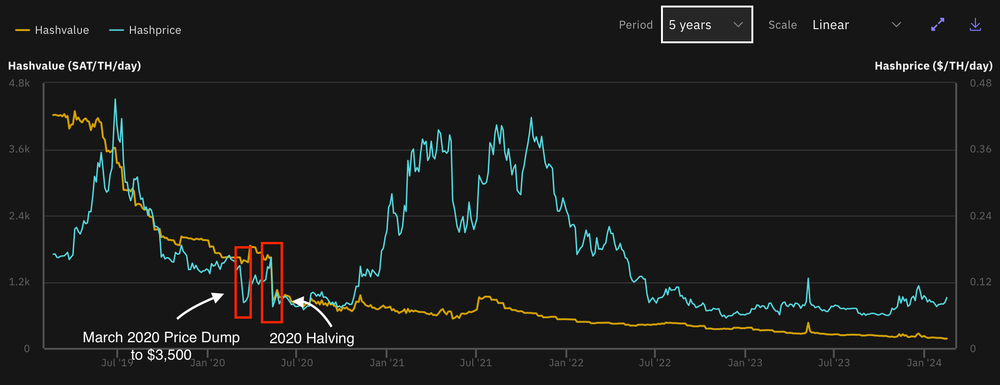
[Mesuré en $/TH/s, le hashprice représente les revenus journaliers en dollars que rapporte la production d’un TH/s.
Hashprice = (Quantité de bitcoins minés chaque jour + frais de transactions) x (Prix d’un bitcoin en dollar) / (Hashrate global en TH/s)]
As you can see in the chart above, the two red boxes highlight the sudden drop in bitcoin towards $3,850 which caused the hashprice to fall by 40%. The second red box is the impact of halving, which reduces the price of hash by an additional 50%.
Today, the context is different. The hash price is rising and it is difficult to see how bitcoin could collapse in 2024 given the success of ETFs. Not to mention central banks which could lower their rates later in the year.
The hashprice has been stable for a little over a year. Minors should therefore not be taken by surprise. Those who have lowered their energy costs and properly amortized their ASIC will do very well.
Indeed, a latest generation ASIC S21 (17 J/TH) is twice as efficient as an S19 Pro released in May 2020 (34.5 J/TH). Enough to compensate for the halving (but not the five-fold increase in the hashrate in four years…).
We are at $0.083/TH/day at the time of writing. In other words, an S21 brings in 18 dollars per day (from which the electricity bill and the depreciation of the machine must be subtracted). It will be 9 dollars after the halving.
If the value of bitcoin continues to rise, it is not impossible that this halving will go well. But the next one?…
Don’t miss our article: Bitcoin Mining in 2024.
Maximize your Tremplin.io experience with our ‘Read to Earn’ program! For every article you read, earn points and access exclusive rewards. Sign up now and start earning benefits.