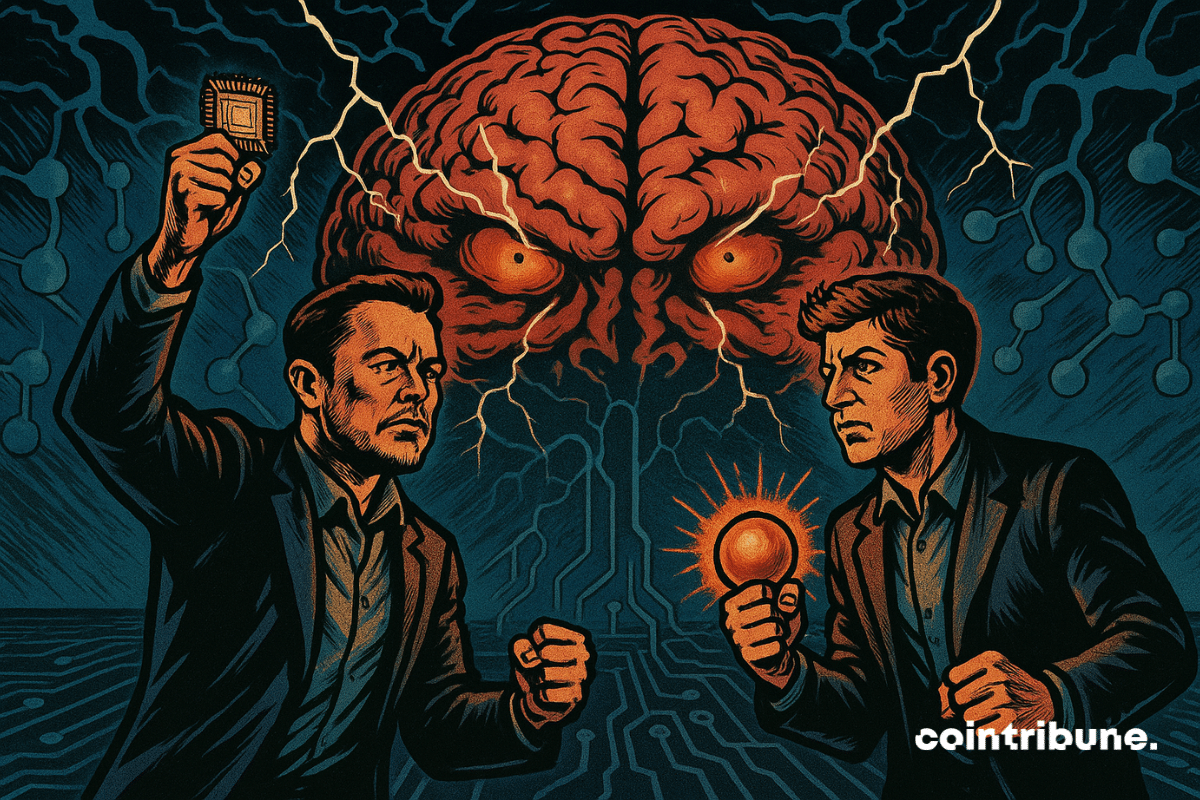
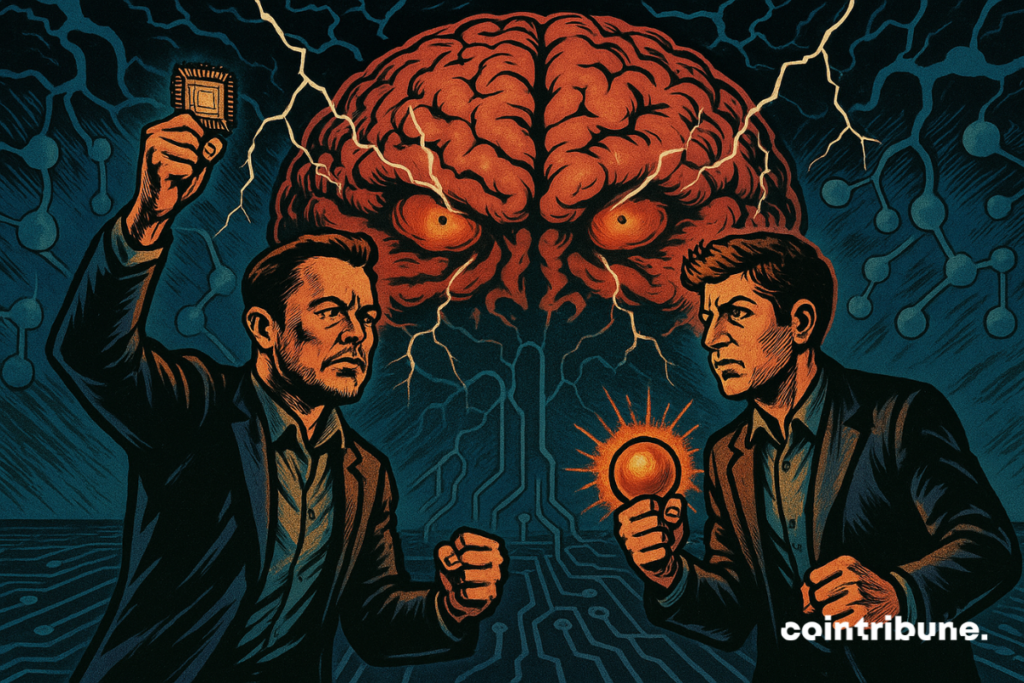
After the moon, space, internet, nanotechnologies, quantum computer science, cryptos and artificial intelligence, a question is essential: what remains to be discovered for humans? Myriads of things, of course. But there is one that fascinates as much as it scares: the brain. At a time when Elon Musk and Sam Altman inject millions into neural interfaces, the border between humans and the machine becomes more porous. And in this race for fusion, the issues far exceed science fiction.
In short
- Elon Musk is already implanting brain chips with Neuralink to merge human and human thought.
- Sam Altman supports Merge Labs, betting on a softer and non-invasive neuronal interface.
- The UCLA develops a co -pilot for EEG headsets, making robotic assistance more efficient.
- Experts alert for possible drifts if some giants control access to our thoughts.
When AI meets neurons: the obsession of pioneers
Neuralink, Merge Labs, Kernel … So many names that resonate like the new Tech temples, with a common objective: to connect the human brain to the machine. Elon Musk does not hide it. Since 2016, it aims at a symbiosis between human and artificial intelligence to “preserve civilization”. Five patients have already received the Neurralink implants, and one of them, Noland Arbaugh, now controls his computer by thought.
His last feat? A game session of Mario Kart, totally by thought.
For Sam Altman, co -founder of Openai, it is with Merge Labs that he enters the fray. Less invasive, more “soft” than Neuralink, his approach flirts with the idea of brain cohabitation between men and AI without heavy implants. Behind these projects, the same idea: to control the next interaction platform.
If only one company holds infrastructure, code and data, it has the keys to an individual's thoughts and intentions. This discourages transparency and slows independent validation as well as scientific advances. Access to BCI technology – and cognitive autonomy – then depends on the commercial decisions of a few figures in sight. It's too much power between too few hands.
Andreas Melhede, Elata Bioscience – Source: Decrypt
This connected AI race is not trivial. For these titans, Have the brain-machine interface amounts to having the future. A power struggle to the air of dystopia, or revolution, depending on where the limit is placed.
Sweet tech implants: a diversity of approaches
If the implants type neuralink make one, other visions emerge, less invasive but just as promising. UCLA researchers, for example, have developed an AI assistant, A “co -pilot”to improve the performance of non-invasive EEG headsets. Result ? A paralyzed patient was able to handle a robotic arm, hitherto impossible without assistance.
Same speech at Kernel, funded by Bryan Johnson, who wants to build the cognitive infrastructure of the future, rather than spectacular gadgets. The objective is clear: capture mental signals, analyze them en masse, and draw predictive models, at the crossroads of AI and neuroscience.
But not all of them share the unbridled enthusiasm of billionaires. Tetiana Aleksandrova, founder of Subsense, recalls that:
Their funding can accelerate advances at a rate that public funds rarely allow. At the same time, the pressure to obtain results at the speed of a start-up can lead to unrealistic promises that jeopardize confidence. And in science, confidence is just as essential as capital.
Tetiana Aleksandrova – Source: Decrypt
Between technological ambition and clinical reality, tension rises. The brain's tech is no longer science fiction, but the terrain remains undermined.
The figures behind the conquest of the brain
In this race, the figures and facts are as spectacular as the ambitions. Here is an overview:
Benchmarks to keep in mind:
- Elon Musk Neuralink raised $ 650 million in series E;
- Patient Noland Arboash broke the world check in BCI with 8.0 BPS;
- Merge Labs, supported by Sam Altman, aims for a valuation of $ 850 million;
- The non-invasive interface with IA developed at the UCLA allowed a patient to handle a robotic arm in 6 minutes.
These advances raise major questions. Who will have the right to read (or control) our thoughts? What place for ethics in this new intimate tech? The competition between AI giants already shapes the rules of the game, long before technology was available to the general public.
And yet, despite technical limits – signals still vague, biological risks -, management seems inevitable: tech interferes in the brain, and AI is installed in our synaptic connections.
While tech titans compete for cables in our brains, the crypto world is not to be outdone. In the world of DESCI (decentralized science), projects are born to transform scientific research with more transparency, collaboration, and equity. What if the next cognitive revolution came, not giants, but outsiders?
Maximize your Cointribne experience with our 'Read to Earn' program! For each article you read, earn points and access exclusive rewards. Sign up now and start accumulating advantages.