

The Bitcoin Bitcoin Stock Exchange Funds in cash in the United States now generate billions of daily transactions, competing with global crypto platforms. Cryptoist data show that American Bitcoin ETFs become a major institutional access channel to Bitcoin.

In short
- Bitcoin ETFS now generate billions of daily transactions, competing with Binance and strengthening institutional access to the market.
- ETHE ETFS recorded higher entries than Bitcoin, attracting $ 1.24 billion in four days and 4 billion in a month.
- ETFS transform the liquidity and adoption of cryptos, offering a regulated exposure to Bitcoin and Ethereum.
American Bitcoin ETFs stimulate daily trading activity
Julio Moreno, research manager at cryptocurrency, says that Bitcoin trading in cash in ETFs based in the United States has become A major exhibition for investors. These funds and others record daily volumes between 5 billion and 10 billion during active trading days. This activity tends to compete, or even exceed, large platforms.
Binance remains the largest platform in terms of cash activity, but the ETFs reduce the gap. The total daily volume of transactions of the 11 ET Bitcoin based in the United States reached approximately 2.77 billion dollars. This represents approximately 67 % of the Bitcoin trading volume in cash in Binance, which is recorded at $ 4.1 billion By Coingecko.
The overall volume of Bitcoin trading, including platforms and ETFs, has increased sharply in recent weeks. The volume of Bitcoin in cash has reached $ 18 billion in peak days. These figures show the growing role of ETF regulated in the broader ecosystem of trading.
Binance dominates but ETFs gain market share
Despite a strong ETF activity, Binance continues to dominate trading in cash with its wide selection of pairs. Its total daily volume, covering all the active ingredients, amounts to around $ 22 billion. Bitcoin represents a large part of this volume, alongside Ethereum, which saw cutting -edge volumes of $ 11 billion.
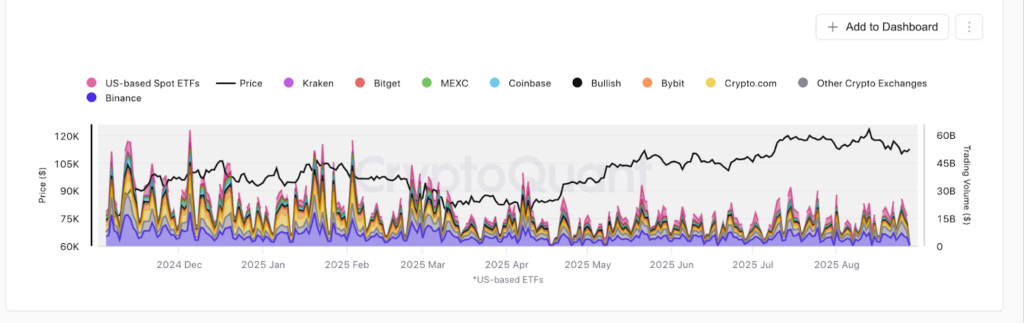
However, Bitcoin ETFs based in the United States are attractive to institutional investors seeking regulated exposure. The BlackRock Ishares Bitcoin Trust (IBIT) is the most important of them, holding almost 40 % of recent entries. Since Monday, Ibit has received around $ 223.3 million in new capital.
Recent statistics Also indicate that the Bitcoin ETF have recorded entries totaling $ 571.6 million in the last four days of trading. This suggests that the entries are not as high as before, but the interest of investors for regulated bitcoin products remains important.
ETHE ETFs record larger inputs
While the ETF Bitcoin dominate the volumes in cash, the ETF Ether recorded stronger inputs during the same period. In just four days of trading, ETF Ethers in the United States attracted $ 1.24 billion in the capital, more than double the entries in Bitcoin funds.
The ETHE Ether also maintained a constant flow of new investments. Since August 20, these funds have not recorded any exit. During the last month, more than $ 4 billion flocked to ETF Ether, representing 30 % of total entries since their launch.
According to Moreno, the ETH trading spot remains concentrated on Binance and Crypto.com, while the ETF currently occupies sixth place in terms of market share. This means that ETHEREUM ETHERE gain in importance, but their adoption by institutions is still in development compared to bitcoin.
ETFs redefine the liquidity of the Crypto market
Industry researchers claim that ETFs are now a central part of market liquidity and pricing in digital assets. In addition, they become a fundamental bridge for traditional capital.
As ETFs continue to grow, they transform the way Bitcoin and Ethereum are exchanged. Their presence offers a regulated entry point for investors, which expands market participation. This helped ETF become a major engine of the Bitcoin trading volume in cash in the United States.
Maximize your Cointribne experience with our 'Read to Earn' program! For each article you read, earn points and access exclusive rewards. Sign up now and start accumulating advantages.


