
The latest data published by Dune Analytics relates an important fact: stablecoins are entering a new phase of their development. Indeed, USDT and USDC no longer seek to dominate the same markets. The first establishes itself as the reference for payments. The second, on the other hand, consolidates its place at the heart of DeFi. Analysts therefore agree on one point: this development could permanently transform the crypto ecosystem. More details in the paragraphs that follow!
In brief
- Stablecoins are no longer waging a head-on war: their uses are becoming more specialized.
- USDT concentrates the bulk of crypto payments, with nearly $95 billion in commercial transactions observed.
- USDC maintains its lead in DeFi, exchanges and dApps.
- The Tron, Ethereum and Base networks play a determining role in this distribution.
- This development could redefine the global adoption of stablecoins and accelerate their integration into financial infrastructure.
USDT emerges as the king of stablecoin payments
Data compiled by Dune Analytics indicates that theUSDT issued by Tether reigns supreme in the commercial transactions segment. For the first half of 2026 alone, it represents around $95 billion of stablecoin payments (compared to just $14 billion for USDC). Which equates to a ratio close to 7 to 1.
That's not all! THE Tether stablecoin also single-handedly captures nearly 92% of the $48 billion in business-to-business (B2B) payment volume over the same period.
Crypto analysts agree: if USDT today outperforms its competitors in the stablecoin payments market, it is mainly thanks to the success of the Tron crypto network. Around 93% of the total circulating supply of Tether is in fact kept in private wallets rather than on exchanges or within complex protocols.
Decryption: the stablecoins USDT primarily serve as an accessible store of value, an instrument for cross-border funds transfer and a direct means of payment for international trade. Enough to illustrate a concrete adoption. More importantly, this performance demonstrates that Tether is now establishing itself as the monetary infrastructure of emerging markets.
Good to know: In June, USDT briefly overtook Ethereum in terms of market capitalization.
USDC becomes DeFi’s preferred stablecoin
According to the Dune analysis report, Circle’s USDC rises to the rank of reference asset for:
- liquidity providers;
- lending platforms;
- algorithmic traders.
Concretely, the data shows a massive concentration of stablecoins USDC on Ethereum networks as well as its main layer 2 of growth, Base. In June 2026, for example, the transfer volume of USDC on the crypto Base network reached an all-time high of $2.6 trillion. This is the highest figure of all token-blockchain pairs tracked by Dune.
Even more interesting! Over the same period, this digital asset processed $1.6 trillion in transactions on Ethereum.
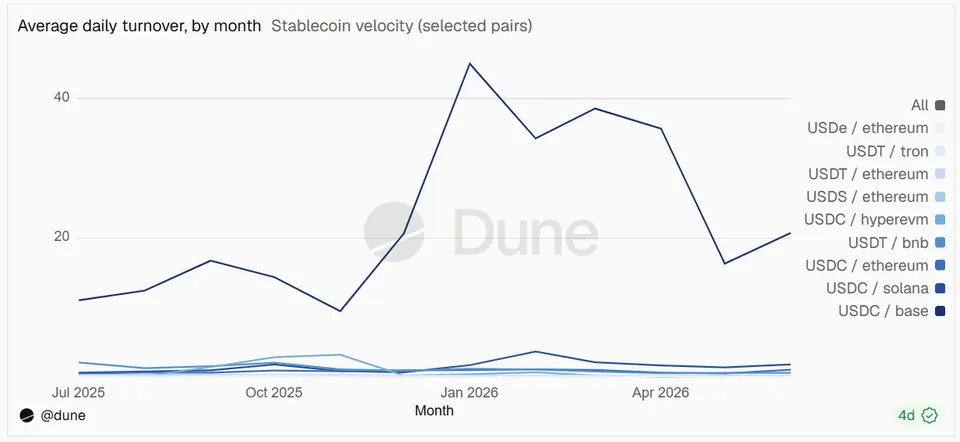
But the analysis of Dune reveals another key indicator: the financial velocity. On Base, USDC in fact records a daily velocity equivalent to approximately 20 times its circulating supply. This means that the same unit of Circle's digital dollar is reused on average twenty times per day across various smart contracts, yield loops and DEXs.
Unlike USDT, stablecoins USDC therefore circulate mainly within an ecosystem where capital is constantly reallocated between different protocols. To put it more clearly, they mainly fuel onchain liquidity.
A historic concentration that redefines the structure of the crypto market
The Dune analysis result confirms an important point: the stablecoin market is entering a maturity phase. The days when USDT and USDC faced each other in a fruitless duel are now over. Today, both main stablecoin issuers no longer fight for the same market shares. They extend their respective monopolies over distinct territories. Thus, each asset gradually develops a specialization.
Note that between them, Tether and Circle now control nearly 83% of the overall sectoral market capitalization which amounts to $315 billion. The calculation is based on tracking more than 200 stable assets across multiple blockchain networks.
To summarize this turnaround, the CEO of Dune Fredrik Haga declared during theETHCC 2026 which was held in Cannes:
The train is now moving.
For investors, the evolution of the stablecoin market shows that several actors coexist today by responding to distinct needs:
- On the one hand, USDT is emerging as the asset of choice for international payments, fund transfers and everyday settlements.
- On the other hand, USDC is becoming an essential component of DeFi protocols, trading platforms and new financial services built on the blockchain.
The key indicators now include transaction volumes, the speed of circulation of tokens, the depth of liquidity as well as the diversity of use cases. In other words, the adoption of stablecoins no longer depends solely on their size. It also (and above all!) takes into account their ability to effectively respond to specific needs within the crypto ecosystem.
This segmentation of the stablecoin market complicates the task of US regulators
Signed in June 2025, the GENIUS Act creates the first federal framework for payment stablecoins. Thanks to this law, banks have the possibility of issuing digital assets indexed to the dollar. THE CLARITY Acthe defines the areas of intervention of the SEC and the CFTC. It passed the Senate Banking Committee in May by a vote of 15 to 9. It has faced persistent resistance ever since.
Three unresolved disagreements prevented the vote before July 4:
- ethical obligations;
- protection of DeFi developers;
- stablecoin yield rules.
The Senate returns to action on July 13, with about three useful weeks before the August recess. Without a clear distinguishing frame a payment stablecoin of a stablecoin used massively in DeFiregulatory uncertainty could weigh on the entire sector.
What future for stablecoins in the face of growing institutional demand?
According to the Dune analysis report, the evolution of stablecoin market towards segmentation by use is probably only one step. It could even become more accentuated in the coming years, propelled by:
- the rise of digital payments;
- tokenization of assets;
- the arrival of new institutional players.
These are all factors which should reinforce the differentiated uses of main stablecoins.
That's not all! The boundary between payment and DeFi could also be redrawn if new issuers target specific niches such as business-to-business payments or institutional liquidity.
For Tether, the challenge will therefore be to consolidate its lead in payments while supporting the expansion of digital economies. For Circle, the priority will likely remain integrating USDC into decentralized finance infrastructure and regulated financial services.
In any case, the fracture of the stablecoin market demonstrates the maturity of the crypto ecosystem. It remains to be seen whether the emergence of CBDCs will disrupt this perfectly orchestrated private balance. Knowing that these are not unanimous either.
Maximize your Tremplin.io experience with our 'Read to Earn' program! For every article you read, earn points and access exclusive rewards. Sign up now and start earning benefits.


