What if tomorrow DeFi signed the death warrant for traditional finance? While decentralized finance continues to gain ground, the tools it generates, such as stablecoins, now seem to weigh on the monetary decisions of central banks. The correlation is such that some, like Fed Governor Stephen Miran, speak of a paradigm shift. The crypto industry, once marginal, is now pushing to reconsider the rules of the game.
In brief
- The Fed anticipates a drop in the neutral rate because of dollar-backed crypto stablecoins.
- The crypto stablecoin market could reach $3 trillion by 2030.
- The GENIUS Act requires issuers to hold liquid dollar reserves for each stablecoin issued.
- Bank disintermediation could weaken the Fed's traditional monetary transmission.
When stablecoins shake up the Fed’s tempo
Stephen Miran, Governor of the Fed, affirms: the rise of stablecoins could well influence American monetary policy. According to himthe growing demand for these dollar-backed assets, estimated at potentially $3,000 billion within five years, is pushing down the neutral interest rate. “ It follows that the equilibrium interest rate in the presence of stablecoins is lower than that which would prevail in their absence. “, he says.
Stablecoins, far from being just internal tools in the crypto universe, are becoming real vacuum cleaners of American Treasury bonds. Miran believes that they offer unprecedented access to dollar assets for savers in emerging countries, where traditional finance is struggling to establish itself. He recalls:
The US capital markets are the deepest in the world, supporting economic growth, financing new ideas and allocating capital efficiently… Stablecoins could well lead the way in this area, making it easier to hold and pay in dollars, both domestically and internationally.
What if this was just the beginning? Global adoption, encouraged by transnational financial bridges, could transform the situation.
Crypto vs. dollar: a silent war of influence
With more than 99% of stablecoins indexed to the dollar, the supremacy of the greenback is asserted… via crypto. However, behind this dynamic, pressure is being exerted on the traditional banking system. Purchases of stablecoins drain funds that would otherwise fuel bank deposits. Result: progressive financial disintermediation which could weaken the transmission of Fed decisions.
The GENIUS Act, praised by Miran for its clear framework, imposes a reserve backed by safe assets at a rate of 1:1. But it is not enough to regulate everything. Many non-US issuers still escape these obligations. And with ever more efficient crypto platforms, the appeal of stablecoins is skyrocketing.
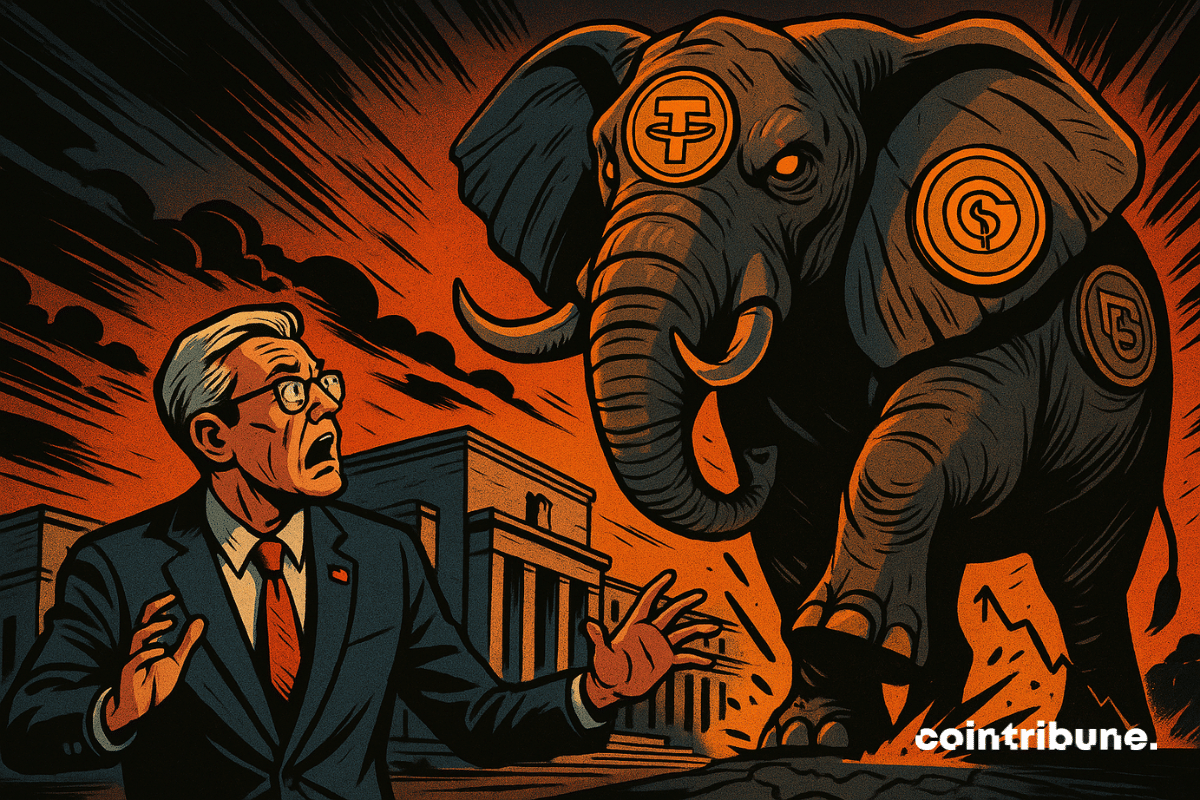
Stablecoins could become a multi-trillion dollar elephant in the middle of the room for central bankers.
Source: Speech by Stephen Miran, 07/11/2025.
A slow but deep slide, like a tide that settles in without making a sound.
A tide of dollars that is shaking up the world monetary order
An influx of liquidity in dollars via stablecoins could weigh heavily on macroeconomic balances. The Fed, already faced with a falling neutral interest rate (r*), could be forced to rethink its approach. Miran does not exclude an impact comparable to that of the “global saving glut” mentioned by Ben Bernanke.
In economies with high inflation, these stable cryptos represent a refuge for households. But be careful of the other side of the coin: too much dollarization, and exchange rates lose their buffering role, accentuating the volatility of economic cycles.
Key figures to remember:
- $3,000 billion: high projection of the stablecoin market by 2030 (source: Fed);
- 99.6% of stablecoins are backed by the dollar (source: DeFiLlama);
- Up to 40 basis points reduction in rates (source: Azzimonti & Quadrini, 2024);
- Less than $7,000 billion in Treasury bills in circulation (source: Fed);
- The impact could reach 60% of that of global saving glut (source: Miran speech, 2025).
A crypto without borders, an omnipresent dollar: this is an explosive mix for traditional economic models.
The Fed, despite certain conciliatory speeches, maintains a reservation regarding the framework established by the GENIUS Act. An internal report even mentions “serious critical flaws” in this law deemed too permissive for an asset with systemic implications. Decentralization is disturbing, and the ramparts of traditional finance are wavering.
Maximize your Tremplin.io experience with our 'Read to Earn' program! For every article you read, earn points and access exclusive rewards. Sign up now and start earning benefits.