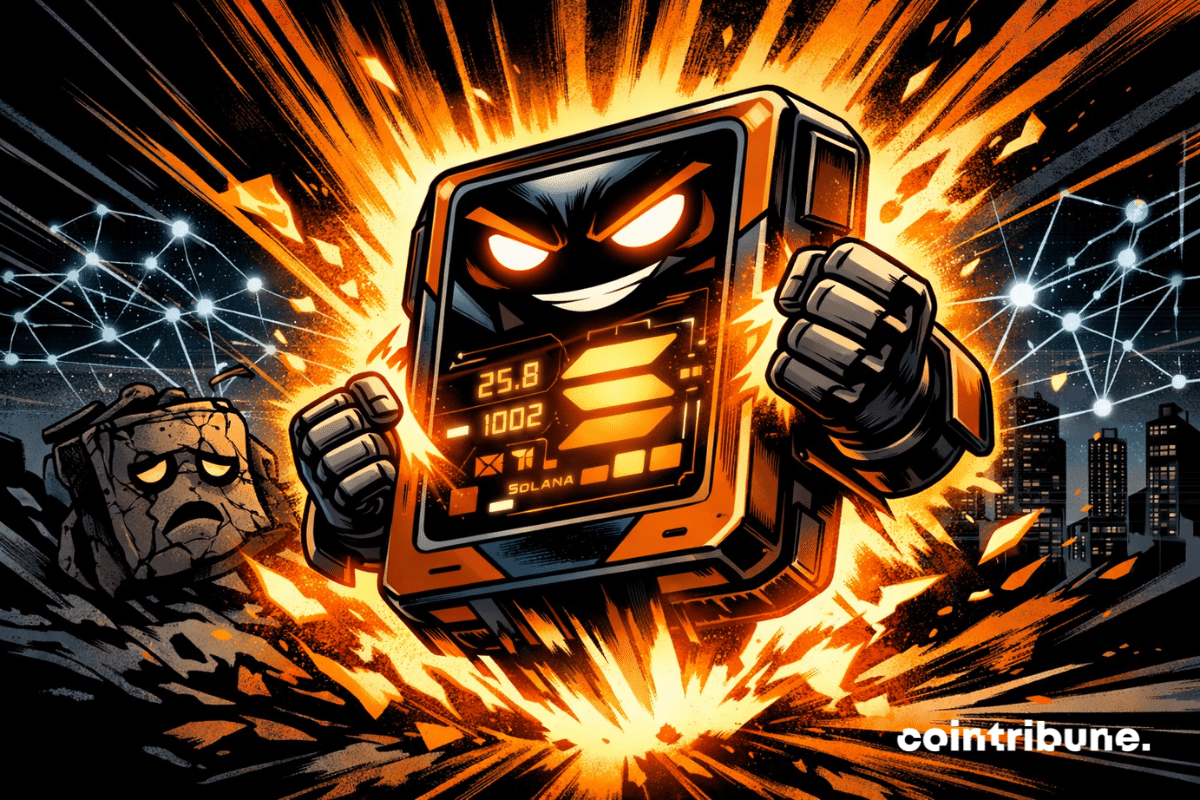
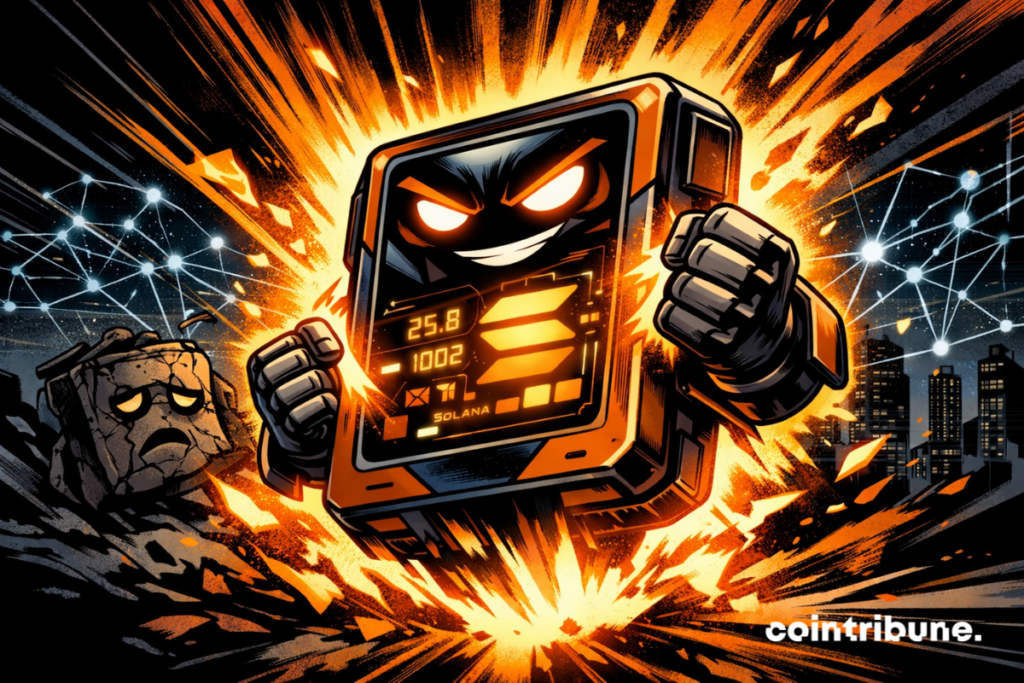
The French cryptocurrency investment platform Meria formalizes its integration as a staking provider within the ecosystem SollPaya new Solana wallet which promises to democratize access to the blockchain by removing an important barrier, the seed phrase. This strategic alliance aims to make SOL staking accessible to as many people as possible.
In brief
- SollPay simplifies access to Solana with a seed phrase-free wallet.
- The wallet remains non-custodial and secure thanks to Zero-Knowledge Proofs.
- SOL staking is integrated in one click via the French validator Meria.
SollPay is positioned in a growing segment: that of smart wallets, designed to remove the friction that slows crypto adoption. Developed on the blockchain Solana (SOL)this mobile application allows you to create a portfolio in a few clicks, simply with a phone number or email address.
The main argument of SollPay lies in the absence of seed phrase visible to the user. As a reminder, a seed phrase (or recovery phrase) is a sequence of 12 to 24 words which constitutes the only way to restore access to a non-custodial wallet. Its loss means the permanent loss of funds. According to various industry studies, the management and protection of this secret phrase remains one of the main obstacles to the mass adoption of cryptocurrencies.
A non-custodial wallet despite everything
Essential point: despite the absence of a visible seed phrase, SollPay claims to offer a wallet non-custodial. This means that the user remains the sole holder of their private keys, stored locally on their device in a secure environment. SollPay therefore theoretically does not have access to its users' funds, unlike centralized platforms (exchanges).
This architecture is similar to solutions of the type “ account abstraction » which are currently developing in the blockchain ecosystem. The objective: to offer a user experience comparable to Web2 and its traditional applications, while retaining the advantages of decentralization.
Zero-Knowledge technology for security
To guarantee the protection of personal data, SollPay relies on the Zero-Knowledge Proofs (ZKP)or zero-knowledge proofs. This advanced cryptographic technology makes it possible to verify information (identity, balance, transaction) without revealing the underlying data.
Concretely, ZKPs allow SollPay to:
- Verify a user's identity without exposing their personal data;
- Validate transactions securely while preserving confidentiality;
- Ensuring the integrity of blockchain operations without compromising privacy.
This technology is not new to the Solana ecosystem. Protocols like Light Protocol are already using ZK-proofs for state compression (ZK Compression), reducing on-chain storage costs by over 99%. Other projects like Arcium (formerly Elusiv) use zero-disclosure proofs for confidential transactions.
Simplified transfers to any contact
SollPay includes a feature that is particularly geared towards mainstream adoption: the ability to send funds to a phone number, even if the recipient does not yet have a wallet. This approach is reminiscent of certain traditional mobile payment applications and could facilitate the onboarding of new users into the crypto ecosystem.
Meria becomes staking provider for SollPay
This is the main announcement of this partnership: Meria integrates the SollPay ecosystem as staking provider. Thus, users of the application can now delegate their SOL tokens directly to the Meria validator, and generate regular passive returns.
Who is Meria?
Founded in 2017 by Owen Simonin (known under the pseudonym Hasheur), Meria is a cryptocurrency investment platform French, registered as Digital Asset Service Provider (PSAN) with the Financial Markets Authority (AMF). The company is a pioneer in France in crypto staking and yield services, thanks to the technical expertise of its teams.
Since 2019, Meria has operated its own validators on more than 40 blockchains, including Solana, Ethereum, Cosmos and Polkadot. This technical expertise sets the platform apart from the many competitors who simply delegate their users' funds to third-party validators. Meria also offers more than 50 cryptocurrencies staking on its platform.
SOL staking: returns and operation
Solana staking is based on the mechanism of Proof of Stake (PoS)combined with Solana's proprietary innovation, the Proof of History (PoH). By delegating their SOL to a validator like Meria, users help secure the network and in exchange receive a portion of inflation rewards and transaction fees.
In 2025, Solana staking returns generally oscillate between 5% and 8% APY depending on the validators and the state of the network. Some liquid staking solutions (Marinade Finance, Jito Network) can offer slightly higher returns thanks to MEV (Maximal Extractable Value) optimization.
Concerning the constraints:
- The minimum to stake SOL is generally 0.01 SOL
- The unbonding period (time to recover funds) lasts between 2 and 3 days
- Rewards are distributed every epoch (approximately 2-3 days on Solana)
What this partnership changes for users
The integration of Meria on SollPay allows significant simplification of the user journey. Until then, staking SOL involves going through several steps: creation of a compatible wallet (Phantom, Solflare), transfer of funds, selection of a validator, then validation of the delegation transaction.
With SollPay, the entire process is integrated into a single interface, and the user can:
- Create your account in seconds;
- Buy or receive SOL directly in the application;
- Stake your tokens on the Meria validator in one click;
- Monitor your returns and manage your positions.
This vertical integration is part of the current trend of crypto “super-apps” which bring together all decentralized financial services under a single interface.
Risks to consider
Like any investment in cryptocurrencies, SOL staking involves risks that must be evaluated:
Price volatility : staked SOLs remain exposed to price fluctuations. A 6% return can be wiped out by a 10% drop in price.
Technical risk : blockchain protocols can be subject to bugs or attacks. Although Solana is an established network with billions of transactions, zero risk does not exist.
New from SollPay : At the time of writing this article, SollPay is a recent solution. You should check for independent security audits before depositing significant amounts.
Key management without seed phrase : while this model simplifies use, it raises questions about account recovery in the event of loss of the device or change of telephone number. The backup mechanisms offered by SollPay should be examined carefully.
A major partnership?
The partnership between SollPay and Meria illustrates a fundamental trend: the race for simplifying the crypto user experience. By combining a wallet without a visible seed phrase and direct access to staking via a validator established as Meriathis alliance could attract a new generation of users previously put off by technical complexity.
It remains to be seen if SollPay will manage to keep its promises in terms of security and establish itself in an already well-stocked Solana wallet market (Phantom, Solflare, Backpack). Adoption by institutional actors like Meria constitutes, in any case, a positive signal for the credibility of the project.
FAQs
A non-custodial wallet is a crypto wallet that allows the user to retain exclusive control of their private keys. Unlike centralized platforms (Binance, Coinbase, etc.), no third party can access or block the funds of the user in question.
Yield typically ranges between 5% and 8% APY in 2025, depending on the validator chosen and network conditions. Rewards are distributed approximately every 2-3 days.
Yes, Meria is a French platform registered as a PSAN (Digital Asset Service Provider) with the AMF since 2020.
Yes, but an unbonding period of approximately 2-3 days applies to recover your funds after a staking withdrawal request.
Maximize your Tremplin.io experience with our 'Read to Earn' program! For every article you read, earn points and access exclusive rewards. Sign up now and start earning benefits.