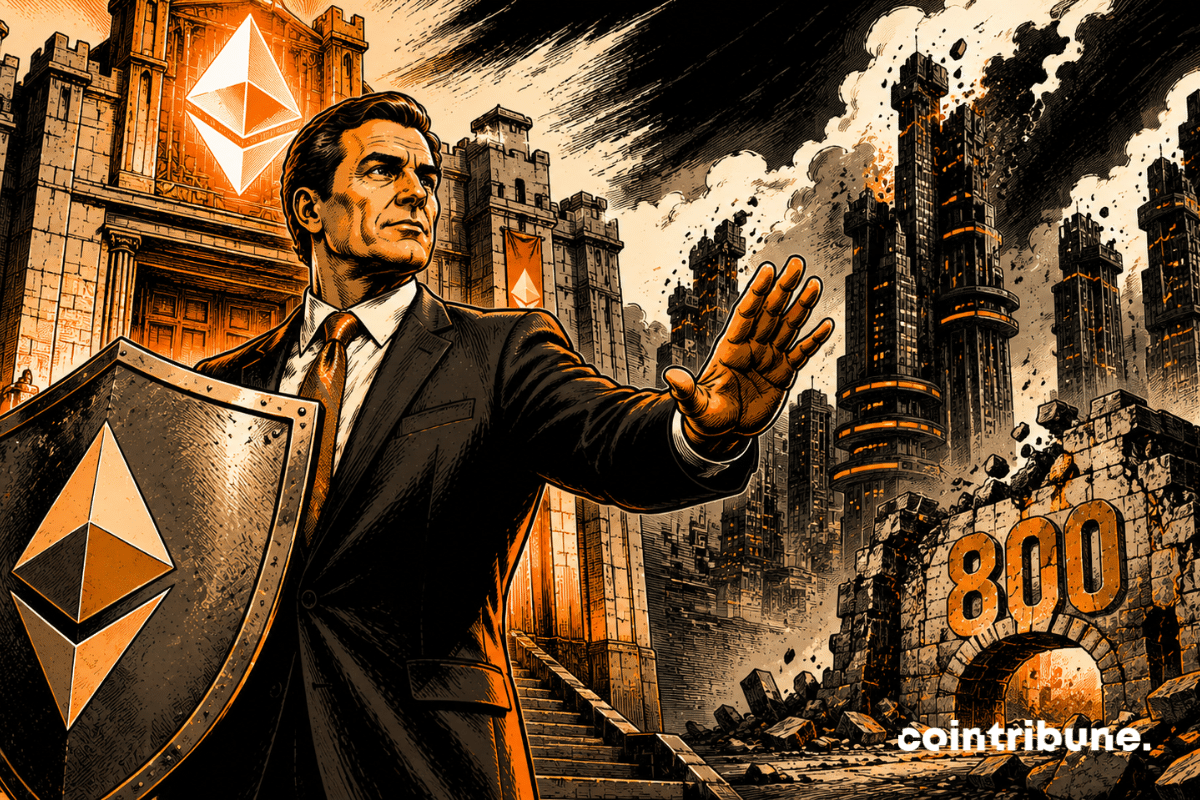
Solana lost 68% of its validators in three years, going from around 2,500 to around 800 after a purge launched in 2025. Joseph Chalom, co-CEO of Sharplink and former BlackRock executive, contrasts this decline with Ethereum's more than 900,000 validators. This battle of numbers reignites the debate on the true decentralization of large blockchains. Will institutional investors decide in favor of robustness rather than speed?
In brief
- Joseph Chalom, co-CEO of Sharplink and former BlackRock executive, says Ethereum's 900,000 validators outperform Solana's 800.
- Electric Capital lists 1,012,824 developers having contributed to Ethereum, including 232,000 active over the last twelve months.
- Sharplink held 886,725 ETH at the end of June 2026, one of the largest corporate ether reserves.
Why is Chalom pitting Ethereum and Solana validators against each other?
Joseph Chalom, co-chief executive of Sharplink and former head of digital assets strategy at BlackRock, disputes the lingering idea of a cultural problem at Ethereum, a criticism that has been circulating in the crypto community for several months.
He also contrasts the more than 900,000 active validators on the network with the approximately 800 still listed on Solana, a gap that he considers decisive for the future of smart contracts.
This confrontation comes as Solana has just strengthened its on-chain governance with the Solana Governance Proposals, a mechanism that redistributes voting power between validators and token holders. Chalom believes, however, that this project does not compensate for the erosion in the number of validators.
Electric Capital has in fact identified more than a million cumulative contributors to the Ethereum code since its creation, including approximately 232,000 who have remained active over the last twelve months. On Solana, on the other hand, 92% of applications still run on a single software client, a concentration that Chalom considers risky for the resilience of the network in the event of a major bug.
What are the challenges for decentralization after the purge of Solana validators?
Solana had around 2,500 validators three years ago, before introducing a pruning process in 2025 intended to remove inactive or poorly performing nodes. This choice thus caused their number to drop to around 800, a purge that its supporters describe as a qualitative improvement.
Chalom recalls that his years at BlackRock showed him the consistent preference of large institutions for the neutrality of a network and its resistance to capture by a single actor. Sharplink also illustrates this belief through its ether treasury strategy, increased to 886,725 ETH at the end of June, and its financial support for Ethlabs, a research center founded by former members of the Ethereum Foundation.
A historic figure at the Ethereum Foundation, however, recognized that the network still lacks a clear value proposition to convince new investors. For his part, Solana team champions lighter, faster networkbetter suited according to her for high-frequency trading and applications intended for the general public.
This duel of numbers illustrates two opposing visions of decentralization, between robustness of numbers and operational lightness. Three elements will weigh on the future: the appetite of institutions for Ethereum ETFs, the trajectory of the number of Solana validators after its purge, and the growing place taken by tokenization. The battle for standards has only just begun.
Maximize your Tremplin.io experience with our 'Read to Earn' program! For every article you read, earn points and access exclusive rewards. Sign up now and start earning benefits.