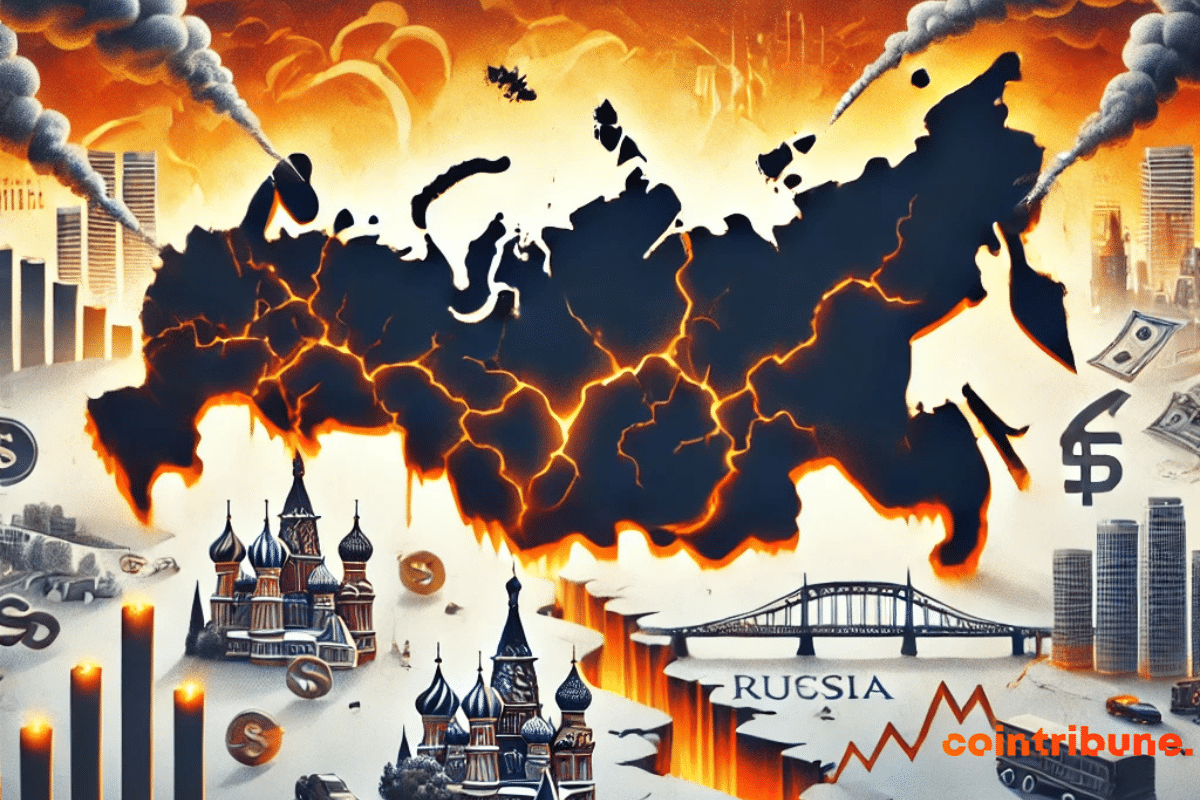
Russia, although resilient in the face of Western sanctions, seems to be heading downhill. Supported by a thriving war economy in 2024, the country could see its efforts crumble the following year. The International Monetary Fund (IMF) predicts a severe slowdown in 2025, while the Russian machine, long driven by military orders, risks running out of steam.
Resilience in 2024, but for how long?
For the year 2024, the Russian economy still seems strong. The IMF has revised its growth forecast for the country upwards to 3.6%, supported by massive military spending.
This third year of war in Ukraine boosted the industry of the military-industrial complex, providing Russia with a facade of prosperity. However, this growth, while significant, does not mask the signs of impending exhaustion.
The explosion of public orders created an overheating of the market, leading to an already perceptible inflationary cycle.
The Kremlin, despite its speech of victory over sanctions, will not be able to escape the long-term impact of this situation.
The IMF expects growth to slow in 2025, falling to 1.3%, a figure that reflects the end of an artificial expansion cycle.
It is no longer a question of “if,” but “when” the Russian economy will begin to collapse under the weight of its own policies.
Russia: Inflationary spiral and labor shortage
One of the main reasons for this slowdown is soaring inflation. Massive spending on the war effort exacerbated the pressure on prices.
By pumping billions into the military-industrial complex, Moscow has unwittingly created a bubble. Resources are becoming scarcer, wages are increasing, and with inflation already reaching 8.6% in September, the Central Bank of Russia (CBR) is being pushed to raise its key rates, currently at 19%.
But the real time bomb is the lack of labor. With hundreds of thousands of men sent to the front lines or fleeing abroad, Russia faces a critical shortage of workers.
Even Vladimir Putin has had to publicly acknowledge this problem, admitting that historically low unemployment is becoming a drag on economic growth. This situation can only deteriorate in 2025, making the IMF's forecasts all the more credible.
The war economy, a long-term trap
By relentlessly injecting into the war effort, the Kremlin risks finding itself trapped in an unsustainable economic model.
Russia has certainly succeeded in circumventing certain sanctions and reducing its dependence on hydrocarbons, but at what cost? The country's economy is now dependent on its own military spending. This strategy, which seemed effective in the short term, could backfire in 2025.
The announced 30% increase in military spending for 2025, planned by the Russian government, will only fuel the inflationary spiral in which the country already finds itself.
Even more worrying, it risks further widening the gap between public investments and the real needs of the population.
By continuing to rely on a war economy, Moscow could very well plunge the country into a large-scale economic crisis, the first signs of which are already visible.
Inflation, labor shortages, and overreliance on the war effort portend economic disaster for the country. Meanwhile, India and China absorb 78% of Russian oil.
Maximize your Tremplin.io experience with our 'Read to Earn' program! For every article you read, earn points and access exclusive rewards. Sign up now and start earning benefits.