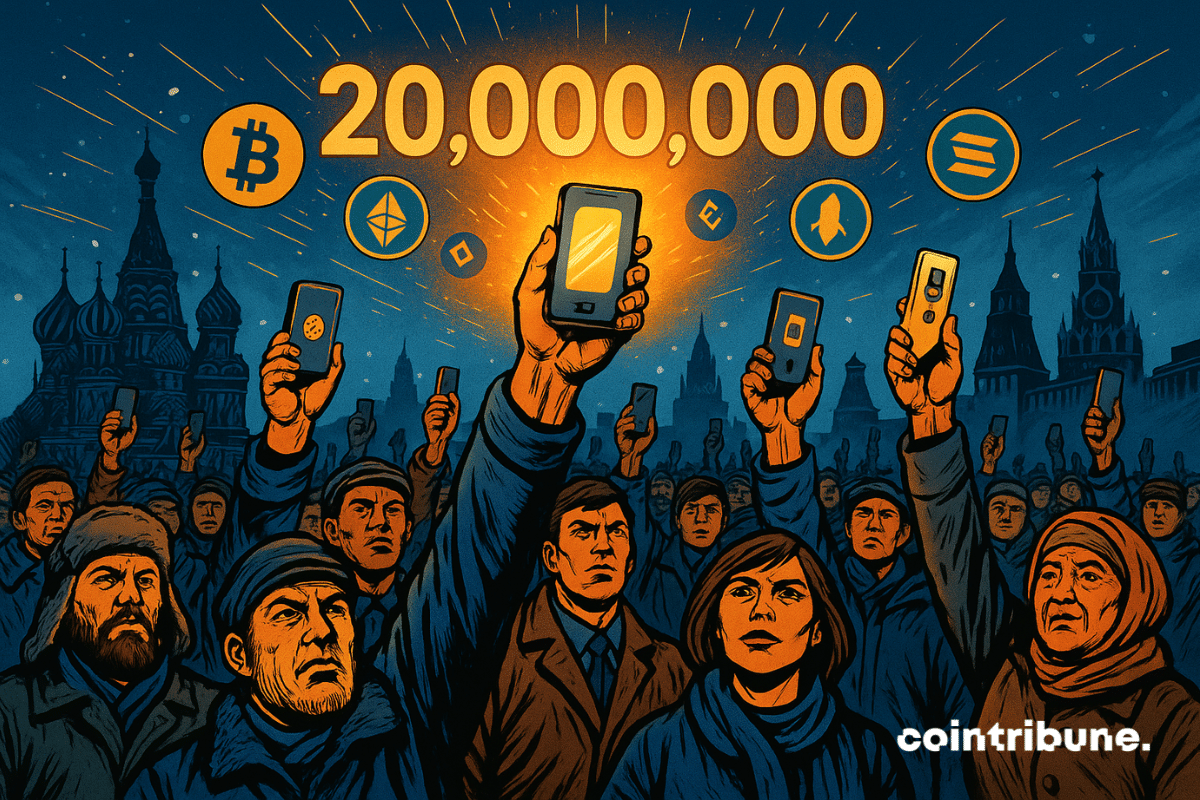
Russia is experiencing a quiet rush into cryptos. Buoyed by Western sanctions, dedollarization and an uncertain economic climate, nearly 20 million Russians now hold these assets. Thus, crypto becomes a mass financial escape. Faced with this massive adoption, the government can no longer look away. A new monetary era is now taking hold in Russia.
In brief
- Nearly 20 million Russians use cryptocurrencies today, according to the Ministry of Finance.
- The total value of cryptoassets held in Russia reaches 827 billion rubles ($10.15 billion).
- Bitcoin remains the dominant asset, representing 62.1% of funds on exchange platforms, ahead of Ethereum and stablecoins.
- Faced with this massive adoption, the authorities are concerned about dependence on foreign platforms.
Massive crypto adoption in Russia
While the Central Bank of Russia admits that bitcoin is the best performing asset, Ivan Chebeskov, Deputy Minister of Finance of the Federation, declared : “we recognize that crypto exists, there is no longer any doubt about it”. He added: “It took time to come to this understanding. We have millions of citizens, by some estimates 20 million, who use cryptos for various purposes”.
These remarks mark a major turning point in the Russian government's posture towards these assets, long viewed with suspicion. The use of cryptos is now deeply anchored in Russian society, to the point of requiring an institutional response.
Official data published by the Central Bank of Russia confirms this trend. They show a clear progression in adoption and a marked interest in certain specific assets:
- 20 million Russian citizens use cryptos, according to official estimates;
- At the end of the first quarter of this year, Russians held a total of 827 billion rubles in crypto, or about $10.15 billion;
- This sum represents an increase of 27% compared to the same period the previous year;
- The breakdown of wallets reveals a clear preference for established assets: bitcoin (BTC) dominates, accounting for 62.1% of funds stored on exchanges, Ethereum (ETH) follows with 22%, and the stablecoins USDT and USDC together represent 15.9%.
This landscape outlines an adoption dynamic centered on assets perceived as safer or more liquid. Despite the proliferation of altcoins, the Russian public remains attached to large-cap cryptos, suggesting a relatively cautious and strategic approach to managing these assets.
Digital sovereignty under construction
If the mass adoption of cryptos is now recorded, it worries the Russian authorities. Ivan Chebeskov spoke about the risks associated with holding these assets on foreign platforms, particularly those located outside the Russian regulatory framework or subject to international sanctions.
“Since citizens are already using them, we must build our own infrastructure to protect them and derive economic and technological benefits”he said. He insists: Russia must develop a sovereign infrastructure, including tools for mining, exchanges and secure storage of cryptos.
These statements signal a paradigm shift. While Russia has until now been cautious, even suspicious, towards cryptos, it is now considering the creation of a national ecosystem, in collaboration with the Central Bank.
The objective is to reduce dependence on foreign platforms, secure citizens' assets through the creation of a crypto bank and maintain state control over a growing part of the money supply outside traditional banking circuits. This strategic orientation is all the more significant as it takes place in a context of distrust towards the Western financial system, accentuated by sanctions and ongoing economic decoupling.
Maximize your Tremplin.io experience with our 'Read to Earn' program! For every article you read, earn points and access exclusive rewards. Sign up now and start earning benefits.