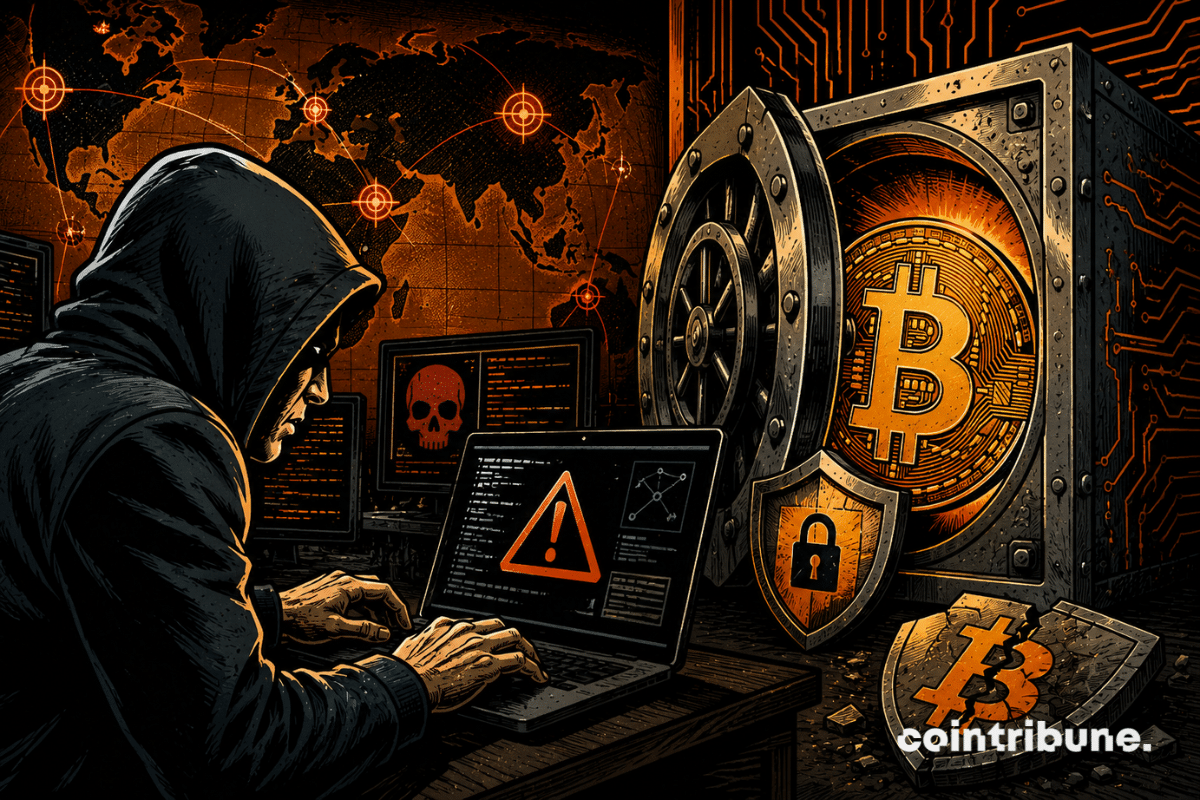
The inexorable advance of cutting-edge quantum computing poses an existential threat to blockchain security, forcing the ecosystem to overhaul its cryptographic foundations. Preserving inactive Bitcoin wallets against machines capable of breaking private keys is a critical priority. This July 16, Project Eleven unveiled a proposal for post-quantum cryptographic proof to meet the challenge of “Q-Day”. By replacing signature validation with parentage verification, this protocol offers an unexpected safety net.
In brief
- Quantum computing threatens to break Bitcoin’s cryptography, making classical signatures unusable to prove ownership of wallets.
- While active users will migrate easily, around 7 million bitcoins are sitting on addresses vulnerable to quantum hacking.
- Developed with the Binius system, this new protocol makes it possible to prove ownership of a wallet using its parent key (the seed phrase), without ever revealing it.
- This method provides a unique safety net for recovering lost funds, even after their private key has been compromised.
The announced collapse of classic Q-Day signings
The current security of the Bitcoin network is based on elliptic curve cryptography (ECC), a shield that the arrival of quantum computers will break during “Q-Day”. The major problem lies in the absolute impossibility of authenticating the true owner of a wallet once the private keys are compromised.
Alex Pruden, CEO of Project Eleven, summary this impasse: “how do you prove that you still own a wallet after a quantum computer has been able to forge its signatures?” After Q-Day, once a quantum computer can derive an ECC private key from its public key, a valid signature no longer proves ownership. Both the quantum adversary and the legitimate owner are capable of producing identical signatures”.
This major vulnerability creates several critical risks for the network:
- Cryptographic spoofing: a hacker equipped with quantum power can calculate the private key from an exposed public key to generate valid signatures;
- Looting dormant accounts: if active users migrated to new addresses in time, the millions of inactive wallets without human intervention would become easy prey, threatening the economic stability of the network.
The Project Eleven protocol
To circumvent this major vulnerability, Project Eleven introduces a path-based method for deriving wallet keys. Rather than using the final private key to sign, the protocol allows the user to prove that they hold the parent key, or recovery phrase, without ever having to reveal it.
As Alex Pruden explains: “So, even after Q-Day, a hacker who has broken the private key of your address does not have, and cannot calculate, the recovery phrase from which it was derived. Proving that you know this parent key, without revealing it, is something only the true owner can do.”.
This implementation was developed with Jim Posen, lead contributor to the open-source Binius zero-knowledge proof system, optimized to accelerate hashing operations. Funded by Project Eleven, this work is based on the concept of “signature facelift” theorized by Alon Sattath and Robert Wyborski. By moving proof to the parent key level, this technology offers a unique fallback solution for accounts that have not been able to be transferred to resilient standards.
The race for integration and the obstacles to consensus
The urgency to act is accelerating as the risks become clearer. In June, Coinbase’s Quantum Advisory Board warned that 7 million bitcoins were at risk of being lost without a post-quantum transition. This proposal comes in a context of technical and political mobilization? In February 2026, the BIP-360 proposal entered formal review, followed in March by a test network from BTQ Technologies, while US President Donald Trump signed executive orders to accelerate the federal transition to post-quantum cryptography.
However, implementing this proof faces the challenge of community consensus. The Project Eleven prototype remains unaudited and requires a Bitcoin protocol upgrade. Pruden admits the limits of awareness: “As much as I wish the whole world would take a quantum migration plan seriously, the reality is that some crypto wallets will miss the boat. This gives them a fallback: prove ownership by derivation, not by signature, even after this window closes.”.
Ultimately, while Project Eleven’s technology solution offers an ingenious rescue prospect for orphaned wallets, it illustrates the complexity of adapting a decentralized network for the quantum era. The future implications of this debate will force the community to trade off between historical immutability and the necessary integration of disaster recovery protocols. The long-term future of bitcoin will depend on this delicate compromise between mathematical rigor and survival pragmatism.
Maximize your Tremplin.io experience with our ‘Read to Earn’ program! For every article you read, earn points and access exclusive rewards. Sign up now and start earning benefits.