
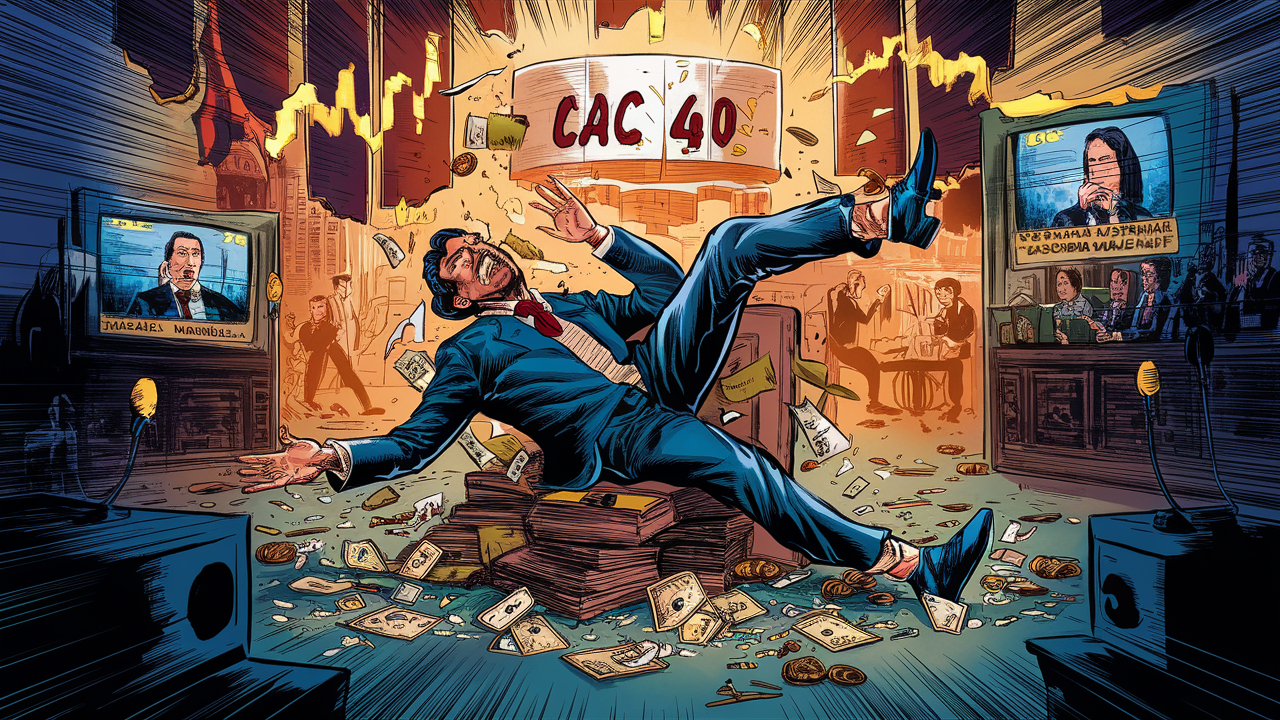
The dissolution of the National Assembly brings an air of great uncertainty to the markets. In one week, the CAC 40 fell by almost 7% to erase its gains since January 1. For its part, the CAC for small caps fell by almost 11%. Uncertainty over the outcome of the election, and growing economic confusion, is weighing on many stocks and sectors. In particular, the banking sector was heavily penalized. The increase in the cost of French debt could also worsen the already critical situation of public finances. Decryption of a theatrical week.
France drops out after dissolution
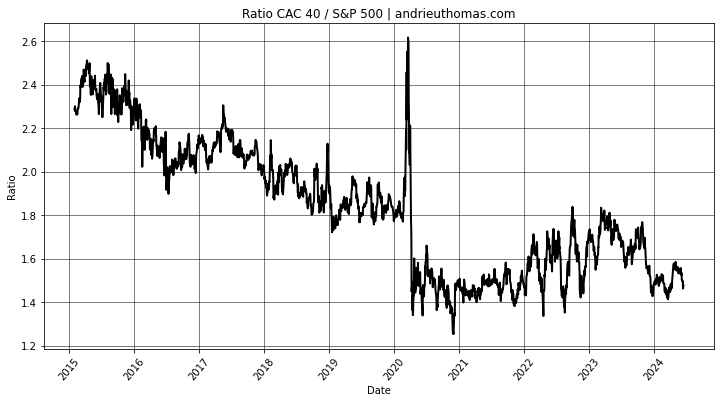
While the S&P 500 closed in the green for the week, the CAC 40 erased all of the performance observed since January!
The performance gap over the week reached almost 9%. The previous week, the ECB had lowered its rates, ahead of the rate cut expected later from the FED. Despite the change in monetary policy, the CAC 40 appears to be entering a new period of underperformance against the S&P 500. Since 2015, the relative value of the CAC 40 compared to the S&P 500 has almost been divided by 2.
Small caps are the most impacted by electoral uncertainty, because a large part of their turnover is generated in France. Banking stocks also fell sharply over the week: -12% for BNP, -11% for Crédit Agricole, and up to -15% for Société Générale. Other stocks like TF1 lost more than 17% due to concerns about the privatization of public broadcasting, which would increase competition in the sector. So how can we explain this decline and these concerns?
It is indeed recurrent in history to observe crashes or panics for political reasons. Program changes, declarations of war, or budgetary instabilities often lead to panic. However, the markets are not sanctioning the results of the European elections but the prospect of the legislative elections. A change of government would effectively cause a change in economic policy with more or less structural results.
What consequences for the euro and your savings?
The euro also seems to have fallen this week under the impetus of political instability. The value of the euro against the dollar fell 1.7% over the previous week. Downward pressure on the euro is also increasing under the effect of the ECB's more flexible monetary policy. If the fall of the euro is still moderate, it is entirely possible that growing instability in France will lead to instabilities at the European level.
“The ECB is pushing for a potentially lasting rate cut while the FED remains inflexible. A lasting difference in the key rate between the different central banks could therefore harm the value of the euro. At the same time, the rate cut comes at a time when growth in the eurozone is almost standing still. In addition, the interest burden weighs heavily on many states and businesses. »
Pivot of the ECB: what consequences? – Tremplin.io
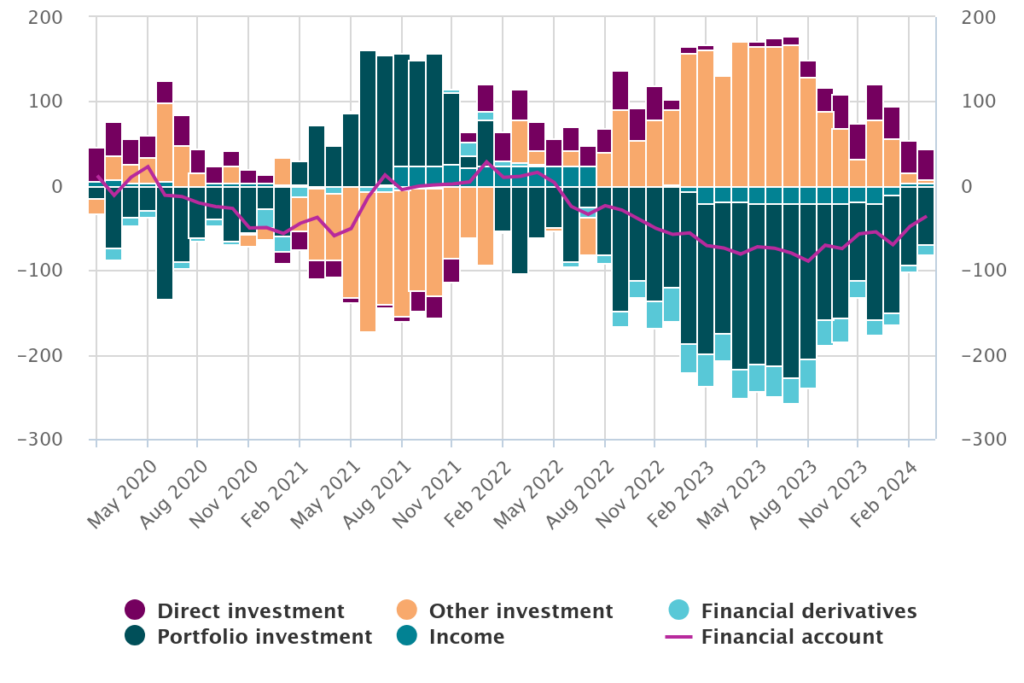
The risks of a significant drop in the value of assets in France leads to an economic risk. Indeed, while several banks have suffered a sharp decline, too significant a depreciation of the public debt would put the fundamental investments of the French, such as life insurance, at risk. But this risk is still remote. However, too heavy an economic risk would reduce foreign investments. However, the presence of a significant trade deficit imposes incoming capital flows on France. The reduction in foreign investment would have the immediate consequence of lowering the standard of living in France. From this perspective, the effects of the trade deficit would be felt, in the absence of a return of capital to compensate for the trade balance.
Are political programs really that vague?
In autumn 2022, former Prime Minister Liz Truss announced a £45 billion tax cut without funding. This error earned him a significant sanction from the markets, which ultimately led to his resignation… Are we going to experience the same scenario?
Although many more or less accurate estimates are circulating, it is clear that the New Popular Front, like the National Rally, are proposing increases in public spending. The financing of these expenses remains difficult to read for the markets, which is precisely what worries the markets. In addition, these programs intervene in a context where the debt is already at a record level. The presence of significant public deficits also prevents any room for maneuver for a new government. The dissolution could also promote a situation of political instability and regular alternation of reforms.
Thus, cost estimates for the proposed reforms range from 100 billion euros for the RN to more than 200 billion euros for the NFP. Such an increase in public spending would be unprecedented and would bring the spending-to-GDP ratio to over 60% or 65%. Unprecedented in the history of all world capitalism. This leap into the unknown could harm market stability, as some economists point out.
“The markets are going to go wild, it’s a shot to take 200 basis points and there it will be a complete reverse, anticipates an economist. When we do aberrant things on the financial level, we explode interest rates, for sovereign debt, but also for households who can no longer borrow.”
Sylvain Bersinger for BFM Business, economist at Astéres.
Will the cost of debt increase?
The French public debt is 53.2% held by foreigners. With a debt of nearly 3,000 billion euros, France is one of the most lax countries in terms of spending in recent years. In 2023, the debt burden, that is to say the interest cost alone, was close to 51 billion euros, or more than €760 per French person. This burden could rise to 70 billion euros by 2027.
Furthermore, the average lifespan of French debt is close to 8 years. In this context, a lasting increase in the interest rate on French debt would cause an increase in the cost of debt. A rate close to 4%, like Italy, would lead to more expensive debt issues. In this example, the cost of debt could reach almost 100 billion euros in the long term. Which is not sustainable at this time.
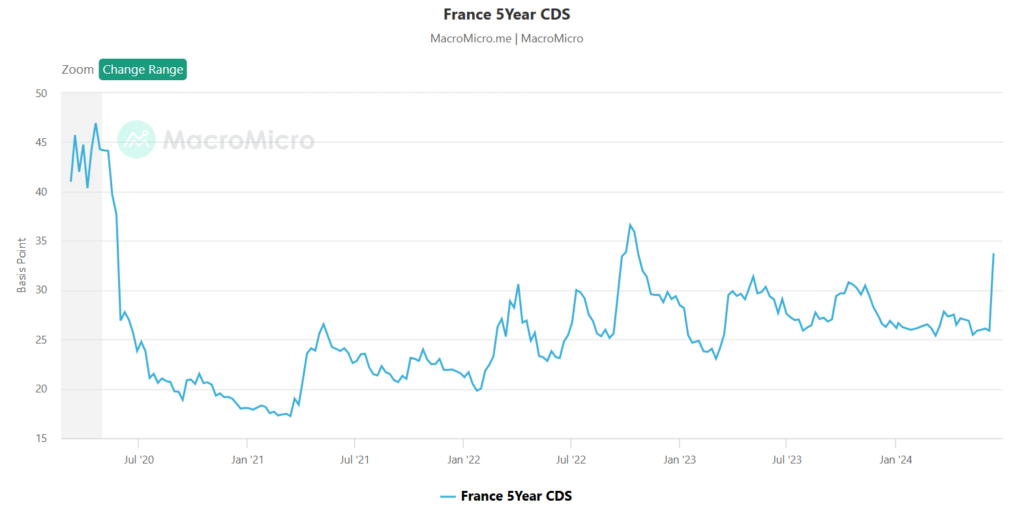
The cost of insurance on the 5-year French government debt (CDS) also increased by 16% over one week. Credit default swaps, also called CDS, are financial instruments for which the buyer pays premiums to the seller in exchange for compensation in the event of a credit default. The cost of insurance on French debt has thus returned to its highest since the period of rate increases in 2022.
How far would the fall go?
The CAC 40 has validated a double peak in formation since March 2024. The strong downward pressure following the announcement of the dissolution thus triggered a break in the figure. The technical objective suggested by this figure is thus close to 7500 points, an objective reached at the end of the week. The violent fall observed thus filled two major gaps opened in January and February 2024. The fall in the markets observed over the past week therefore seems to be well managed technically.
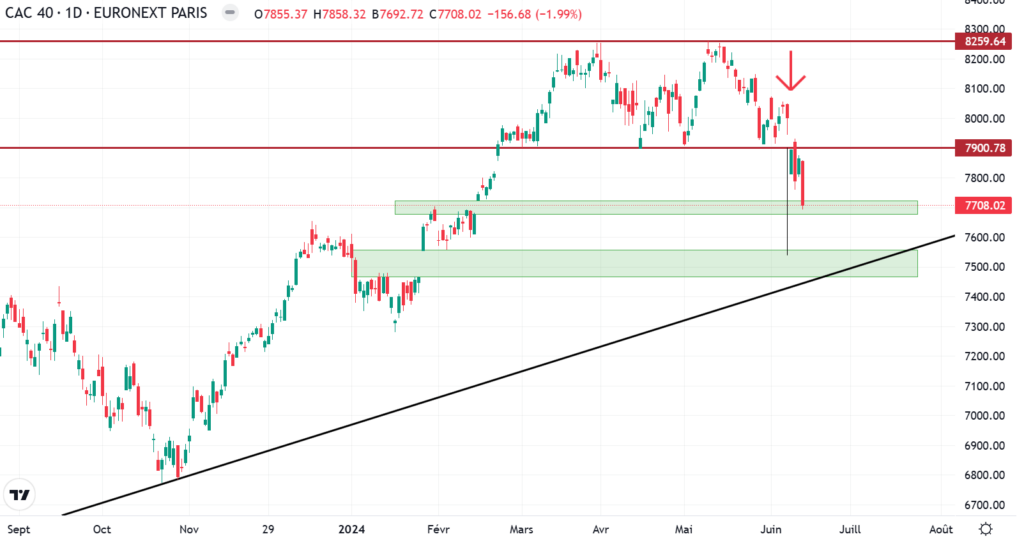
However, the close at 7503 at the end of the session on Friday led to a break of the upward trend line built since September 2022! Confirmation of this break during the week could thus push the CAC 40 to around 7,250 to 7,000, without any further reaction.
In conclusion
Ultimately, political risk in France canceled out the entire year's performance. An increase in political instability could weigh heavily on the risk and value of financial assets in France, and potentially in Europe. The pressures on the euro are therefore rather downward, while the CAC 40 does not seem to be calm again. The lack of clarity in the political situation on the one hand, and in certain programs on the other, imposes great uncertainty on the markets.
Conversely, a relaxation of the political situation could constitute an interesting entry point. But technical signals still call for caution. This political scene since the dissolution has had only one benefit: recalling the importance of diversifying assets abroad.
Maximize your Tremplin.io experience with our 'Read to Earn' program! For every article you read, earn points and access exclusive rewards. Sign up now and start earning benefits.
Click here to join 'Read to Earn' and turn your passion for crypto into rewards!


