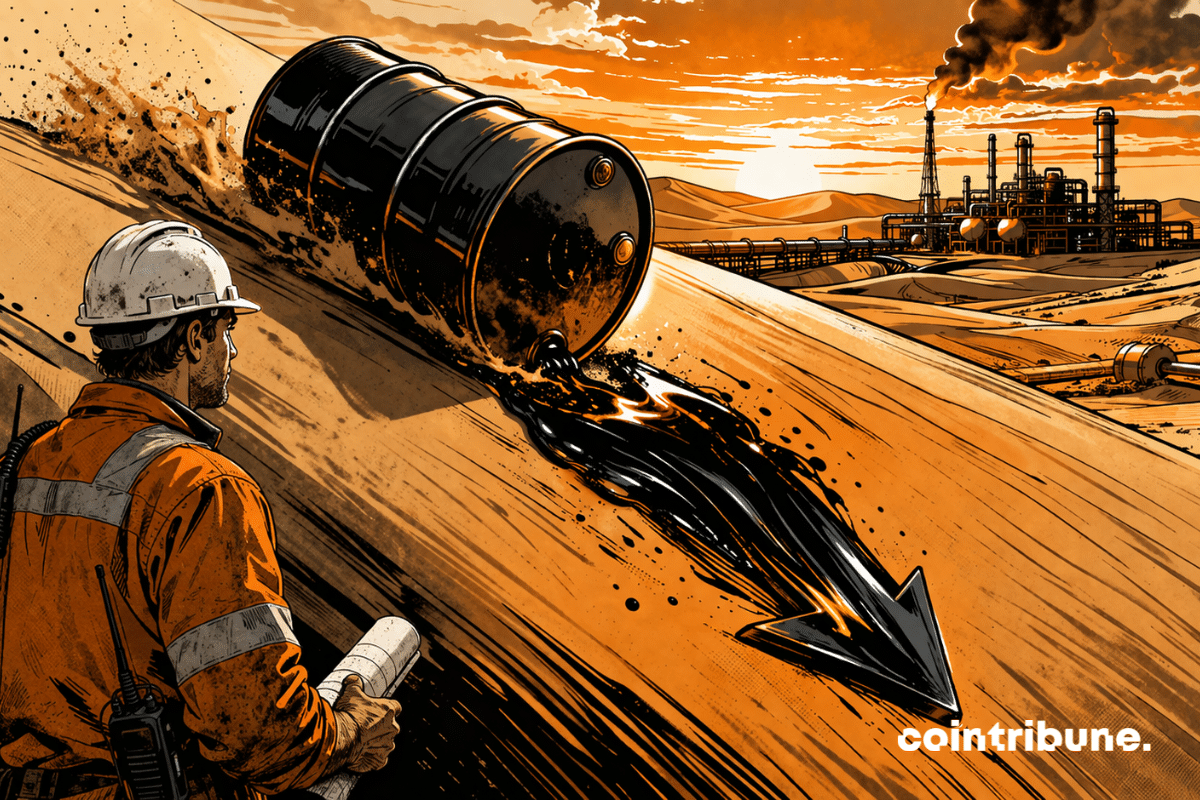
Oil prices fell in a few hours, driven by a sudden change in the context in the Middle East. The announcement of a ceasefire provoked an immediate market reaction, causing Brent and WTI to fall. This rapid correction reflects the adjustment of investors' expectations in the face of a decline in geopolitical tensions.
In brief
- Oil prices fall more than 10% after the announcement of a ceasefire in the Middle East.
- Markets immediately react to the de-escalation and adjust their expectations.
- The disappearance of the geopolitical risk premium leads to a rapid price correction.
- This movement illustrates the strong dependence of markets on geopolitical events.
An immediate fall in oil prices after the announcement of a ceasefire
The announcement of a ceasefire triggered a rapid movement on oil markets, with prices falling by more than 10%. Indeed, this correction results directly from a de-escalation of the conflict in the Middle East, perceived as a signal of stabilization.
Donald Trump has declared on Truth Social only discussions “particularly encouraging” had taken place between the two nations in recent days, with a view to a comprehensive settlement of tensions in the Middle East. This development de facto suspends the ultimatum mentioned previously for a minimum period of five days.
Here are some important elements :
- A drop of more than 10% in oil prices;
- The immediate reaction of the markets to the announcement of the ceasefire;
- The rapid disappearance of the geopolitical risk premium.
This fall is explained by a rapid adjustment of expectations. In times of tension, oil prices incorporate a premium linked to supply risks. When these tensions relax, this bonus is mechanically erased. The correction observed thus reflects a realignment of prices with a less uncertain environment.
A strong signal about the dependence of markets on geopolitics
Beyond the fall in prices, this episode reveals the structural dependence of markets on geopolitical signals. Oil's rapid response shows that investors are adjusting their positions in real time, based on overall risk perception. De-escalation acts here as a catalyst for massive repositioning, without gradual transition.
This type of movement also highlights the central role of political announcements in price formation. A simple statement or change in diplomatic tone can be enough to change expectations about global energy supply. This dynamic reinforces the idea of a market driven as much by psychology as by economic fundamentals.
In this conflictual context, bitcoin appears as an uncorrelated alternative, attracting investors seeking diversification in the face of rapid fluctuations in raw materials and persistent geopolitical uncertainties.
The current détente remains fragile in an unstable regional context. Iran has closed the Strait of Hormuz, disrupting a key route of global energy trade and reigniting supply uncertainties. Between signals of appeasement and persistent tensions, markets are now evolving in step with geopolitical developments.
Maximize your Tremplin.io experience with our 'Read to Earn' program! For every article you read, earn points and access exclusive rewards. Sign up now and start earning benefits.