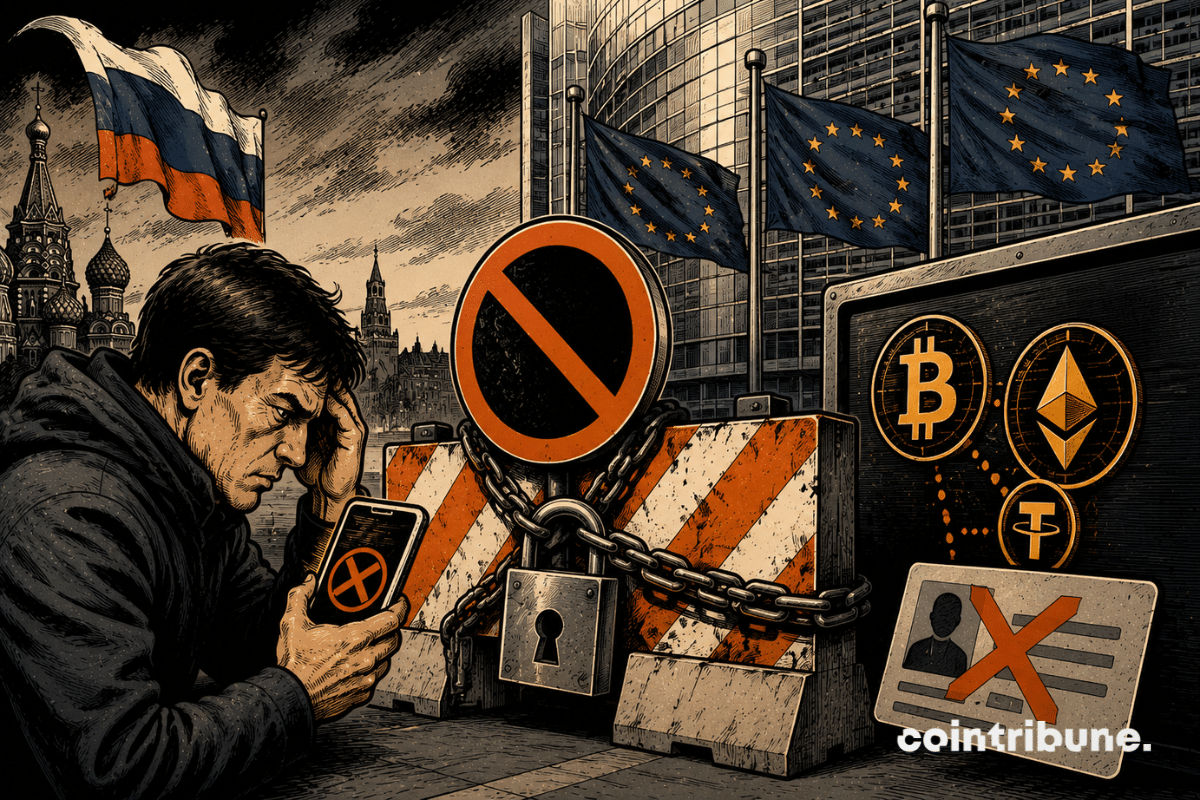
The European Union is taking a new step in its offensive against Russia. Member States have validated a new set of sanctions which directly targets services linked to cryptos and Web3, previously considered as alternatives to traditional banking restrictions. By tightening access to these digital infrastructures, Brussels seeks to reduce the possibilities of circumventing economic sanctions imposed on Moscow. A decision which marks a turning point in the use of financial diplomacy against cryptos.
In brief
- The European Union is toughening its tone by simultaneously hitting 11 crypto platforms, 94 Russian banks and the Moscow Stock Exchange.
- Brussels grants itself for the first time the power to ban crypto services operating in third countries outside Europe.
- The new measures respond to the resilience of parallel networks, illustrated by the A7A5 token which has generated more than 100 billion dollars in one year.
- While holding Bitcoin remains legal, MiCA controls are strengthening on centralized exchanges, leading to account freezes, delays and increased fees.
Expanded EU regulatory arsenal targeting Moscow’s financial heartland
The ambassadors of the member countries of the European Union have given their agreement in principle to a new system: the 21th package of sanctions against Russia. This major regulatory offensive includes several key measures:
- Targeted sanctions on Web3: the complete blocking of 11 crypto service platforms, mainly located outside Russian territory;
- Lockdown of the financial sector: the placing under total sanctions of 94 Russian banking establishments and the Moscow Stock Exchange;
- Additional measures: restrictions applied to vessels of the “ghost fleet” and freezing the crude oil price cap at $44.10 per barrel over a 12-month period.
Faced with this political escalation, Kaja Kallas, High Representative of the EU for Foreign Affairs and Security Policy, declared on its official networks: “we agreed on the 21stth package of sanctions against Russia. It includes sweeping measures targeting Moscow’s financial system, its military-industrial complex and its energy sector, which fuel Russia’s war economy. We are hitting Putin where it hurts most: by cutting off the…”.
This European response is a direct result of repeated attempts to dodge the previous control networks set up by Brussels and Washington. In the past, one-off targeting of a platform has only temporarily slowed volumes. The Garantex exchange, sanctioned by the United States in 2022 then by the EU at the beginning of 2025had its website seized while being frozen by more than $26 million in March 2025, before being reincarnated almost instantly under a mirror identity named Grinex.
It is the dizzying scale of these parallel channels which has forced the EU to revise its prerogatives upwards. According to estimates provided by the analysis firm Elliptica simple token backed by the ruble, called A7A5, managed to move more than $100 billion in financial flows in the space of a single year. To counter this organizational flexibility, European diplomacy has granted itself for the very first time the legal power to ban the exercise of crypto services in third countries outside Europe.
An operational bottleneck for users
In the field of daily operations, this new normative stack profoundly modifies the conditions of access to centralized markets without criminalizing the possession of cryptos. If bitcoin as well as the various cryptocurrencies remain perfectly legal and authorized for possession by individuals, the central exchange infrastructures fall under increased surveillance. Large international exchange platforms are now required to scrupulously comply with the MiCA legal framework, which requires them to increase identity checks, systematically audit the origin of deposits and block accounts interacting with entities under sanctions.
Thus, the direct consequences for users result in an overload of administrative and technical obstacles at the level of banking gateways. Several users have already suffered the freezing of their assets following deposits identified as coming from the A7A5 token, foreshadowing an increase in complex verifications, a drastic drop in the number of tokens supported by platforms, a surge in processing fees as well as a marked slowdown in cross-border transfers. In addition, previous waves of restrictions had already left some capital completely blocked, increasing the vulnerability of asset holders passing through centralized intermediaries.
Moscow’s sovereign counter-offensive and the balkanization of the sector
In reaction to this progressive blocking of its connections with the West, particularly the EU, Russia is trying to structure its own closed economic circuit while accepting the risk of prolonged isolation. The Russian legal framework has adapted by authorizing the use of cryptos in foreign trade to pay for imports and exports, while the country is working on establishing national exchanges under state license to supervise these flows.
However, this strategy of autarchy creates a direct consequence. The more Russia erects barriers to close and control its internal market, the more it cuts itself off from global liquidity and global financial networks. This strategic withdrawal is accompanied by real challenges regarding the concrete capacity of European authorities to enforce such sanctions on an international scale, while the fragmentation of the Web3 landscape increases as state borders impose themselves on protocols.
Ultimately, this regulatory deployment highlights the complex confrontation between state sovereignty and the cross-border paradigm of cryptos. If the European Union demonstrates that it can paralyze centralized access points, close exchange bridges with the banking sector and put pressure on service companies, it is simultaneously pushing Russia to build parallel financial channels entirely under sovereign control. The future of this confrontation will depend on the ability of regulators to maintain effective sealing in third-party zones outside Europe, in the face of a technology whose decentralized nature constantly offers new alternatives to the control of global financial flows.
Maximize your Tremplin.io experience with our ‘Read to Earn’ program! For every article you read, earn points and access exclusive rewards. Sign up now and start earning benefits.