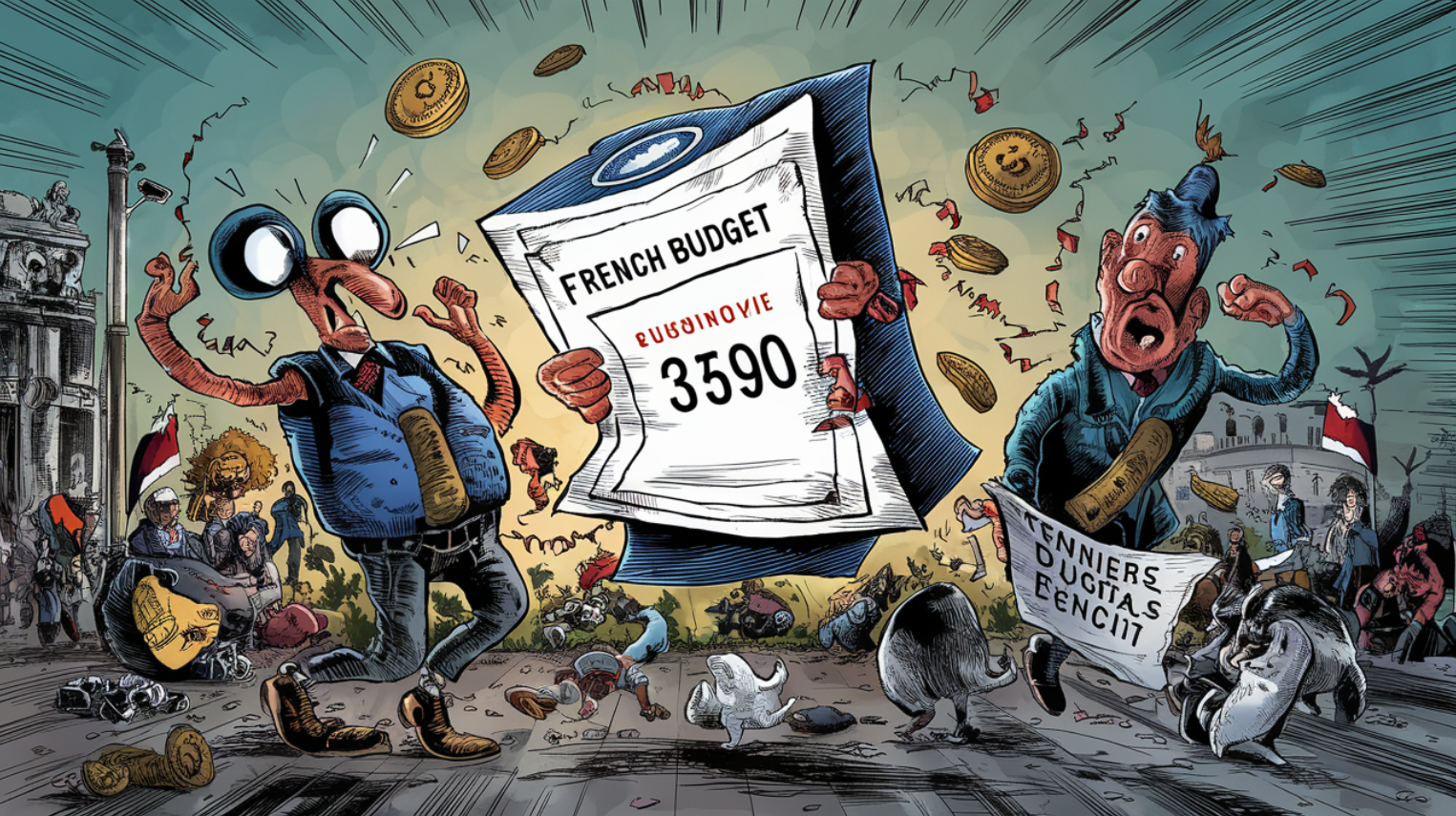
The legislative elections have increased the risk of political and financial instability in France. The Paris stock exchange has fallen by nearly 5% since June 9 to hedge against the risk of witnessing instability in economic policies. While the public deficit is already considerable (nearly 5.1% of GDP in 2024), the 2025 budget seems impossible to conclude… Will France be able to hold out economically in the coming months?
“Budgetary rules must be respected in the EU”
During the ECB Forum in Sintra On Tuesday 2 July, ECB President Christine Lagarde stated that “budgetary rules must be respected in the EU”. This message to the States comes at a time when France is downgrading its deficit expectations. Furthermore, the ECB has initiated a reduction in key rates, which should theoretically benefit the States by reducing the interest burden. But the absence of a clear budget line, and the lack of control over public finances, add risk to the markets. So how can budgetary rules be respected in the midst of the political uncertainty that is looming?
The 2025 budget will add volatility to the markets!
For 2025, the preparation and adoption of the budget are expected to be particularly delicate due to political instability. According to the rating agency Fitchthe political context “increases uncertainty about the country's fiscal consolidation trajectory and the prospects for further economic reforms.” The agency adds that “if no party wins an absolute majority, it is unclear what a potential coalition government would look like or how stable it would be.” Added to this is the excessive deficit procedure launched by the European Commission and which should constrain the 2025 budget.
“Furthermore, we expect that France will be placed under the excessive deficit procedure this year. In any case, the next administration will have the responsibility to formulate corrective measures, as well as a medium-term adjustment plan in response to the European Commission's debt sustainability assessment under the reactivated EU fiscal rules.”
France's Snap Election Heightens Fiscal and Reform Uncertainty (fitchratings.com)
The ECB to limit risks?
In 2009, the Greek debt crisis was about to erupt. The crisis was triggered by high budget deficits and unsustainable public debt. Added to this were questionable fiscal practices. As a result, interest rates on Greek bonds skyrocketed, making it impossible for Greece to refinance its debt. The risk was exponential.
To avoid default, Greece has received several bailout packages from the Troika (European Commission, European Central Bank – ECB, and International Monetary Fund – IMF). These interventions totalled more than 260 billion euros. In return, Greece had to implement severe austerity measures, including budget cuts, tax increases and structural reforms.
In the case of France, such a scenario would seriously endanger the euro. So far, the euro is relatively stable and shows relative confidence despite the clear withdrawal of speculative investors. The Vice-President of the ECB, Luis de Guindosjudged that the rise in rates in recent weeks was not sufficient to prompt the intervention of the Central Bank. Therefore, this statement also shows the fact that The ECB can be attentive and active in the event of a slippage. Let us recall that the ECB holds nearly 20% to 30% of all sovereign bonds in the eurozone. Finally, in a recent paper, Reuters specifies that ECB has no intention of discussing emergency purchases of French bonds.
“European Central Bank policymakers have no plans to discuss emergency purchases of French bonds and still believe it is up to French politicians to reassure investors spooked by the prospect of a far-right government, five sources told Reuters.”
ECB in no rush to discuss French bond rescue, sources say | Reuters
How does the 2025 budget work?
As a reminder, the draft finance law (PLF) is prepared by the government, mainly by the Ministry of Economy and Finance. The process begins in the spring of the previous year. In this stage, internal discussions within the ministries to determine the main budgetary guidelines.
From September, the PLF is submitted for examination to the National Assembly and the Senate. This passage through Parliament is marked by intense debates and amendments… and this is where things could get stuck! The deputies and senators discuss the different budget lines, propose modifications and vote on each article of the project. The work in the finance committee and the plenary sessions allow the text to be refined.
The difficulty of the 2025 budget lies in the financing needs. Indeed, France has committed to reducing the deficit to 3% of GDP by 2027. Considering a deficit of 4% of GDP, France should find more than 25 billion euros in savings for the coming year alone. Moreover, this is a fortune in the current context… A first solution would be to increase the average levy by almost €375 per French person. Moreover, this could be done directly (through VAT or income tax), or indirectly (through companies for example). But the situation becomes even more critical if political decisions also have the effect of increasing spending…
Can France survive a 'debt attack'?
Furthermore, the French debt is growing faster than the GDP under the Macron mandates. As a result, the debt is therefore not sustainable in the strict sense. Added to this is the debt burden which will represent the State's largest budget, ahead of education. That is to say that the first cause of deficit is the interest charge paid to… cover the deficit. However, other States such as Italy also show an even heavier debt. It is clear that governments are now partially or totally dependent on the interests of the markets.
“The French public debt is held at 53.2% by foreigners. With a debt of nearly 3000 billion euros, France is one of the most lax countries in terms of spending in recent years. In 2023, the debt burden, that is, the cost of interest alone, was close to 51 billion euros, or more than 760 euros per French person. This burden could climb to 70 billion euros by 2027.
Furthermore, the average life of French debt is close to 8 years. In this context, a sustained increase in the interest rate on French debt would cause an increase in the cost of debt. A rate close to 4%, like Italy, would lead to more expensive debt issues. In this example, the cost of debt could reach almost 100 billion euros in the long term. Which is not sustainable at this time. »
Panic on the markets after the dissolution of the National Assembly – Tremplin.io
Conclusion
Ultimately, the legislative elections will determine the political framework for voting on the 2025 budget. The latter will be discussed from the start of the school year, and it could well shake up France's commitments… The ECB also reiterates the need for States to control their budgets. Nevertheless, the ECB still rules out any emergency intervention in the event of a worsening of the situation. A destabilization of the euro would, however, cause a need for intervention for the ECB. The CAC 40 still remains below its levels before the dissolution, proof of investors' distrust of this political and economic fog.
Maximize your Tremplin.io experience with our 'Read to Earn' program! For every article you read, earn points and access exclusive rewards. Sign up now and start earning benefits.
Click here to join 'Read to Earn' and turn your passion for crypto into rewards!