
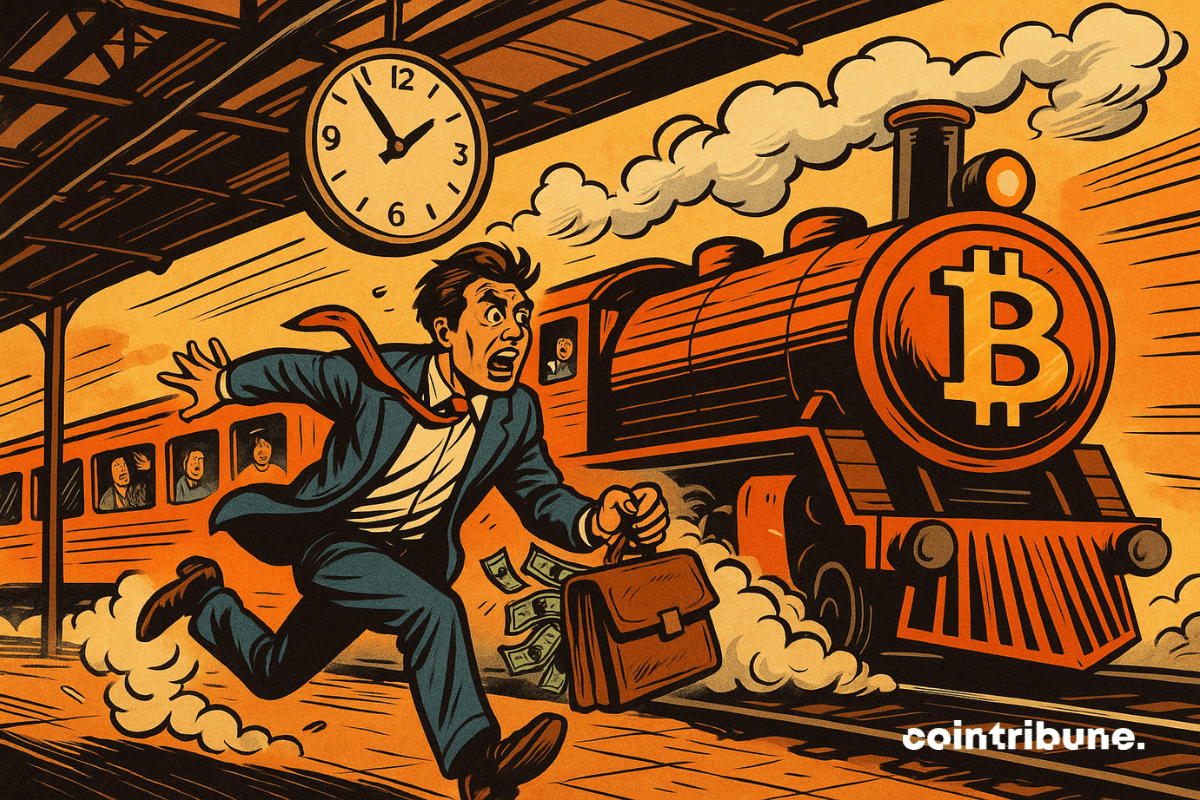
Bitcoin's course is tutoring historic heights, but the interest it triggers has never been so clearing. While some see it as a final opportunity, others wonder about the relevance of an investment at this stage. This year, the signals from financial institutions, influential investors and markets themselves, feed a strategic debate: should we still buy bitcoin, or has this train already passed?
In short
- Bitcoin reaches historical levels, arousing a lively debate between ultimate opportunity and risk of late entry on the market.
- Jamie Dimon announces access to Bitcoin at JPMorgan, while reaffirming his skepticism, illustrating the tension between institutional adoption and persistent distrust.
- Several signals show an accelerated institutionalization of Bitcoin in the United States and internationally, in particular via political initiatives, state strategies and the involvement of private actors.
- Michael Saylor and Robert Kiyosaki defend the purchase at the highest, convinced that the bull's bull potential is far from exhausted.
The reversal of institutions: between prudence and forced adoption
On May 19, 2025, Jamie Dimon, CEO of JPMorgan Chase, pronounced a sentence that marked a turning point in the historical relationship between the big banks and Bitcoin: “We will allow you to buy it”.
This declaration, made during the annual day of the bank's investors, formalizes access to bitcoin for JPMorgan customers, a first for the institution.
However, Dimon has not moderated his skepticism: “I don't think you should smoke, but I defend your right to smoke”he coward To illustrate his approach to Bitcoin. He also reaffirmed his criticisms of the crypto, and again spoke of his use in “Sex trafficking, money laundering and terrorism”.
In addition, signals converge on increased institutionalization of Bitcoin, especially in the United States:
- The presidential decree: Donald Trump formalized the creation of a Bitcoin strategic reserve, funded by seized assets, positioning the crypto as a recognized asset;
- Local state initiatives: American states such as New Hampshire and Arizona voted laws authorizing the allowance up to 5 % of public funds to cryptos, including Bitcoin;
- A strategic accumulation of sovereign states: the Salvador continues its BTC purchases, despite the reluctance of the IMF, using independent state structures to bypass blockages;
- Expansion by the international private sector: Metaplanet, Japanese company, exceeds Salvador in Bitcoin volume detained, with a clear objective: reach 1 % of the total supply in circulation;
- A consolidation of the BTC as reserve active: these coordinated actions of governments and companies reflect an increasing integration of bitcoin in the long -term reserve and diversification strategies.
This change of course, even among the most skeptical, shows that Bitcoin is now an asset that institutions can no longer ignore, even when they publicly disappear.
Buy at the top: a rational bet according to the maximalists
While some people wonder about the relevance of buying an asset that has just broken its historic record, other figures from the financial world see it on the contrary an opportunity not to be missed.
Michael Saylor, founder of Strategy, theexpresses Without detour on May 21 on the X platform:
If you don't buy it at the historic summit, you leave money on the table.
For him, Bitcoin has not yet revealed all its potential, especially because the big banks are only at the beginning of their foray into this universe.
And it goes further: “When the banks eventually bless Bitcoin, everyone will want to buy it, no one will want to sell it, and you can no longer allow yourself”.
In the same spirit, Robert Kiyosaki, famous author of ” Rich father, poor father “says on social network X (ex Twitter) on May 26“That even buy 0.01 BTC today could make you very rich in two years”. He revised his forecasts upwards, and estimated that Bitcoin could reach $ 350,000 by the end of this year.
If these declarations may seem speculative, they are based on a conviction shared by several actors: the scheduled rarity of Bitcoin, combined with the expected influx of institutional investments, could mechanically make the price increase in a sustainable manner.
However, these upward positions are accompanied by warnings. As Arthur Azizov, founder of B2 Ventures reminds us, any projection remains theoretical today, for lack of historical data beyond this price level.
In the event of a correction, the BTC could fall to the zone of 60,000 to $ 50,000. However for his most convinced supporters, this volatility does not change the essentials, because in a world where fiduciary currencies crumble, Bitcoin would represent a reserve of essential value in the medium term and a much better investment than ten years ago. As the boundaries between traditional finance and crypto fade, one thing is certain: the debate around Bitcoin has only just begun.
Maximize your Cointribne experience with our 'Read to Earn' program! For each article you read, earn points and access exclusive rewards. Sign up now and start accumulating advantages.


