
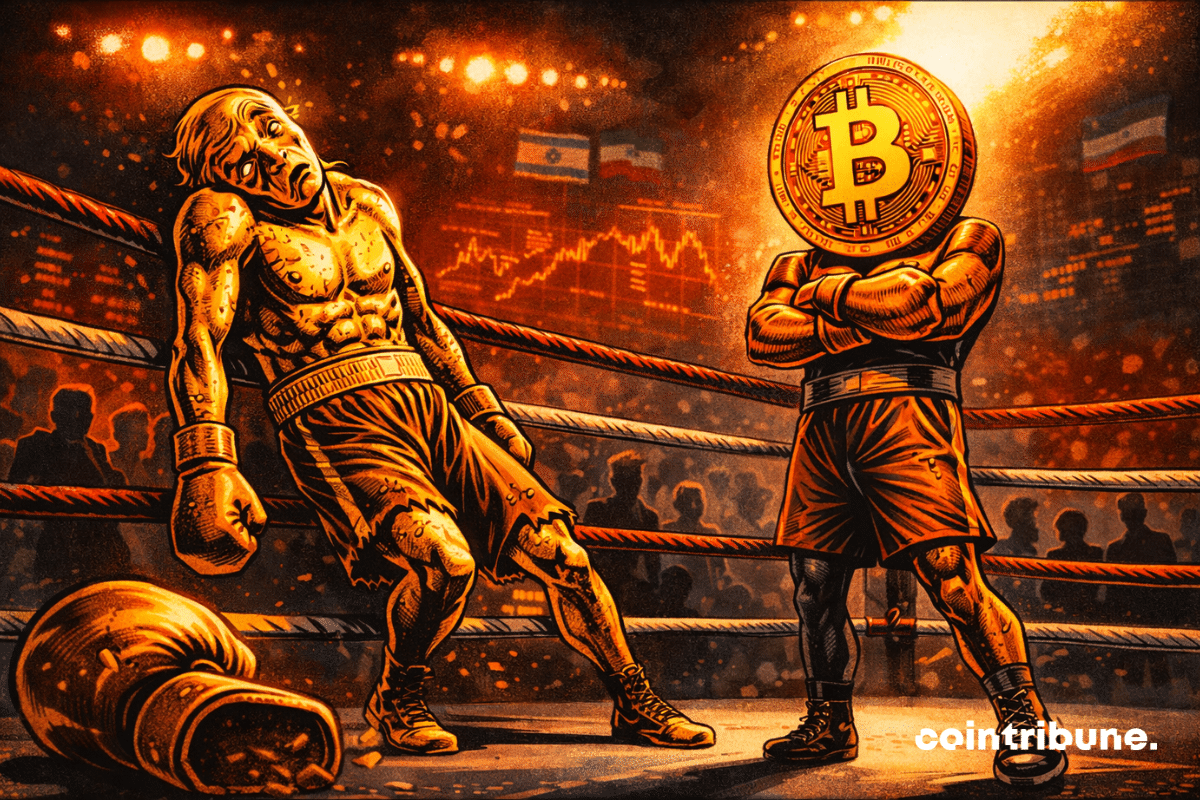
Historically, periods of war have given gold an almost sacred role in global financial markets. When tensions explode, investors seek a solid refuge and instinctively turn to gold. However, this well-oiled mechanism today seems to be suddenly seizing up, and the crypto market is observing this shift with a certain curiosity. Against a backdrop of conflict in the Middle East, gold is losing its luster, and this reversal is intriguing.
In brief
- Gold fell 11% in one week, marking its worst weekly performance since 1983.
- Since the start of the Iranian conflict, gold has declined sharply, despite its traditional refuge status.
- High rates, a strong dollar and energy inflation outweigh the war now.
- Bitcoin is holding up better in the short term, while markets reassess the safe haven role of gold.
Gold in free fall despite the war: the refuge that disappoints investors
First, the shock is violent, because gold has just recorded its worst week since 1983 with a fall of 11%. Gold, which was until recently moving around historic highs, is now trading below $4,500. Since the start of the conflict with Iran, the decline now exceeds 14%, which calls into question its traditional role.
In theory, a war pushes investors into gold because it is supposed to protect against uncertainty and inflation. However, this time, the market does not react as expected, and the crypto-sphere is observing this phenomenon carefully. Gold, after a spectacular surge, seems to have reached a saturation point.
According to an analysis relayed by CNN:
I think in the recent drop in gold prices, higher yields played a major role.
Hardika Singh, Economic Strategist at Fundstrat
Then, some investors sell their gold to cover losses on other assets, adding to the pressure. Ultimately, gold is not falling just because of the conflict, but because its environment has profoundly changed.
Rates, inflation and the dollar: why gold and crypto no longer react the same
Then, we have to look elsewhere to understand the situation, because war is no longer the main factor guiding financial markets. Now, interest rates dictate the pace, and this reality is disrupting both gold and the crypto market.
Investors anticipate that the Fed will not cut rates this year, and some are even considering a hike soon. In this context, bonds become more attractive, because they offer a return that gold cannot provide.
At the same time, the dollar is strengthening, making gold more expensive for international investors. This mechanism slows down global demand and accentuates the downward pressure on gold.
Oil, meanwhile, has jumped 50% since the start of the conflict, fueling inflationary fears. This inflation reinforces strict monetary policies, which indirectly weighs on gold and certain crypto segments.
As Andre Dragosch explains in CoinDesk columns :
Bitcoin has once again played the role of canary in the macroeconomic coal mine. At current levels, bitcoin is already pricing a recession into its price, unlike many traditional assets.
Thus, war becomes a backdrop, while rates take control.
Gold versus crypto: Bitcoin resists and changes the market reading
Finally, another player attracts attention in this tense context, and it is Bitcoin, pillar of the crypto market. Since the start of the conflict, Bitcoin has increased by more than 11%, while gold has declined sharply.
Over a twelve-month period, gold remains dominant with an increase of 48.5%, while bitcoin continues to decline. However, in the short term, crypto shows a faster reaction capacity.
Crypto investors analyze this movement as a signal, because it reflects a change in risk perception. Gold is no longer automatically seen as the ultimate safe haven, and crypto is gradually gaining ground.
Some players sell their gold to reallocate their capital, while others adjust their positions in the face of an uncertain environment. This recomposition of portfolios highlights a structural change.
The figures that are reshaping the market
- Gold fell 11% over the week, worst performance since 1983;
- Gold has fallen by more than 14% since the start of the conflict;
- Oil rises 50%, reinforcing inflationary pressures;
- BTC price reaches $70,713 at time of writing;
- US rates exceed 4.3%, weighing on gold.
Meanwhile, the crypto market is sending more encouraging signals, notably with a slowdown in sales from historical holders. This lull reduces selling pressure and restores confidence. Gradually, some investors are considering a rebound in bitcoin, driven by healthier dynamics and market stabilization.
Maximize your Tremplin.io experience with our 'Read to Earn' program! For every article you read, earn points and access exclusive rewards. Sign up now and start earning benefits.


