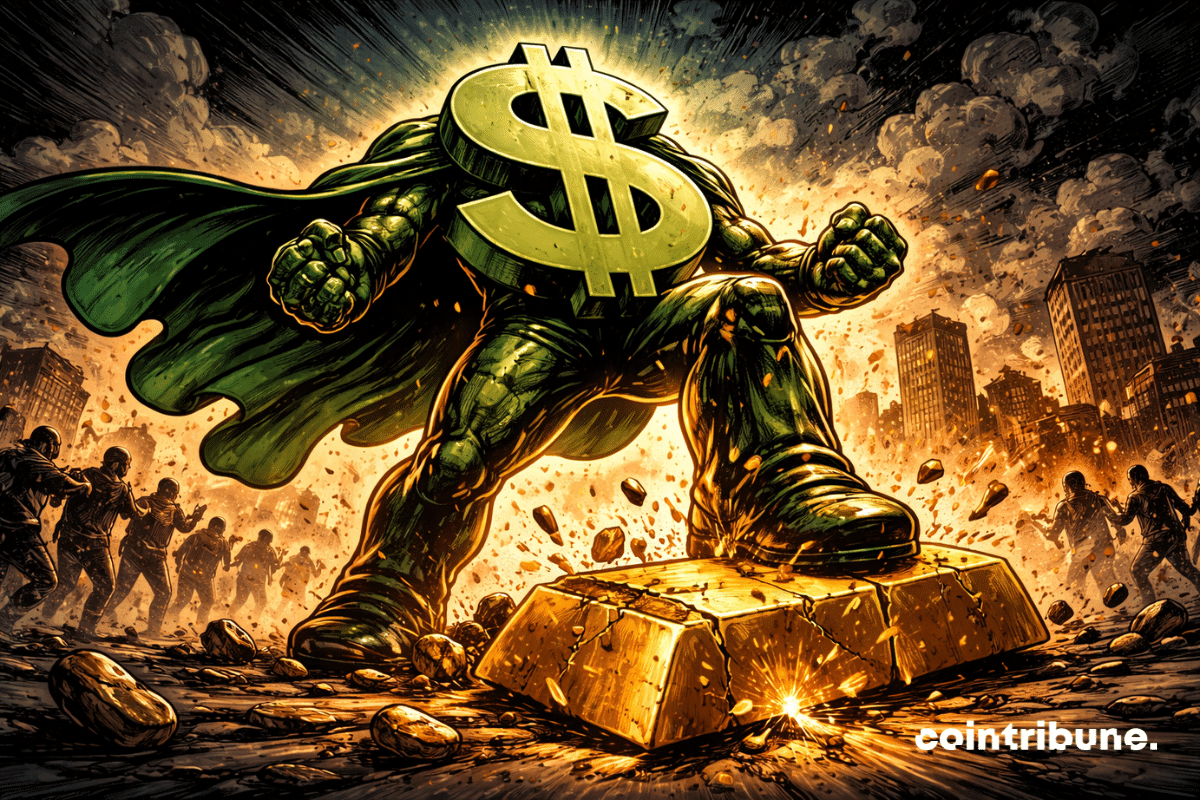
Peter Schiff has been insisting for years that gold will eventually dominate global finance and crush its rivals. However, recent reality tells a completely different story, much more brutal for investors. Instead of playing its role as a safe haven, gold is falling as geopolitical tension sharply intensifies. This time, even bitcoin does not need to intervene, because the dollar is enough to completely shake up traditional balances.
In brief
- Gold fell sharply after its initial peak caused by the US strikes against Iran.
- The 178,000 American jobs created in March strengthened the dollar and dampened gold.
- Oil above $110 fuels inflation and further wards off rate cuts.
- Mario Nawfal reads behind this war a monetary battle between the Chinese yuan and the American petrodollar.
Why gold disappoints despite the war and shakes global finance
First, everything seemed aligned to propel gold to new highs in the global stock market. Open war between the United States, Israel and Iran immediately triggered a rush for safe haven assets. Gold briefly climbed towards $5,423 before buckling under market pressure.
Then, the dynamic was suddenly reversed in international finance. Gold is fell back towards 4,600 dollarserasing nearly 15% of recent gains. Then, investors abandoned gold in favor of the dollar, considered more liquid and more responsive.
Finally, this shift shows a profound evolution in finance. Fear no longer directs the flow as before. The stock market now favors the speed, liquidity and monetary power of the dollar over gold which has become slower.
The dollar regains control and imposes its law on finance
Then, the real break comes from American economic data which surprised all of world finance. The United States added 178,000 jobs in March, compared to around 60,000 expected by analysts. The unemployment rate fell to 4.3%, which strengthens the strength of the economy.
Then, the dollar rises sharply and pulls bond rates with it. Gold suffers immediately as it is not generating any returns in this tight stock market setup.
One analyst sums up this situation clearly:
The latest strong NFP release reinforced fears of tight central bank monetary policy, as lingering concerns over oil-driven inflation continue to overshadow gold's traditional safe-haven shine.
Tim Waterer, Chief Market Analyst, KCM Trade
Finally, finance becomes mechanical, almost cold. The dollar attracts capital while gold declines under the combined pressure of rates and inflation.
Behind the war, a monetary battle
Finally, a deeper reading is emerging in certain circles of global finance and geopolitics. According to Mario Nawfal, the conflict does not only concern weapons or visible nuclear power. It directly affects the global monetary system and the dominance of the dollar.
The war that no one interprets correctly concerns the dollar, not nuclear power. Iran sold 90% of its oil to China in yuan, not dollars.
Then he adds that this system is based on the recycling of petrodollars into American debt. In this logic, each energy flow becomes a lever of financial power.
The key figures of this shift in finance
- Gold falls to around $4,600 after peaking near 5,400;
- Oil moves between 111 and 115 dollars per barrel;
- Job creation reaches 178,000 in March 2026;
- Unemployment falls to 4.3% in the United States;
- The price of bitcoin is trading around $69,193 at press time.
In this context, gold no longer reigns alone over global finance and is losing its uncontested status. Now, bitcoin is moving forward with clear ambition and refusing to give ground. After each crisis, he tries to assert himself against gold and stocks. Slowly, it is establishing itself as a serious competitor in the global balance.
Maximize your Tremplin.io experience with our 'Read to Earn' program! For every article you read, earn points and access exclusive rewards. Sign up now and start earning benefits.