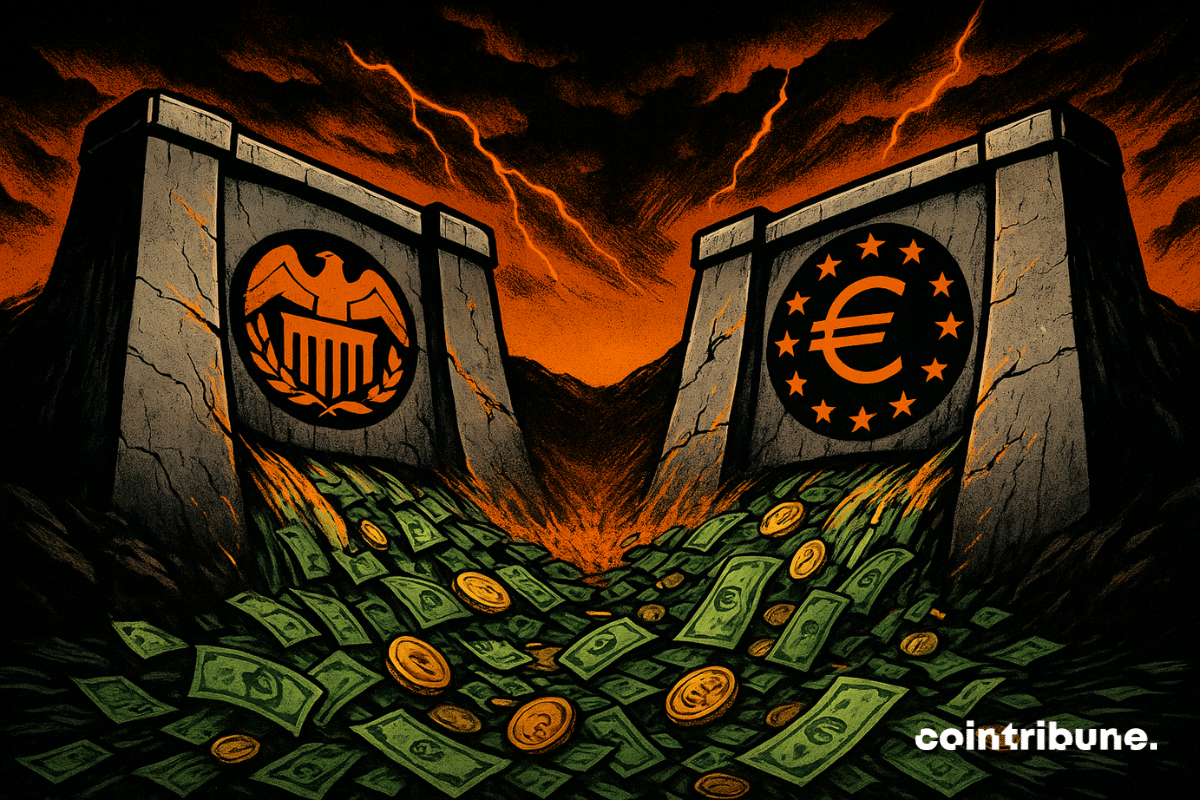
The debt is talking about it on both sides of the Atlantic. Bitcoin is ready to fly away if the Fed and the ECB were to bring out the ticket plank.
In short
- French debt amounts to 3,345 billion euros, or 114 % of GDP. The budget deficit reaches more than 6 % of GDP.
- Faced with budget overflows, the rise in French borrowing rates could force the European Central Bank to monetize debt.
- The Fiat system is a ponzi characterized by an exponential growth of the money supply of very good omen for Bitcoin, the only absolutely anti-inflationary active active in masses.
France does not have the money: overwhelming debt
The Prime Minister is leading a series of discussions with political parties this week to avoid the collapse of his government. The objective is to find common ground to return to a budget deficit less than 3 % of GDP by 2029.
In the shorter term, the budget deficit of 6.1 % of GDP must return from 2024 to 5 %. The budgetary effort to be provided is 60 billion euros, including around 40 billion via the reduction of public spending.
In 200 years, France has accumulated a debt of 3,345 billion euros amounting to 114 % of GDP. It increases around 160 billion a year. Of this great total, 1,115 billion have been accumulated since the election of Emmanuel Macron in 2017.
As a result, interest now represents more than 60 billion euros per year. They could become the first budget of the nation this year if the rates do not go down.
Problem, opposition parties are not satisfied with the austerity strategy and intend to overthrow the government during the September 8 vote.
The president of the ECB has warned against the “worrying” risk of a collapse of the government. The reason being that it will most likely result in an increase in borrowing rates.
The 10 -year rate of France is currently around 3.50 %, at the highest since 2011. It is as much as Greece. And even when the ECB has dropped its rates. Its master rate increased from 4.50 % in September 2023, to 2.15 % today.
Christine Lagarde said that she was monitoring the borrowing costs of France “very carefully”. But what could she do in the event of censorship of the French government on September 8?
Quantitative eating in sight?
As a reminder, the ECB holds around 25 % of European public debt. It is 23 % in the United States. Yes, the ECB has bought a quarter of European public debt via its asset buyout programs.
This means that governments no longer pay interest on 25 % of their debt. The reason being that the interests perceived by the ECB are redistributed to national central banks which, in turn, redistribute them to the States.
In other words, the United States government does not pay $ 1,000 billion in interest, as it is often understood, but 750 billion. The same in France. It is not 67 billion, but rather 50 billion.
This reminder being made, the question is whether the ECB could revive a quantitative Easing if ever French rates were to fly away? Yes.
Nothing prevents central banks from turning the ticket board. The fact that Donald Trump is on the Fed's assault suggests that it is precisely his ambition. The rate at 10 years American is 4.22 %…
But there is no miracle. At the end of the end, facilitating debt will always end in more inflation if GDP growth does not follow. Allowing states to increase the money supply much faster than economic production will ultimately result in a general price increase.
Thus, increasing productivity (production per person) is difficult in a world that has crossed its conventional oil peak (2007). Innovations like AI or quantum computer are full of promises. But while waiting for them to really materialize, the observation is that growth continues to slow down, decade after decade, because of the physical limits to growth.
For example, the growth in oil production increased from 7 % per year (from 1900 to 1970), to less than 1 % today. While in front, the money supply continues to climb to a much higher pace (~ 7 % per year).
Bitcoin and the pyromanian firefighter
It is difficult for a government to slash in expenses. Better to print money. As the legendary investor Ray Dalio wrote in June:
When countries have too many debts, the privileged way of political decision -makers is generally to lower interest rates and devalue the currency in which the debt is denominated. It is therefore wise to bet on this scenario.
Ray Dalio, founder billionaire of the giant investment fund Bridgewater.
And to lower interest rates, it is necessary to print, via an “quantitative eating”. This is the keyword that will have to be monitored in the coming months. Especially from May, when Donald Trump replaces the president of the Fed.
To come to the subject that interests us, yet another quantitative eating would be bullish for Bitcoin. Historically, all active ingredients draw during these periods of monetary softening.
Bitcoin immediately appreciated a few days ago, after the president of the Fed suggested an upcoming rate drop, potentially on September 18.
In short, debt puts France and Europe in the face of a dilemma. Reducing public spending by 40 billion euros, as expected, may cause social and political tensions, and all the more so if the government of François Bayrou falls.
Relaunching a quantitative ease would contain borrowing costs, but it would be an admission of weakness. In addition, the ticket board benefits from those who are rich enough to hold prestigious real estate, works of art, good stock markets, etc.
This is why Bitcoin will certainly be the big winner if the central banks had to act in pyromanian firefighters again. He is the rarest asset in the world while being accessible to everyone, regardless of the size of his savings.
Do not miss this article on the same subject: Bitcoin: The Bitwise shock price prediction.
Maximize your Cointribne experience with our 'Read to Earn' program! For each article you read, earn points and access exclusive rewards. Sign up now and start accumulating advantages.