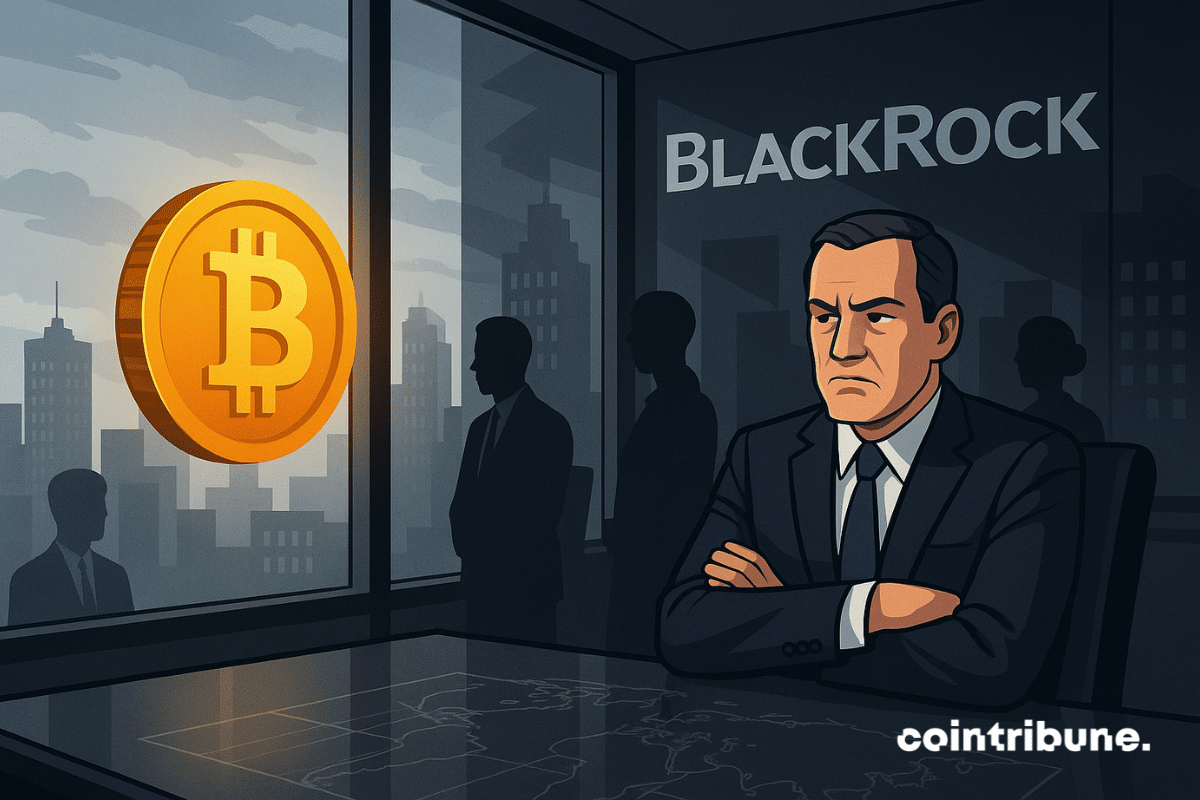
Bitcoin as a global payment rail? For BlackRock, this is clearly not the heart of the matter. For now, clients of the world's largest asset manager are mostly playing the digital gold card, not everyday currency.
In brief
- BlackRock today considers bitcoin primarily as a store of value, a “digital gold”, not as a global means of payment.
- The giant believes that the scenario of bitcoin being used massively in payments remains speculative, while the technical and economic limits of scaling solutions maintain uncertainty.
- During this time, stablecoins are establishing themselves as the real payment rails, capturing the majority of uses while bitcoin is treated as a long-term asset.
Bitcoin at BlackRock: firstly a store of value
Robbie Mitchnick, head of digital assets at BlackRock, puts it bluntly: most clients don't look at bitcoin through the prism of everyday payments. They don't really subscribe to the idea of a global payments network backed by BTC.
In their model, the massive use of bitcoin to pay for coffee or pay bills on the other side of the world is an out-of-the-money option: a bonus, distant scenario, which does not justify the investment decision today. In other words, if bitcoin becomes a global payment rail, it will be additional yield, not the central thesis.
This does not mean that BlackRock is burying this possibility. Mitchnick is talking about a more speculative scenario, not an impossibility. But for institutional clients, the narrative that matters now is simple: bitcoin as a store of value, a rare asset, uncorrelated from the traditional banking system. It’s this story that attracts flows.
Bitcoin's current limits for payments
If bitcoin really wants to exist as an international payments infrastructure, the work is tough. Mitchnick acknowledges that a lot still needs to happen when it comes to scaling, Lightning, and Layer 2 solutions.
There is no shortage of technical promise, but the economic viability of certain models remains unclear. Recent research has already cast doubt on the ability of many rollup solutions to remain sustainable in the long term, despite current popularity. For an institutional investor, betting today on bitcoin as a complete payment rail therefore amounts to financing a still very uncertain future.
In this context, BlackRock adopts a cautious but clear stance: the investment case for bitcoin does not, for the moment, rely on payments. It is based on scarcity, portability, and the digital gold thesis. Payments remain an option, not the foundation.
Stablecoins: the current winners in the payments field
While the BTC and payments debate drags onanother horse is getting ahead: stablecoins. Mitchnick talks about huge success in the payments space. There, the product-market fit is already visible.
Stablecoins meet a simple need: to move value quickly, at low cost, while remaining backed by a familiar unit of account, the dollar or other currencies. For corporate players, fintechs and platforms, the trade-off is obvious: why put up with the volatility of bitcoin when a stablecoin does the job of transferring value without a price shock?
The trajectory is strong enough to shake up even the most bullish on bitcoin. Cathie Wood at ARK Invest explicitly downgraded her 2030 price scenario for bitcoin in part because stablecoins capture some of the role she envisioned for BTC in payments. When a structural optimist on bitcoin admits that stablecoins are scaling faster than expected, the signal is clear: the payments field is being played out elsewhere, at least in the short and medium term.
Bitcoin, stablecoins and the battle for new payment rails
Should we conclude that bitcoin has lost the payments battle? Not so fast. Mitchnick itself recognizes that BTC maintains a credible card on remittance payments, particularly to emerging markets. In these areas, the combination of capital controls + high banking fees + weak infrastructure creates a space where bitcoin remains competitive, especially when it relies on more user-friendly tools.
For the investor, the message is blunt: if you buy bitcoin today, don't tell a story that even BlackRock doesn't support. The payments use case is a distant upside, not the basis of the thesis. The rational strategy is to see bitcoin as insurance, a long-term asset, potentially complemented by targeted exposure to stablecoins which are already capturing the growth of new payment rails.
In short, BlackRock does not question the prospect of bitcoin being widely used in international payments. The asset management giant has already positioned itself on BTC and ETH via Coinbase, but it still limits this scenario to the rank of a speculative option, behind the current market reality where, for the moment, stablecoins capture most of the uses linked to payments.
Maximize your Tremplin.io experience with our 'Read to Earn' program! For every article you read, earn points and access exclusive rewards. Sign up now and start earning benefits.