
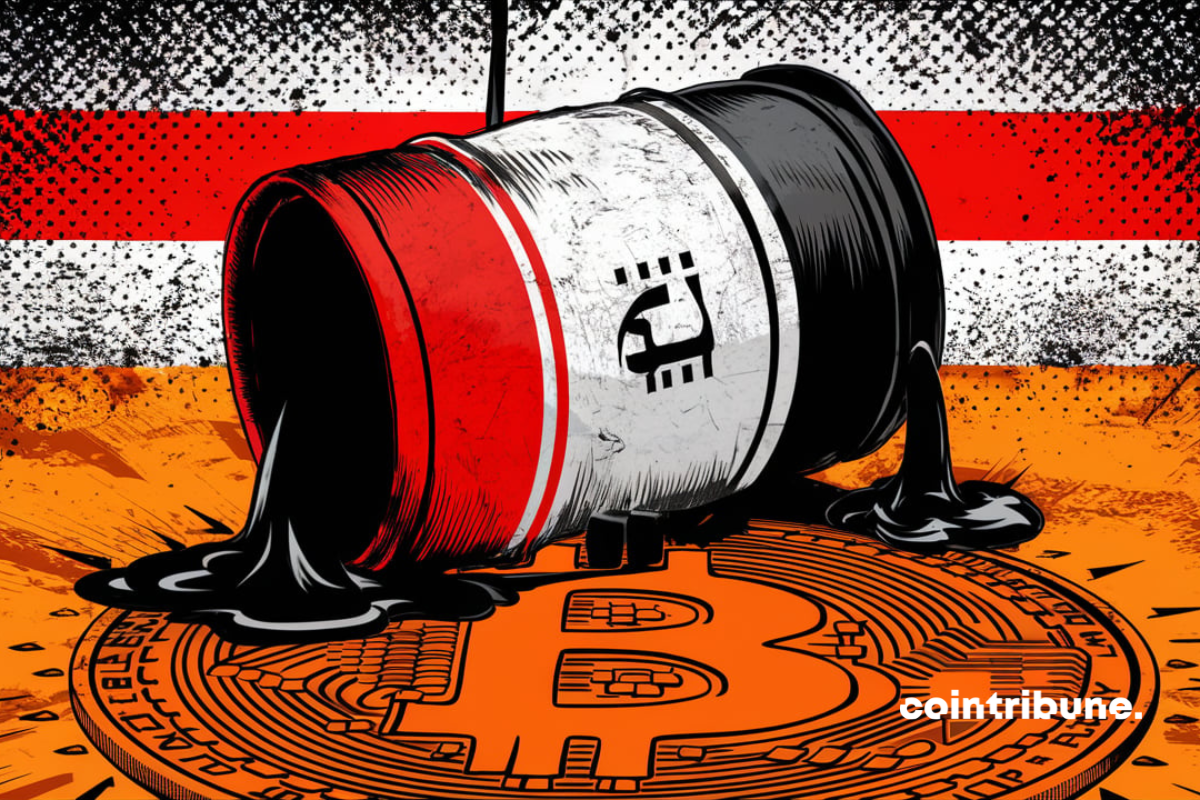
Not only is the Fed drastically limiting how Iraq can spend its dollar reserves, it is now banning it from using the yuan. When will bitcoin be available?
Iraq suspends yuan transactions
We reported earlier this year that Iraq no longer wanted to sell its oil in dollars, but rather in yuan.
This week, the U.S. Federal Reserve ordered Iraq to stop dealing in Chinese yuan. It cited “discrepancies and specific issues related to transactions” according to Mr. Al-Kadhimimember of the parliamentary finance committee.
To put it more transparently, the United States wants to prevent Iraq from trading with its Iranian and Syrian neighbors, two nations under embargo because of their distrust of Israel.
The move comes after the Iraqi parliament's finance committee called on January 31 for oil to be sold in currencies other than dollars, in a bid to circumvent repeated US sanctions against Iraqi banks.
“The US Treasury continues to use the pretext of money laundering to impose sanctions on Iraqi banks. We need a national agreement to end these arbitrary decisions”indicated the communicated.
The Finance Committee reiterated its “call on the government and the Central Bank of Iraq to take rapid measures against the guardianship of the dollar by diversifying foreign exchange reserves.”
This is reminiscent of 2001, when Saddam Hussein decided to sell his oil exclusively in euros rather than dollars. Hence, incidentally, the French opposition to the second Gulf War. At that time, that is to say only two years after Saddam Hussein's decision, the Americans invaded Iraq under a false pretext in order to save the petrodollar.
Iraqi oil was denominated in dollars again immediately after the capture of Baghdad. For more than 20 years now, the conquered country's central bank has been regularly prohibited from using its large dollar reserves.
Iraqi banks must go through the SWIFT network, which requires final authorization from the Fed. The latter can block any payment from the Iraqi central bank and does not hesitate to do so.
Will BRICS take Iraq under their wing?
In short, Iraq is in the same situation as Iran and Russia. Its dollar reserves are partly frozen and its transactions via the SWIFT network depend on the goodwill of Washington.
It is therefore clear that the country of the two rivers would do well to join the BRICS. The MPs in favour of such a move belong to the Shiite Coordination Framework. This is an alliance of parties supported by Iran and which forms the backbone of the current government. The idea is also beginning to gain ground among other political forces.
Member of the Parliamentary Committee on Oil and Energy Zeinab Al-Mousawi said late last year that BRICS membership should be a national priority.
Such integration “could limit the dominance of the US dollar. We could free ourselves from the financial and trade restrictions imposed by Washington” she said.
Indeed, doing without the dollar and the SWIFT network is also a priority for the BRICS. The Deputy Speaker of the Duma Alexander Babakov repeated it again this week. “The priority of the BRICS financial agenda is to create our own financial messaging system similar to SWIFT”he told TASS.
Russian Ambassador to China Igor Morgulov said the same thing in early July. “We are leaving the dollar-dominated space and developing the mechanism and tools of a truly independent financial system”he said.
Mr Morgulov, however, said that the introduction of a new common currency was not on the horizon. However, he stressed that the BRICS – which now includes Brazil, Russia, India, China, South Africa, Ethiopia, Iran and Egypt – “evolves in this direction”.
CBDC and monetary chimeras
Russia already has an alternative to the SWIFT network. The Russian interbank messaging system SPFS ensures the secure transfer of financial messages to partner foreign banks. China also has a similar network called CIPS that it uses for international yuan transactions.
Overall, the BRICS are increasingly using their national currencies and seeking to avoid the SWIFT network. The share of payments in national currencies between Russia and the BRICS countries has increased to 85%, compared to 26% two years ago.
Last month, Russian Deputy Finance Minister Ivan Chebeskov said that Russia was working on an international payments system in cooperation with the central banks of the BRICS member states. The senior official dropped the phrase “BRICS Bridge platform”.
This is reminiscent of the “mBridge” project led by China under the aegis of the Bank for International Settlements. The Russian Minister of Finance Anton Siluanov also specified that the BRICS “Bridge” will work with central bank digital currencies, which is the case with mBridge.
On this subject, don’t miss our article: Bitcoin and CBDC, Russia wants both.
Unfortunately, trading in national currencies has its limits, whether it is CBDC or not. Russia, for example, ultimately refused to accept the rupee as payment because India has nothing to sell that is of interest to the Russian market.
And why not bitcoin?
The world needs a universally accepted standard currency because of its intrinsic qualities. Gold fulfilled this role for a long time before the United States betrayed the entire world by reneging on the Bretton Woods agreements signed at the end of World War II.
Since then, all nations have been trading in dollars, with a gun to their head, for want of anything better. But times are changing. The yuan is becoming increasingly popular, not to mention bitcoin, which appears to be an ideal way out of geopolitical tensions.
On this subject, don’t miss our article: Russia pleads in New York for end of dollar monopoly.
Bitcoin has the immense advantage of being an absolute store of value due to its limited monetary supply of 21 million units.
Another essential advantage is that no one can prevent bitcoin transactions from taking place. The Iraqi central bank would not need permission from the United States if it sold its oil in bitcoins.
Finally, BTC has the good taste of being a strong currency at the same time as a payment system, two-in-one. So much so that Vaneck expects that 10% of global trade will be done in bitcoin by 2050.
Even the United States is waking up to this. Presidential candidate Robert Kennedy has promised to provide the country with a reserve of bitcoins equal to its gold reserve.
That’s quite a promise considering the US government only has 210,000 bitcoins in its possession. In contrast, US gold reserves are worth $640 billion. That’s an amount equivalent to half of bitcoins at the current price…
Maximize your Tremplin.io experience with our 'Read to Earn' program! For every article you read, earn points and access exclusive rewards. Sign up now and start earning benefits.
Click here to join 'Read to Earn' and turn your passion for crypto into rewards!


