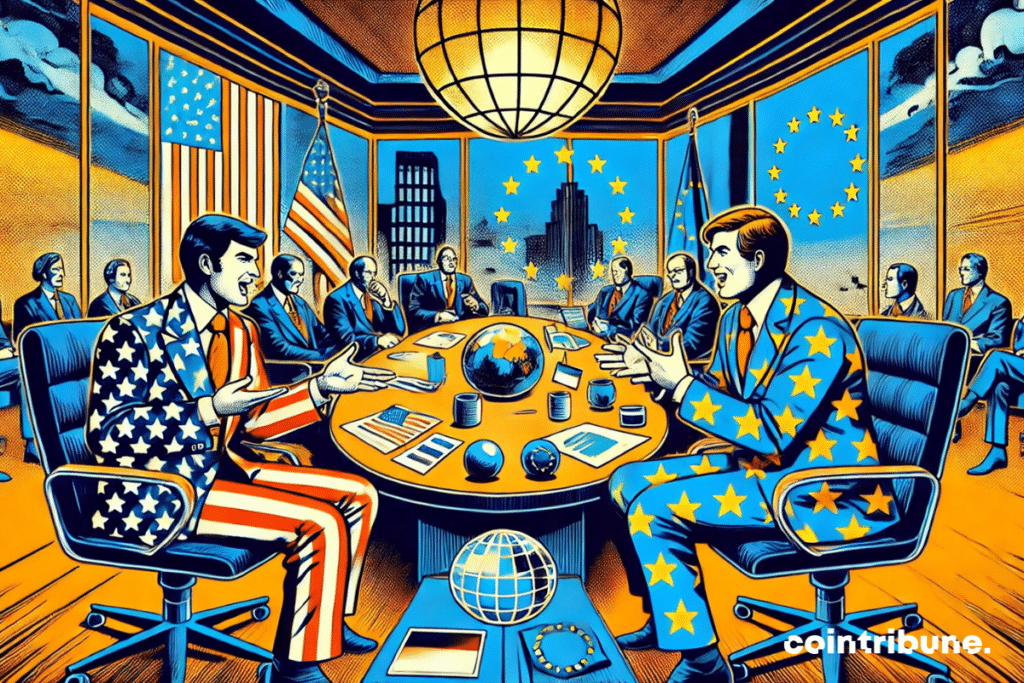
Transatlantic relations are going through a period of great tension, marked by the return of Donald Trump to the American presidency. In this context, Isabel Schnabel, a senior member of the board of directors of the European Central Bank (ECB), sounded the alarm. She says a trade war between the European Union and the United States is “very likely”, due to the protectionist policies already announced by the American administration. If these measures, including high customs duties on European imports, come to fruition, they could destabilize the global economy. This threat, which particularly targets key sectors in the euro zone, poses crucial challenges for the future of international economic relations.
A rise in tensions orchestrated by American policy
Isabel Schnabel, an influential member of the board of directors of the European Central Bank (ECB), expressed clear concerns in an interview with the YouTube channel of the German financial advice site Finanztip. “A trade war with the United States is very likely,” she said, when directly referring to the protectionist measures being considered by the Trump administration. Among these measures, the imposition of 25% customs duties on imports from Mexico and Canada is already triggering fears, and similar threats weigh on European products. These policies particularly target Germany, the euro zone's main trade surplus vis-à-vis the United States, which thus reinforces bilateral tensions.
According to Schnabel, these customs duties represent much more than a simple trade barrier: they could be “poison for the economy”. By increasing the prices of European imports, these measures would directly threaten the purchasing power of households, and increase pressure on businesses already facing a fragile economy. The side effects would not be limited to costs: the continuation of these uncertainties also risks slowing down investment and consumption, two essential pillars of economic recovery in the euro zone.
A global impact and possible responses
Beyond the immediate consequences for the European Union, Isabel Schnabel warns of the broader repercussions that a trade war could generate. She underlines the risk of a “reversal of the gains from globalization”, a process which has nevertheless contributed significantly to the creation of wealth in Europe in recent decades. “If globalization has brought significant wealth gains to Europe, we may now need to prepare to see at least some of these gains reversed,” she warned. This economic regression could be aggravated by the rise in prices of imported goods, which could thus fuel social and economic tensions in many member countries of the European Union.
Faced with this threat, the ECB is showing a certain resilience by maintaining its focus on the 2% inflation objective. Isabel Schnabel recalls that several reductions in key rates, made in 2024, made it possible to reduce this rate from 4% to 3%. These adjustments aim to cushion economic shocks, although Schnabel admits that room for maneuver is becoming limited. In the longer term, the European Union may need to rethink its economic strategy. Among the possible avenues are targeted trade measures to counter American protectionist policies. This dynamic could also encourage Europe to strengthen its strategic autonomy, in order to reduce its dependence on external partners and anticipate similar crises in the future.
A trade war between Europe and the United States, although rooted in economic issues, reveals deep geopolitical divides. The continuation of American protectionist policies would force Europe to review its alliances and strengthen its strategic independence in the face of a partner that has become unpredictable. In this context, the choices that European decision-makers make in the coming months will be decisive for preserving economic stability and limiting the impacts on global supply chains. Such an escalation would not be limited to the markets. It would also strain the principles of international cooperation that have underpinned transatlantic relations for decades.
Maximize your Tremplin.io experience with our 'Read to Earn' program! For every article you read, earn points and access exclusive rewards. Sign up now and start earning benefits.