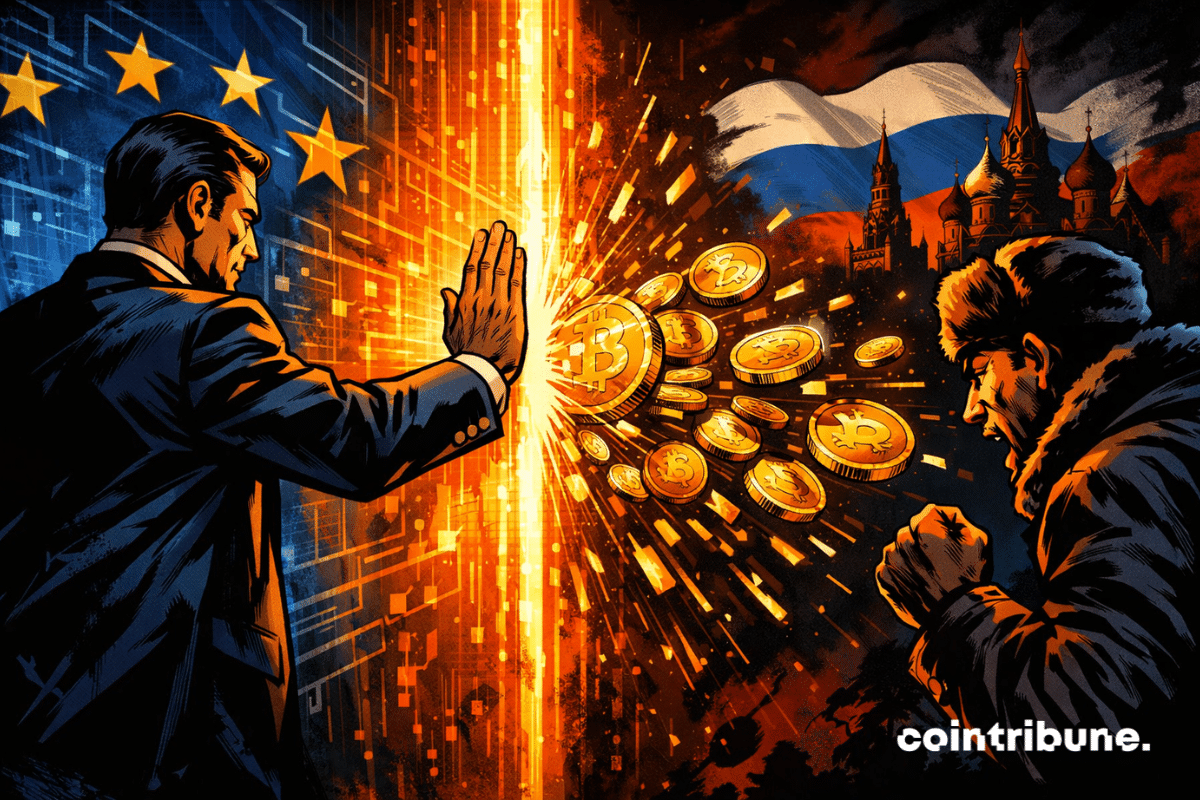
The European Union is preparing to take a major step in its economic war against Moscow. It plans to outright ban all crypto transactions involving Russian entities. A radical decision, but will it be enough to stop the machine?
In brief
- The EU is preparing a total ban on crypto transactions with Russia to circumvent sanctions.
- Brussels is targeting the successors of Garantex, a sanctioned Russian exchange, which represented 85% of flows to sanctioned entities in 2024.
- Kyrgyzstan is also in the EU's sights, suspected of serving as a commercial relay for Moscow.
- The measure must be adopted unanimously by the 27 member states, but three countries are already resisting it.
Brussels counterattacks against Moscow's crypto bypass
The Financial Times revealed the information on Tuesday. The European Union is working on a new sanctions package aimed at blocking any crypto transactions between its residents and Russian entities. The objective is direct: to deprive Moscow of a discreet but massive financing channel, used to fuel its war effort in Ukraine.
In Brussels' crosshairs, we find Russian crypto platforms which imitate already sanctioned exchanges. The EU calls them the “heirs” of Garantex — the Russian exchange platform banned last year. And the numbers are dizzying.
According to the blockchain analysis firm TRM LabsGarantex represented, alongside the Iranian Nobitex, more than 85% of financial flows towards sanctioned entities and jurisdictions in 2024. The American OFAC had also established that the majority of funds sent to Garantex came from exchanges linked to criminal activities.
Kyrgyzstan also enters the equation. Brussels plans to restrict the export of certain dual-use goods. THE document obtained by the Financial Times is unambiguous: since the start of the conflict, EU imports to Kyrgyzstan have jumped by 800%, and Kyrgyz exports to Russia by 1,200%. A bypass circuit that Brussels now intends to close, and quickly.
A regulatory obstacle difficult to adopt
On a legal level, the road remains strewn with pitfalls. The EU's proposals require unanimity from all 27 member states. However, according to the Financial Times, three countries are already slowing down the process. A blocked vote, and the whole mechanism fails.
This potential blockage illustrates the political complexity of crypto regulation in Europe. Because while Brussels deliberates, bypass channels proliferate. The case of the A7A5 stablecoin is the most striking example: according to the firm Elliptic, this discreet token would have made it possible to transfer more than 100 billion dollars via Russian wallets linked to sanctioned entities, before Washington and the EU sanctioned it in turn.
The lesson is clear: reactive regulation is no longer enough. Each closed exchange leaves room for a successor, more opaque, more agile. This is precisely why experts are calling for a coordinated global framework to address these regulatory gaps, rather than managing crises on a case-by-case basis.
The EU is trying to close a door that Moscow has been exploiting since the first day of the conflict. But without political unanimity and international coordination, each ban risks being just a doom and gloom. Because Bitcoin — and crypto as a whole — carries in its genes a natural resistance to control. And this is precisely what gives it its strength.
Maximize your Tremplin.io experience with our 'Read to Earn' program! For every article you read, earn points and access exclusive rewards. Sign up now and start earning benefits.