
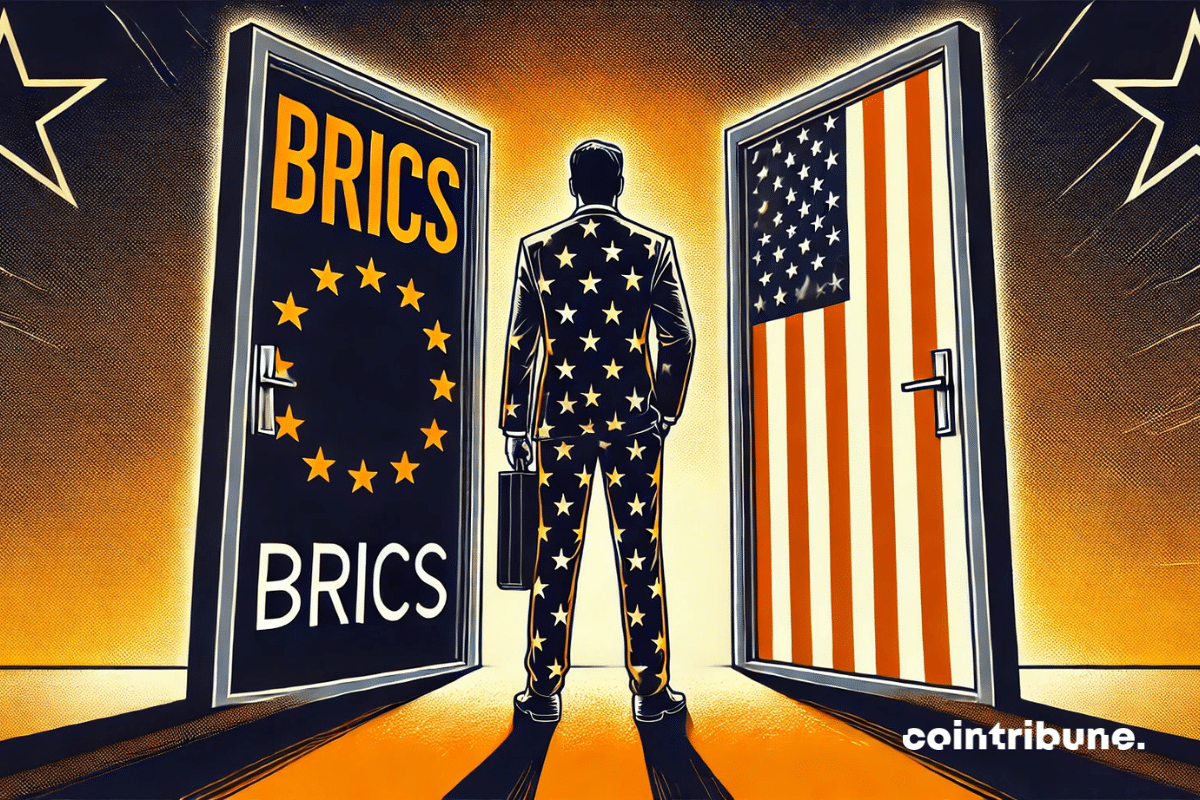
The global economy is evolving under the effect of increasing trade tensions. While the United States imposes new customs tariffs, Europe is faced with a strategic dilemma. Between maintaining its traditional alliances and diversification of its economic partnerships, the continent is now looking at the side of the BRICS. This organization, formerly perceived as a counterweight to the G7, today consolidates its position by weaving closer links with Europe. A shift that could redefine economic and political power relations internationally.
The impact of American prices on Europe and diplomatic tensions
The Trump administration has started a protectionist turn in American trade policy, a dynamic that extends today with new customs tariffs that strike several European products. A decision that immediately sparked reactions within the European Union. José Manuel Albares, Spanish Minister for Foreign Affairs, has notably expressed his concern: “Europe cannot simply undergo these unilateral decisions, we must redefine our approach in international trade”.
At the same time, influential political figures, like Friedrich Merz in Germany, plead for a reassessment of relations with China. “We must consider China not only as a competitor, but also as a partner with which we must establish solid bases”,, he declaredwhich reflects an increasing trend in Europe to reconsider economic alliances. These declarations reflect an increased awareness of the risks represented by too high dependence on the American market, accentuated by the threat of commercial sanctions.
The impact of these new prices goes beyond a simple trade war. He provides information on the differences within the EU as to the strategy to be adopted. Some member states favor the search for alternatives and more balanced alliances, while others remain cautious, because they fear possible reprisals from Washington. However, such a climate of uncertainty pushes several countries to explore new avenues, in particular by strengthening their cooperation with the British countries.
A strategic rapprochement between Europe and the BRICS
Faced with these trade tensions, European nations are starting to strengthen their links with the members of the BRICS, notably China and India. Trade between the EU and these countries have intensified in recent years, and this trend could still accelerate. Beijing, in particular, seizes this opportunity to consolidate its economic influence on the continent. China offers alternatives to European infrastructure via its initiatives in new silk roads, and several European countries plan to engage more.
From a strategic point of view, this rapprochement goes beyond trade. Discussions on industrial and technological cooperation are gaining momentum. India, for example, attracts more and more European investments in the field of new technologies and the energy transition. Such diversification of partnerships could allow Europe to reduce its dependence on US markets, while accessing the growing savings.
This progressive tilting nevertheless poses challenges. The European Union must juggle divergent interests between its member states in order to preserve a diplomatic balance between the United States and its new partners. In the long term, this redefinition of international relations could reshape the world economic order, by giving the BRICS an increased role in global economic and financial decisions. Europe, on the other hand, will have to arbitrate between economic pragmatism and loyalty to its traditional alliances.
Maximize your Cointribne experience with our 'Read to Earn' program! For each article you read, earn points and access exclusive rewards. Sign up now and start accumulating advantages.


