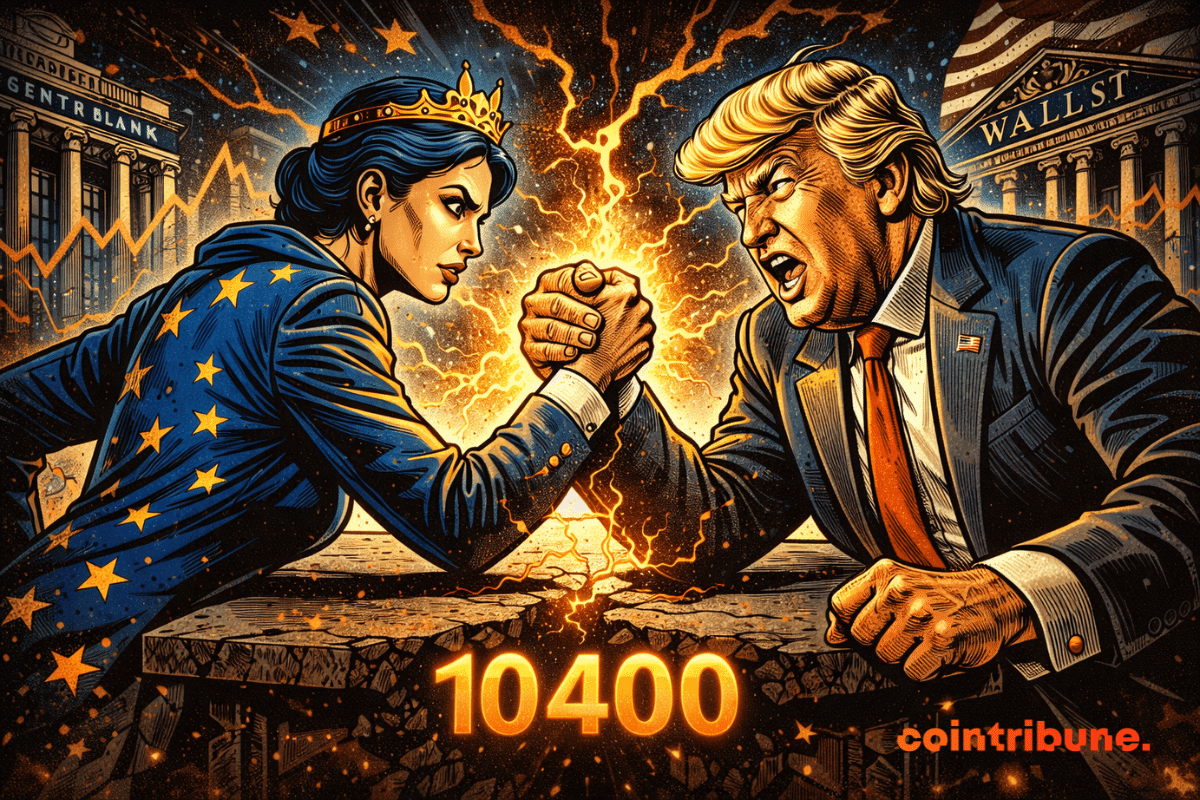
Donald Trump likes to present himself as the man who made American finance “stronger than ever”. He speaks loudly, often threatens, and always promises to “make” those who challenge his leadership. But this time, his bravado could well backfire on him. Because on the other hand, Europe no longer trembles: it holds trillions of dollars invested in the United States and, if necessary, it can bring out its famous “economic bazooka”.

In brief
- Europeans hold $10.4 trillion in financial assets in the United States.
- Trump's tariff threats are triggering attempts to gradually withdraw from American markets.
- The European Union is brandishing the possibility of an “economic bazooka” to counter American pressure.
- Analysts fear contagion in global finance, affecting the dollar, stocks and bonds.
Europe's hidden weapon: 10.4 trillion that makes Wall Street tremble
Europe, with a secret weapon, has for years been the main driver of American markets. Its pension funds, insurance companies and asset managers hold nearly $10.4 trillion in U.S. stocksor almost half of all foreign capital on Wall Street.
This is a colossal figure, yet little known. Behind the records of the American stock market lies a reality: without European money, the American indices would never have reached these heights.
But times are changing. Since Trump threatened to impose tariffs on eight European nations, a wind of distrust has been blowing. At Amundi, the largest European manager, the signal is clear. Its investment director, Vincent Mortier, confides:
We are seeing more and more clients wanting to diversify away from the United States. We saw that this trend started in April 2025, but it accelerated somewhat this week.
Clearly, the investors who have fueled American prosperity could become its Achilles heel. The numbers speak for themselves: Europe holds 49% of all foreign-owned U.S. stocks, and half comes precisely from countries targeted by Trump.
It's a double-edged dependence: Wall Street shines, but thanks to the money of a continent that the President of the United States regularly insults.
Trump, finance and the dangerous game of threats
Markets don't like uncertainty or inflated egos. However, Trump combines the two. His recent bellicose tone towards Europe was enough to make the markets bend: the S&P 500 lost 2.1% after his latest announcements.
Certainly, nothing catastrophic in the short term, but the signals of tension are multiplying: capital flows are stabilizing, requests for withdrawal are increasing and managers are openly talking about “reallocation”.
Europe, in addition to its stocks, holds almost $2 trillion in US Treasury bonds. A reduction, even marginal, would increase the cost of financing the American debt.
Economist Richard Portes (London Business School) recalls that “the United States' debt is today its greatest weakness”. The danger is therefore clear: Trump is playing with the fire of an addiction that he can no longer control.
And while the American president promises a doubling of the markets, investors are looking for an exit. Danish fund AkademikerPension has already started selling its Treasuries, while Greenland's SISA Pension plans to reduce its exposure by 50% to US assets.
Recent performances reinforce the trend: in 2025, the South Korean stock market (Kospi) jumped by 80%, the European Stoxx 600 by 32%, compared to only 16% for the S&P 500.
Result: global finance is slowly sliding towards a new equilibrium, less centered on New York, more diversified.
When Europe rediscovers its weight on the global financial scene
What is at stake today goes beyond a simple diplomatic standoff. For the first time in a long time, the European Union is discovering that it can strike hard without firing a shot. The Greenland episode, where Trump had to back down in the face of the European threat of a $93 billion economic response, is proof of this.
According to The Guardianit was not political speeches but the markets themselves that forced the White House to calm things down.
In Brussels, an idea is emerging: European money is a weapon of massive deterrence. The EU is working on a new tool, the Anti-Coercion Instrument (ACI), capable of economically responding to any American commercial attack.
Of course, Europe does not want to sabotage Wall Street, but it now knows that finance can be political.
Like the underlines Lars Christensenanalyst at Paice:
It is not a question of Europe standing up against the United States. It's a matter of prudence in our investments — of reducing risk.
Analysts from Tikehau Capital and Julius Baer are even talking about a “new investment cycle”, focused on Asia and Europe.
America has long dominated global finance, but its political arrogance could well cost it this hegemony. Finance has no flag — only calculations.
The figures that sum up the financial battle
- Europe holds $10.4 trillion in US stocks, or 49% of foreign capital on Wall Street;
- In 2025, the Stoxx 600 jumped 32%, compared to 16% for the S&P 500;
- European investors own $2 trillion in US sovereign debt;
- The S&P 500 fell 2.1% after Trump's tariff threats;
- Ethereum price is currently trading at $2,931.
When Europe promises to bring out its bazooka, global markets hold their breath. Last time, bitcoin faltered and gold soared. This time, it is perhaps Wall Street which will tremble, if the Old Continent decides to shed its billions. Trump is playing a dangerous game, and finance is unforgiving.
Maximize your Tremplin.io experience with our 'Read to Earn' program! For every article you read, earn points and access exclusive rewards. Sign up now and start earning benefits.