We know to a large extent, and with great consistency, the close link between the S&P 500 and the level of the money supply. We also know the fairly high long-term correlation between the price of the S&P 500 and that of bitcoin. Consequently, it is a priori likely to assume the existence of a close link between the money supply on the one hand, and the price of bitcoin on the other hand. In this paper, we will focus on describing the nature of the relationship between bitcoin (BTC) and money supply for the United States.
The link between the S&P 500 and the money supply
Major stock indexes like the S&P 500 are largely determined by macroeconomic variables. Indeed, the S&P 500 alone represents nearly 80% of the market capitalization of the United States. This mass effect makes it possible, independently of individual values, to judge global economic dynamics. Thus, many economists very early observed a close relationship between the quantity of money (M2) and the S&P 500 for the United States.
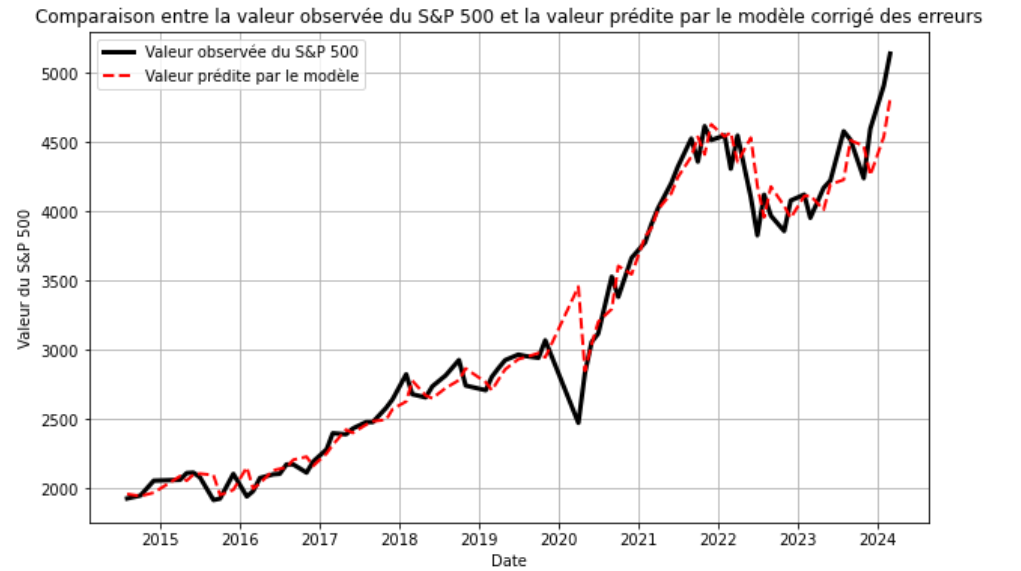
Indeed, an econometric study between 2014 and 2024 shows the existence of a correlation and a determination greater than 90%, even 95%. The link between the money supply and the S&P 500 is not only considerable, it is also particularly decisive. The chart below shows the price of the S&P 500 (black curve), and the level of the model based on the money supply and cyclical phenomena. The correspondence between the two curves is extremely strong. This suggests that the S&P 500 is determined to a large extent by the money supply, as well as the bullish or bearish excesses surrounding monetary expectations.
How to explain this phenomenon ?
The relationship between money supply and the S&P 500 can be explained in both the short term and the long term. In the short term, lower rates can encourage increased money supply growth. This first shock leads to an increase in liquidity on the money market, which mechanically favors stocks. In the long term, this relationship can only be valid if the increase in the money supply reflects an increase in business profits and/or economic growth.
Therefore, we can assume that the increase in the money supply leads to an increase in the wealth of agents (assets and liabilities). There is a wealth effect in the sense of Milton Friedman, that is to say that the increase in the anticipated wealth of agents leads to an increase in growth. Ultimately, company results and share values increase well in the long term. The relationship between money supply and the S&P 500 is viable.
The causes identified by Milton Friedman
The relationship between stock market indices and the money supply is a relationship identified for many decades in the world of finance and economics. In the 1980s, Milton Friedman put forward some elements of explanation for this empirical relationship.
” There inverse relationship between stock prices and money velocity (or the direct relationship between stock prices and the level of real money balances per unit of income) can be rationalized in three different ways:
- (1) A rise in stock prices means an increase in nominal wealth and generally, given the wider fluctuations in stock prices than in income, also in the ratio of wealth to income. The higher wealth-to-income ratio can be expected to be reflected in a higher money-to-income ratio or lower velocity.
- (2) An increase in stock prices reflects an increase in the expected return on risky assets relative to safe assets. Such a change in relative valuation need not necessarily be accompanied by any degree of reduction in risk aversion or increased risk preference. The resulting increase in risk could be offset by increasing the weight of relatively safe assets in an overall portfolio, for example, by reducing the weight of long-term bonds and increasing the weight of short-term fixed income securities more than l 'money.
- (3) A rise in stock prices can be interpreted to imply an increase in the dollar volume of financial transactions, thereby increasing the quantity of money demanded to facilitate transactions. »
Money and the Stock Market (1988) – Milton Friedman
Money supply (M2) and bitcoin (BTC)
The presence of a significant correlation between the S&P 500 and the price of bitcoin (BTC) therefore leads us to consider an influence of the money supply on bitcoin. A simple linear study allows us to identify, between 2015 and 2024, a determination of almost 72%. That is to say, more than 70% of the variability in the price of bitcoin is explained by the money supply. The chart below shows the money supply level and the S&P 500 level. We see pretty clearly from the adjustment shown here that major bitcoin highs are more or less boxed in by the money supply.
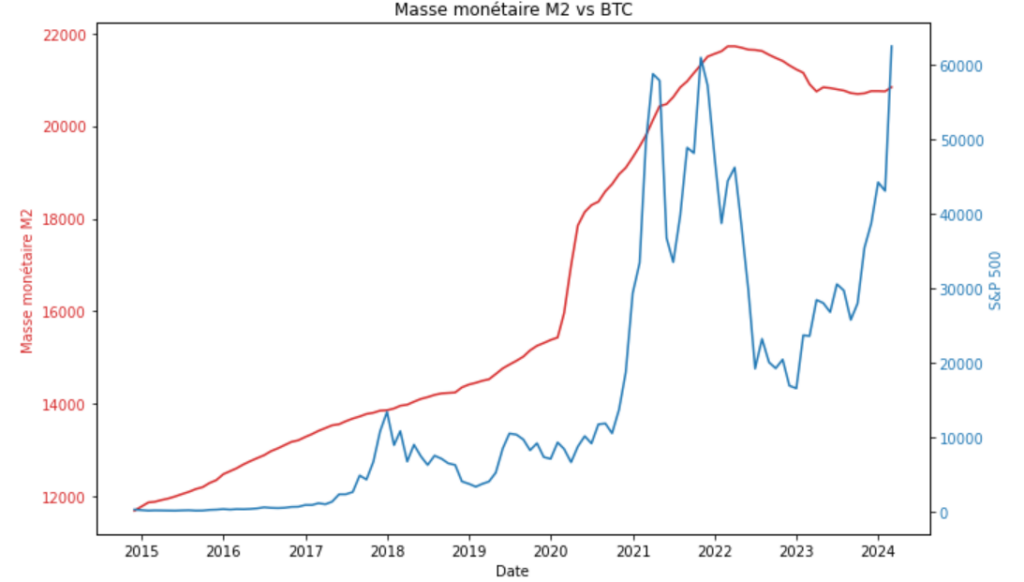
However, it may turn out that the price of bitcoin temporarily exceeds the level suggested by the money supply. This was the case at the beginning of 2024, before the correction of March and April 2024. Therefore, exceeding the level suggested by the money supply indicates that the markets are optimistic about the future growth rate of the money supply.
bitcoin and money supply: the model
The econometric estimation of the relationship between the money supply and bitcoin allows us to build a theoretical model. Indeed, such a model makes it possible to compare the price of bitcoin with the level of the money supply. However, the price of bitcoin is significantly more volatile than the money supply. As a result, bitcoin experiences bullish and bearish excess cycles around the level of the money supply. To improve the model, we correct the initial equation of this cyclical phenomenon. Finally, we obtain the following graph.
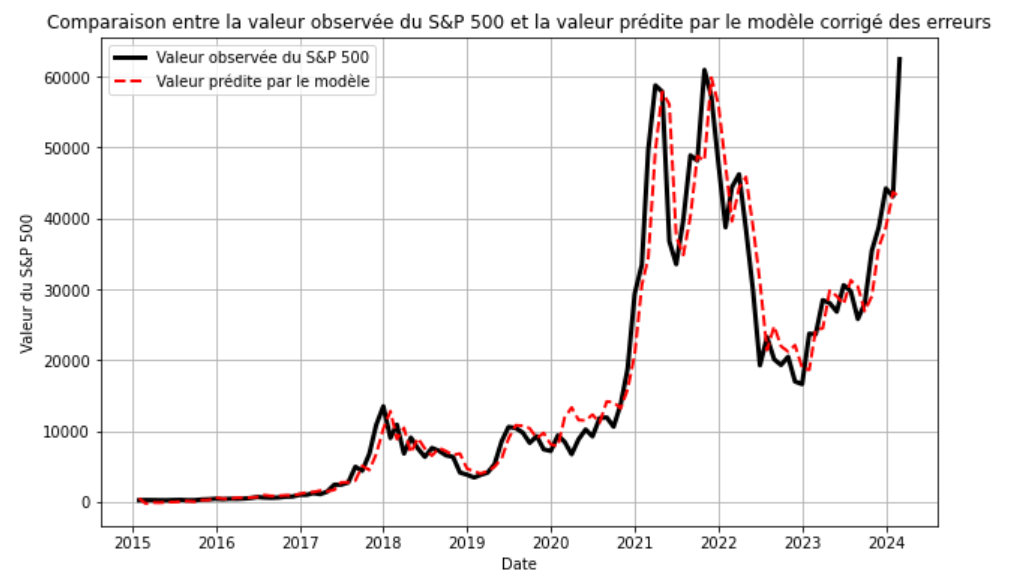
The graph above shows the price of bitcoin with the corrected model based on the money supply. The significant symmetry between the two curves suggests that the price of bitcoin has two major determinants:
- On the one hand, the level of the money supply which determines the “structural potentialities” devolution.
- On the other hand, the cyclicality of the bitcoin price which determines the different bullish and bearish phases, and their time of appearance.
Note that the coefficient of determination of such a model, although simple, exceeds 92%… The vast majority of the variability of bitcoin is thus covered by these two factors.
Bitcoin dependence: a paradox?
In its conception, bitcoin defined itself against the dictates of the single currency. It is therefore a priori paradoxical to observe such a dependence of bitcoin on the money supply. We see that a reduction in the money supply would likely result in a reduction in the upside potential of bitcoin. Consequently, the quantity of currency capable of being converted into bitcoin thus depends, and to a large extent, on the currency previously issued.
On the other hand, bitcoin's dependence on monetary prospects can be interpreted favorably. Indeed, an increase in the quantity of money in circulation leads to a mechanical devaluation of the value of other goods in the economy. Therefore, it seems consistent that bitcoin benefits from the rise in the increase in the quantity of money. We will also note that the quantity of money in circulation is strongly correlated with the level of public debt. A rather lax orientation of monetary and budgetary policies will therefore, in theory, ultimately be favorable to the stock market and cryptocurrencies.
(See also: Which assets best protect against inflation? – Tremplin.io).
In conclusion
The money supply appears to be the determining factor in the level of major global stock market indices. The influence of the money supply on the stock market has been a known relationship for many decades. A major explanation for the dependence between the money supply and the stock market would be a short-term liquidity effect. In the long term, it appears that the increase in the money supply also impacts economic conditions, ensuring the viability of this relationship.
Bitcoin thus has an increased dependence, although slightly less than that of the S&P 500, on the money supply. The money supply thus determines, and to a large extent, the bullish potential of bitcoin. This relationship can clearly call into question the independence of bitcoin, but a rather lax monetary and budgetary context generally benefits financial assets.
Maximize your Tremplin.io experience with our 'Read to Earn' program! For every article you read, earn points and access exclusive rewards. Sign up now and start earning benefits.
Click here to join 'Read to Earn' and turn your passion for crypto into rewards!