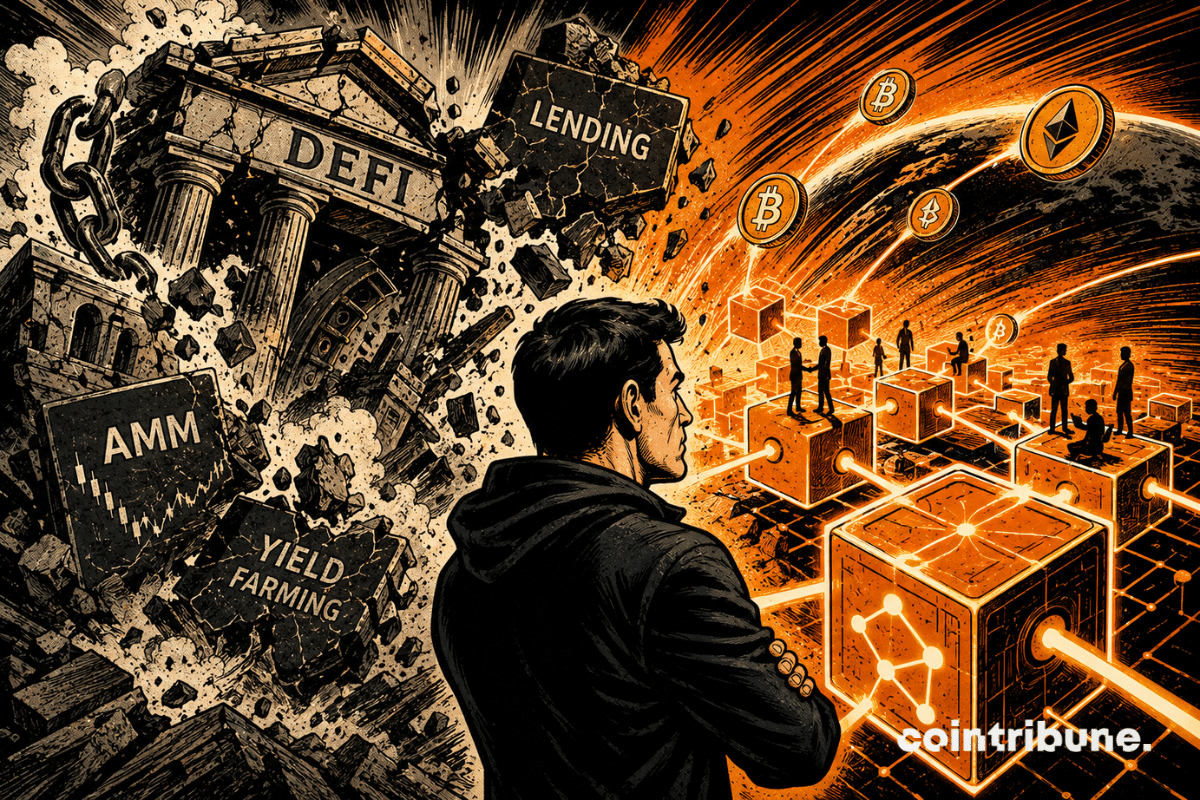
For Andre Cronje, much of what the industry continues to call “DeFi” is no longer really DeFi. The founder of Flying Tulip prefers to speak of “on-chain finance” when companies, teams or committees retain power to intervene over protocols. What really remains of the promise of decentralization?
In brief
- Andre Cronje reserves the term DeFi for decentralized, immutable and intermediary-free protocols.
- The total value locked in DeFi declined by 54.8% between October 5, 2025 and August 13, 2026, according to DefiLlama data.
- Security devices protect users, but they reintroduce actors capable of modifying or stopping a protocol.
For Andre Cronje, DeFi has lost its original meaning
DeFi has not disappeared from the discourse. Andre Cronje, however, believes that it has been reduced considerably. This criticism is consistent with the observation of very concentrated DeFi governance already documented by Tremplin.io. Andre Cronje goes even further: according to him, very few protocols still meet the strict definition of decentralized finance.
During an exchange broadcast today on X, he set three criteria: a protocol must be decentralized, immutable and without an intermediary. Immutability here means that its rules cannot be changed unilaterally after its launch. Gold, his intervention emphasizes the place taken by companies, risk teams and people who select assets.
I don’t think DeFi still exists outside of a few very small niches.
Cronje therefore proposes another name: on-chain finance, or open finance. Operations remain recorded on a blockchain and can be consulted publicly, without the entire organization being decentralized. A protocol can thus execute on-chain transactions while depending on a human group for its essential parameters.
Security puts middlemen back in the loop
The problem is that this partial centralization does not necessarily come from a desire to take power back from users.
It also responds to a very concrete reality: protocols sometimes manage several billion dollars and can be confronted with a breach, price manipulation or unexpected market behavior. At such times, waiting for a lengthy governance process can be costly.
The teams therefore added guardrails. Emergency pause, deposit limit, limitation of certain assets, modification of risk parameters: these tools can prevent an incident from escalating. When a flaw threatens to empty a protocol in a few minutes, being able to react quickly is not anecdotal.
But this safety net raises another question: who is in charge? If a handful of people can pause withdrawals, change a setting, or decide which assets are accepted, the absence of an intermediary becomes more difficult to defend.
The contested vote at Aave has already shown that the line between community, founders and operational teams remains difficult to draw.
The working document published by the ECB in March provides a measurable element. On Aave, MakerDAO, Ampleforth, and Uniswap, the top 100 addresses held over 80% of observed governance tokens. This study, however, is based on statements from November 2022 and May 2023. It mainly measures the concentration of governance, not alone the current technical decentralization of each protocol.
A market crisis which makes the debate more concrete
The discussion also takes place in a context that is much less favorable to DeFi. According to the history of DefiLlamathe total value locked in the protocols increased from $165.71 billion on October 5, 2025 to $74.96 billion on August 13, 2026.
In just over ten months, nearly $90.75 billion has left the sector, a drop of approximately 54.8%.
This drop obviously cannot be attributed to the centralization of protocols. On the other hand, a period of strong financial pressure makes the dilemma raised by Cronje much more visible.
When markets turn around or a protocol is threatened, teams often prioritize speed. A committee capable of modifying a parameter in a few minutes then becomes more efficient than a decentralized vote which can take several days.
Cronje’s statement remains a demanding definition, not proof that all innovation has disappeared. He himself recognizes the existence of small pockets of “real DeFi”. For the user, the right reflex now consists of looking beyond the label: who can modify the code, suspend withdrawals or change the parameters? Projects that claim to operate without intermediaries will have to show that this promise is also resistant to crises.
Maximize your Tremplin.io experience with our ‘Read to Earn’ program! For every article you read, earn points and access exclusive rewards. Sign up now and start earning benefits.