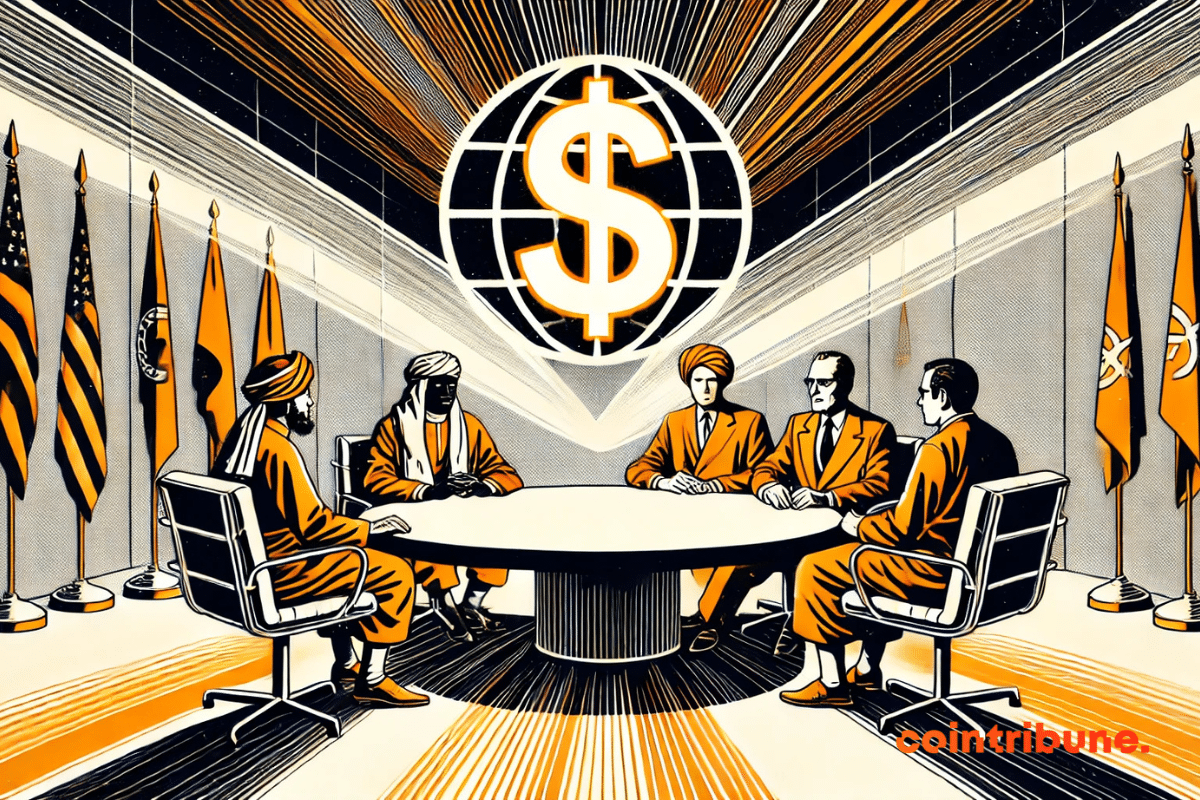
In a geopolitical context in full recomposition, two striking initiatives shake the hegemony of the dollar. Brazil and China are acting a strategic turn by favoring their national currencies for bilateral exchanges. For their part, Russia and Iran announce the construction of a new common motto to bypass Western sanctions. These distinct but convergent movements illustrate a shared will of the influential members of the BRICS: to build a financial system less dependent on the greenback and to assert monetary sovereignty in the face of external pressures.
Brazil – China: a partnership formalized for payments in local currencies
Brazil and China cross a new level in their common strategy of dedollarization. Thus, their already robust trade relations are now taking a more assertive monetary turn, with a desire to gradually switch to regulations in local coins. This approach was publicly confirmed by Brazilian official representatives.
Here are the essential facts:
- An official agreement between the two countries for the use of local currencies in bilateral exchanges: this decision aims to reduce dependence on the US dollar in cross -border payments.
- Transactions already underway in national currencies: Tatiana Rosito, secretary to the Brazilian Ministry of Finance, declared that “Trade in local coins is already underway, for example between Brazil and China”.
- The political support of the Lula government: Brazilian President Luiz Inácio Lula Da Silva actively campaigned for a gradual exit from the system dominated by the dollar, notably as the next BRICS summit approaches.
- No technical barrier on the Brazilian side: Rosito claims that “Brazil fully supports the use of local currencies” and “That no obstacle exists that on the Brazilian side”.
- A clear economic objective: to reduce transaction costs for members of the BRICS Alliance, and strengthen the financial autonomy of the Alliance. “The objective is to extend the use of local currencies in any way that will reduce costs”specifies Rosito.
- Structural support via the BRICS bank: the New Development Bank allows member countries to avoid the use of the dollar for the financing of projects, which strengthens the efficiency of this alternative monetary strategy.
This Sino-Brazilian rapprochement is therefore not a simple declaration of intention. It marks a concrete strategic inflection towards a regionalization of financial flows, carried by institutional means and a strong political alignment.
Russia – Iran: a new currency to get around the dollar?
In a more speculative, but no less symbolic register, Russia and Iran, two other powers aligned in increasing opposition to Western hegemony, claim to work on the creation of a new common currency within the BLICS block.
Kazem Jalali, Iranian ambassador to Russia, declared that :
The creation of a new single currency within the framework of the BRICS association is what Russia and Iran are working on to get rid of dependence on the dollar.
This announcement is part of a context of growing economic sanctions against the two countries, which seek alternatives to maintain the stability of their economies.
However, the details surrounding this project remain very vague. The Iranian ambassador did not provide deadline or specific mechanism or even concrete elements on the progress of this initiative.
Nothing allows us to say if this currency is in the active design phase or if it is only a displayed political intention. The lack of transparency fueling skepticism. Some observers do not exclude a communication operation more than a short -term viable project. Such vagueness contrasts with the more pragmatic advance of the Sino-Brazilian couple.
Beyond the project itself, this announcement, however, testifies to a desire to rethink the world economic order. If a common currency were to emerge at the level of the BRICS, an idea evoked in a recurring way for several years, it could rebatter the cards of global financial balances, provided that the political, technological and economic obstacles that mark out its creation. For the time being, this perspective remains uncertain.
Maximize your Cointribne experience with our 'Read to Earn' program! For each article you read, earn points and access exclusive rewards. Sign up now and start accumulating advantages.