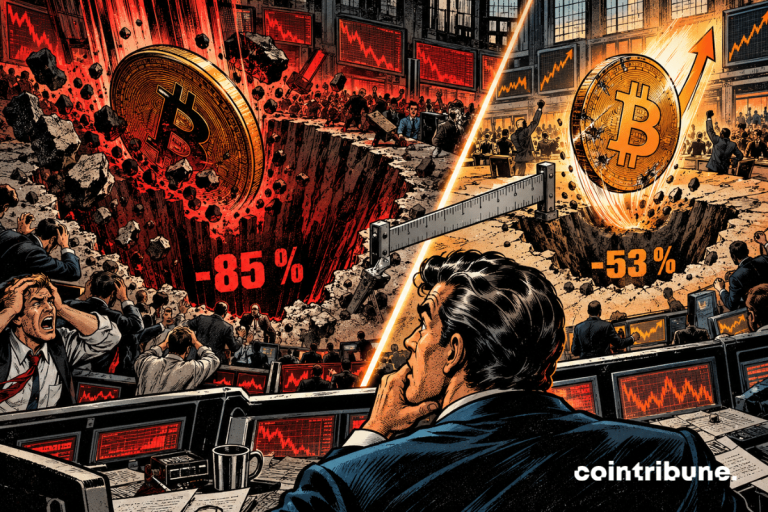
The crypto market is going through a zone of severe turbulence. In the first quarter of 2026, trading volumes on centralized platforms plummeted by 39%, confirming what many feared: a crypto winter well established. And the signals for the second quarter are hardly reassuring.

In brief
- Top 10 CEX volumes fall 39% in Q1 2026, from $4.5 trillion to $2.7 trillion.
- March 2026 records the lowest monthly volume since November 2023, at $800 billion.
- Bitcoin fell 22% over the quarter, even underperforming the Nasdaq and the S&P 500.
A dark quarter for centralized crypto platforms
In a report published Thursday April 17, 2026, CoinGecko sounds the alarm. The ten largest centralized exchanges in the world saw their spot volumes plummet by 39% between the fourth quarter of 2025 and the first quarter of 2026, from $4.5 trillion to just $2.7 trillion. A brutal decline, which spares no player in the sector.
And the worst came at the very end of the quarter. Mars indeed marked the lowest point: with only 800 billion dollars exchanged during the monththe market falls back to its level of November 2023. For comparison, January and February had still held the bar of 1,000 billion monthly. The deterioration therefore clearly accelerated at the end of the quarter.
HTX, formerly Huobi, displayed the worst performance among the large platforms: its volumes collapsed by 55% over the period, to $133.6 billion. However, the trend is general, no CEX is doing well.
The average daily volume also confirms this gloomy picture. At $117.8 billion over the quarter, it shows a decline of 27% compared to Q4 2025, a figure which illustrates, in itself, the extent of the slowdown.
Bitcoin under pressure, fragile rebound, powerful headwinds
Bitcoin has not weathered the storm. Over the quarter, it lost 22%, a remarkable underperformance when we know that the Nasdaq and the S&P 500 fell “only” by 7.1% and 4.8% respectively, their worst quarterly performances since 2022. The king of cryptos is thus doing less well than traditional equity markets, which weakens its safe-haven narrative.
Several factors explain this downward dynamic:
- Geopolitics: the American-Israeli strikes against Iran in February created a shock wave on the markets.
- Monetary policy: the appointment of Kevin Warsh as president of the American Federal Reserve suggests a tightening of financial conditions, bad news for risky assets.
- Market dynamics: after the all-time high of more than $126,000 reached six months ago, bitcoin is now in a prolonged correction phase.
And recent signals do not argue for an immediate rebound. According to CryptoQuant, BTC is facing key resistance around $76,800. In the space of a single hour, nearly 11,000 BTC were deposited on the exchanges, a level not seen since December 2025, thus revealing increasing selling pressure.
At the same time, the whales, these large holders, seem to be taking advantage of the rebound to lighten their positions. Their share in deposit flows thus increased from less than 10% to more than 40% in a few days.
The crypto market is entering a decisive phase. If the $67,600 zone were to break down, a deeper correction would be considered. In this context of macroeconomic uncertainty and falling volumes, caution remains in order. Will spring be one of rebound, or that of a stretching winter?
Maximize your Tremplin.io experience with our 'Read to Earn' program! For every article you read, earn points and access exclusive rewards. Sign up now and start earning benefits.