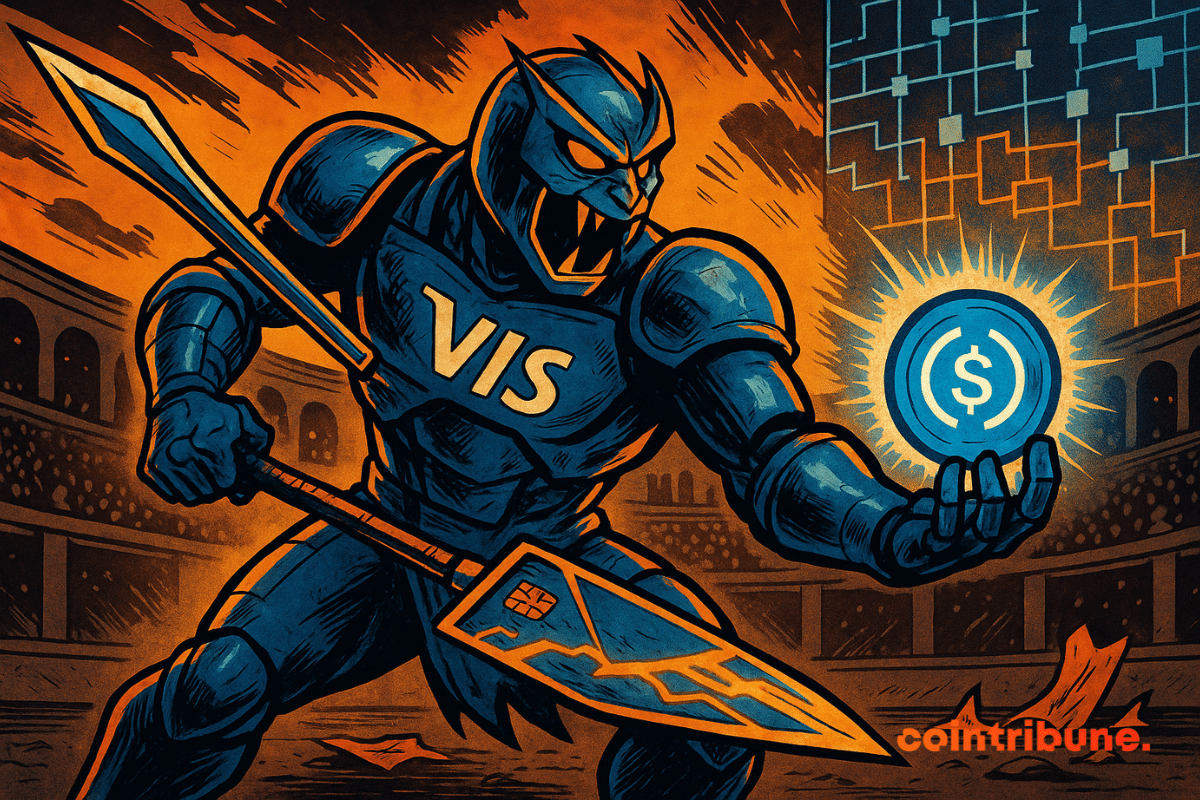
As the borders fade between traditional finance and blockchain innovation, Visa does not play spectators. On the contrary. The historical payment giant has just expanded its crypto arsenal with an audacity revealing its ambitions. Stablecoins, Blockchain networks, rupture strategy: Visa takes out the fangs in a more competitive arena than ever.
In short
- Visa accelerates in the crypto by integrating new stablecoins and blockchains into its payment network.
- Faced with the rise of stablecoins, the giant no longer wants to follow, but directing the financial transition.
- Between regulation, innovation and rivalry, Visa is positioned as a key player in the future of digital payments.
Reinforced offer: a clear response to institutional pressure
Banks, technological giants and stablecoins issuers compete to dominate payments. Visa, it advances with precision. The company has just announced a strategic partnership with Tangem. It also widens the list of supported stablecoins. Among them: the Global Dollar, the USD Paypal (Pyusd) and the Euro Coin. In parallel, Visa incorporates two new blockchains into its payment infrastructure: Stellar and Avalanche.
These additions enrich an already solid list, including Ethereum, Solana and the existing support at the USDC, the stablecoin emitted by Circle. From now on, users can send, receive or convert stablecoins to fiduciary currency via integrated networks, while benefiting from the fluidity and speed of the regulations operated on the blockchain. A silent modernization, but deeply strategic.
Visa no longer adapts, it takes control
The rise of stablecoins is no longer a simple hypothesis: it is indeed in progress. The recent signature of the Genius bill in the United States has sent a strong signal to the entire ecosystem.
The regulatory framework takes shape, and opportunities open for actors ready to rush into it. In this context, Visa accelerates the rateby expanding its stablecoins offer in order to respond to the growing pressure of the institutional market.
And Visa is not alone on this ground. Mastercard, its lifelong rival, has already tokenized almost 30 % of its transactions and multiplies partnerships with companies in the crypto sector. Even trade giants like Walmart and Amazon are now interested in it, seduced by the promise of almost instant and much less expensive cross -border payments.
But the real threat could well come from the inside: the banks themselves. Institutions like Bank of America and JPMorgan, which has adopted crypto as a guarantee, actively develop their own payment infrastructure based on blockchain. JPMorgan even went so far as to connect Coinbase to his Chase accounts, marking a decisive turning point towards a programmable and decentralized finance.
Maximize your Cointribne experience with our 'Read to Earn' program! For each article you read, earn points and access exclusive rewards. Sign up now and start accumulating advantages.