
The ECB is taking a decisive step forward in the realization of its crypto project. On July 14, 2026, it announced the selection of 36 payment service providers to participate in the digital euro pilot. Decryption: the CBDC project is moving from the design phase to the operational test phase. We’ll tell you more in the next paragraphs!

In brief
- The ECB has selected 36 payment service providers to test its digital euro.
- The pilot will begin in the second half of 2027 for twelve months.
- This step could influence the balance between stablecoins, banks and the crypto ecosystem.
A list of varied models between banks and crypto players
Since the start of the year, the ECB has stepped up its efforts to carry out its crypto project. In June, for example, it launched a banking test in Italy. In March 2026, it opens a call for expressions of interest with a view to the operational phase of its CBDC project. Result: more than 50 applications submitted.
In this sense, ECB board member and head of the high-level working group on the digital euro Piero Cipollone said:
The strong market interest in this crypto project shows that the private sector is ready to actively engage and rapidly advance the digital euro project in order to strengthen the European payments landscape.
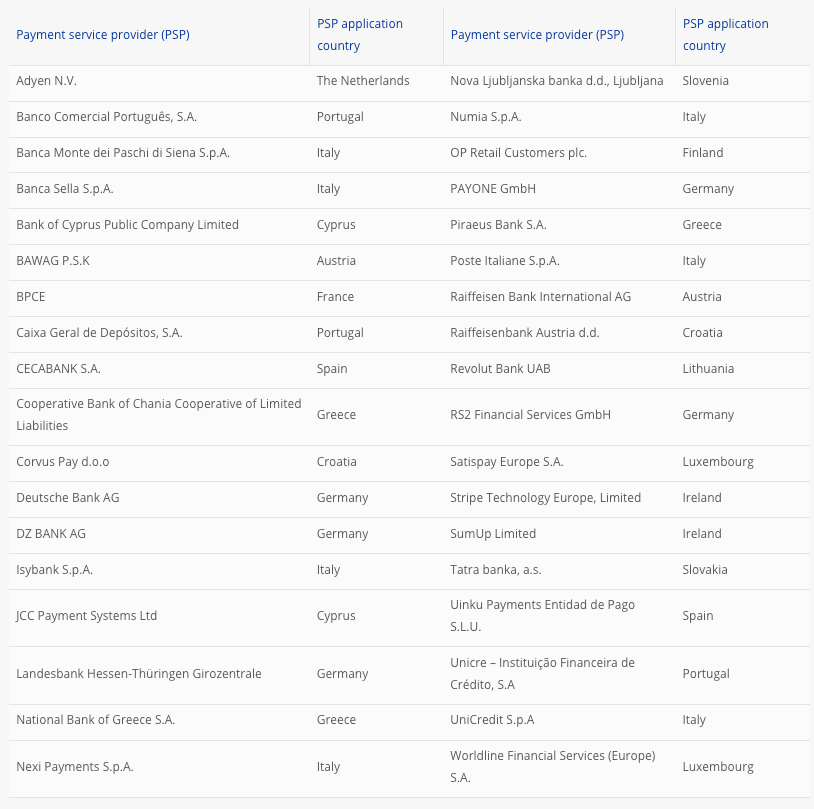
There list of 36 service providers selected includes traditional banks like Deutsche Bank and Revolut. But we also find UniCredit, BPCE, Stripe, Adyen, SumUp and Worldline. Italy comes first with seven participants, including:
- Poste Italiane;
- Nexi Payments;
- Banca Sella;
- Banca Monte dei Paschi di Siena;
- Isybank;
- Numia.
It is followed by Germany with five players, then Portugal and Greece with three participants each.
According to the official press release published by the ECB on July 14, service providers come in two distinct profiles: distributors and acquirers. The first will give staff of the ECB and national central banks access to digital euro beta services. The latter will allow selected merchants to accept digital euro payments. Several actors will combine both roles.
A single strategic ambition: strengthening European monetary sovereignty
One of the drivers of this CBDC is the rise in power of dollar-backed crypto stablecoins. We mainly refer to Tether’s USDT and Circle’s USDC. The ECB indeed considers their growing adoption as a threat to European monetary autonomy. A risk often mentioned publicly by President Christine Lagarde. According to her, these stablecoins could promote a form of “digital dollarization” of the continent.
In this context, the digital euro therefore presents itself as Europe’s sovereign response to the expansion of private crypto in everyday payments. The reasoning is simple: if European citizens and traders massively turn to dollar-denominated crypto stablecoins for their digital transactions, the ECB would lose part of its ability to steer the monetary policy of the euro zone.
The CBDC thus aims to offer a European alternative, backed by central bank currency. It would be able to directly compete with the uses that crypto has widely popularized for several years (notably in cross-border payments and online commerce).
CBDC versus crypto: the European trajectory contrasts with that adopted by the United States
At the beginning of July 2026, an American law came into force prohibiting the Fed from issuing or creating a digital dollar until December 31, 2030. A decision welcomed not only by supporters of crypto and decentralized currencies, but also by certain defenders of individual freedoms. The latter fear that a CBDC would allow increased surveillance of transactions or arbitrary blocking of access to money by a central authority.
Conversely, Europe is choosing to move forward: a committee of the European Parliament last month validated progress on the legislative framework governing the CBDCwhile the ECB enters the testing phase.
This strategic divergence illustrates two opposing visions: regulatory restraint in the United States in the face of acceleration in the euro zone. Each reflects distinct political and monetary priorities.
What are the next steps for the crypto and banking ecosystem?
THE pilot of this CBDC will begin in the second half of 2027 for a period of 12 months. This phase will involve the ECB as well as 19 national central banks in the Eurozone, including:
- in Germany;
- In France ;
- in Italy;
- in Spain;
- in the Netherlands.
It will test person-to-person payments (online and offline) as well as payments at physical merchants and e-commerce, with the participation of central bank staff and partner merchants such as cafeterias and restaurants.
There beta version used will remain close to the design provided for by the European legislation under discussion, but without legal value during this phase.
The final decision on the issuance of this digital euro will depend both on the adoption of the European legislative framework and a vote by the Governing Council of the ECB. A potential issue is planned for 2029. This still leaves time for the crypto and banking ecosystem to adapt to this new monetary situation.
In any case, the ECB has just transformed its CBDC project into an operational reality. If the tests and the legislative framework are conclusive, the digital euro could usher in a new stage where crypto, public currencies and stablecoins will coexist sustainably. File to follow…
Maximize your Tremplin.io experience with our ‘Read to Earn’ program! For every article you read, earn points and access exclusive rewards. Sign up now and start earning benefits.