
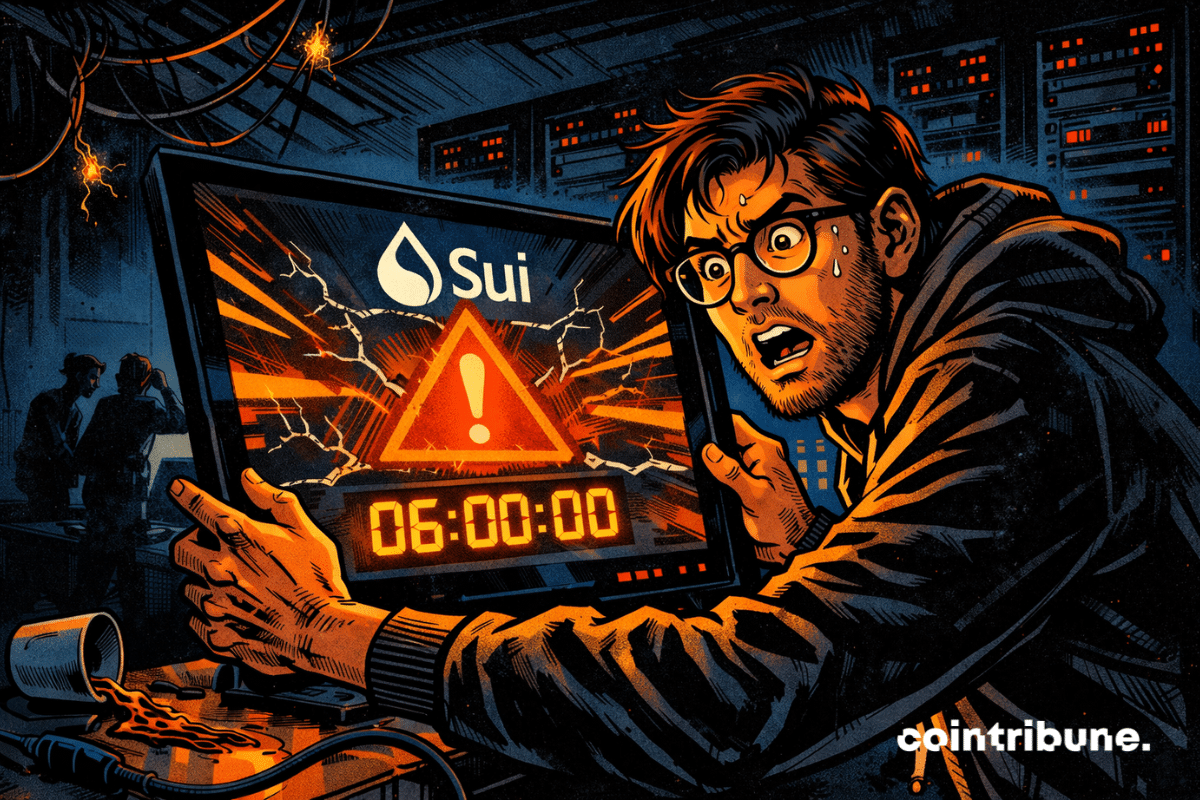
The Sui blockchain suffered a major outage lasting nearly six hours, completely halting transactions and tying up over $1 billion in on-chain value. The incident, confirmed by the Sui Foundation, rekindles the debate on the resilience of so-called “high-speed” blockchains, in a crypto context where technical reliability becomes a key criterion.
In brief
- The Sui crypto blockchain was down for almost six hours, blocking all transactions.
- The Sui Foundation confirmed a consensus breakdown without specifying the exact origin.
- The SUI token remained stable, with a brief rise after the network returned online.
A sudden breakdown that stops the network
On Wednesday, the Sui Foundation confirmed a consensus breakdown on the layer 1 blockchain. Immediate result: no more transactions can be validated. The network, although presented as one of the fastest in the crypto sector, finds itself frozen.
The foundation says it identified the problem around 2:52 p.m. UTC. The main developers are mobilized immediately. At 3:24 p.m. UTC, the message is clear: a correction is in progress, but no precise deadline has been communicated. This lack of visibility reminds us that, even on modern infrastructures, incidents remain difficult to anticipate.
The network will finally be restored at 8:44 p.m. UTC. That's 5 hours and 52 minutes of almost total interruption. An eternity on the scale of crypto, where protocols are supposed to work without pause.
Few explanations, many questions
If Sui is now “fully operational”, one intriguing point: the exact cause of the failure has not been detailed. The Foundation mentions a consensus problem, without specifying whether it is a software bug, poor coordination of validators or a more complex scenario.
This minimal communication leaves room for doubt. More than a billion dollars was blocked on the chain at the time of the incident. For DeFi users and protocols, the total shutdown poses a trust issue. In crypto, technical transparency is almost as important as speed.
This silence contrasts with the practices of other ecosystems, which sometimes publish detailed post-mortems after this type of event.
A precedent which weighs on the image of Sui
This is not the first time Sui has encountered this kind of difficulty. By November 2024, the network had already experienced a significant outage. This week's therefore becomes the second major outage since the official launch of the blockchain in May 2023.
The comparison with Solana is obvious. Solana has long been criticized for her repeated interruptions. But the network has not experienced a major outage on a global scale for more than 18 months. Emergency updates and better coordination of validators have clearly improved the situation.
For Sui, the challenge is similar: to prove that these incidents remain exceptional and that they can be avoided in the future.
The crypto market remains surprisingly calm
Notably, the market reaction remained measured. The SUI token briefly rose around 4% after the network recovery announcement, before stabilizing around $1.84, according to CoinGecko.
This stability suggests that investors have not panicked. Either because they consider the incident to be under control, or because the crypto market has become accustomed to this type of technical turbulence.
There remains a simple reality: in a sector where competition between blockchains is fierce, each failure leaves a trace. For Sui, the next challenge will be less technical than narrative: convincing that the promise of performance does not come at the expense of reliability.
Maximize your Tremplin.io experience with our 'Read to Earn' program! For every article you read, earn points and access exclusive rewards. Sign up now and start earning benefits.


