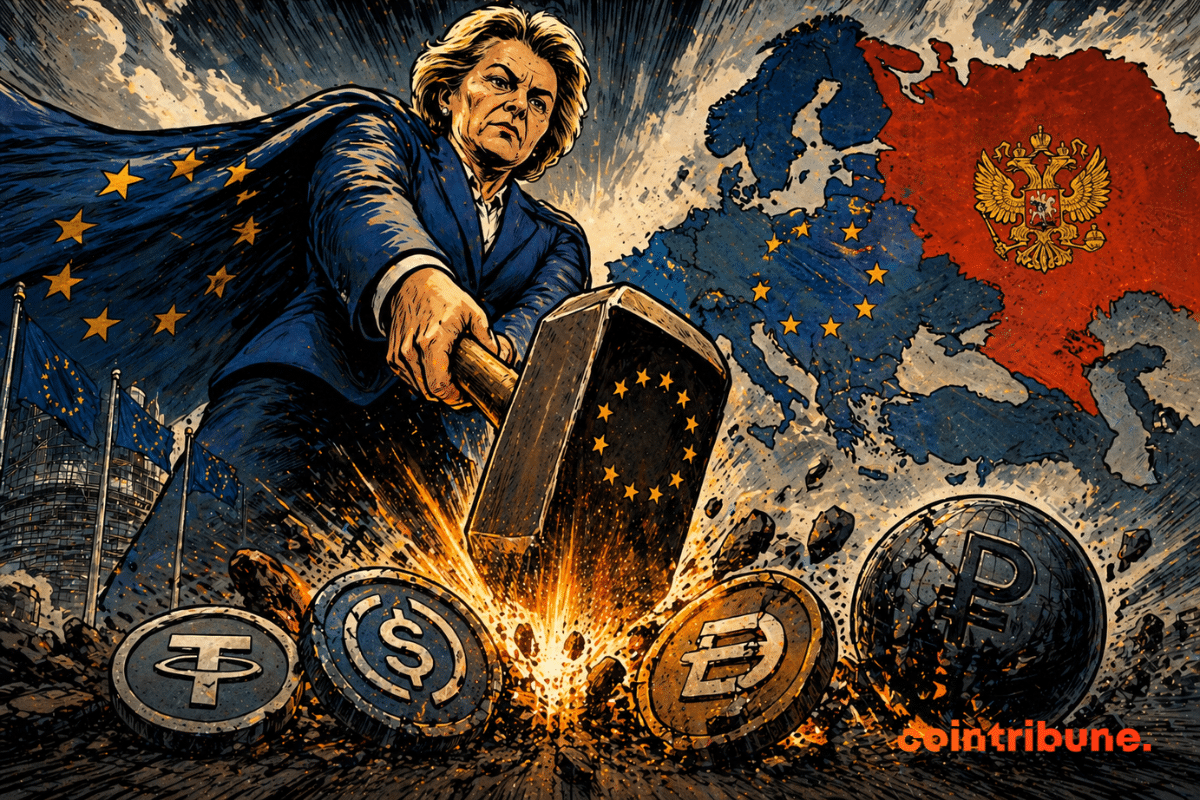
Europe is taking advantage of a moment of respite between Washington and Tehran to put another burning issue back on the table. While eyes turn elsewhere, Russia continues its strikes in Ukraine unabated. The conflict never stopped, it just receded from media attention. Brussels, for its part, does not look away and decides to activate a new lever: crypto.
In brief
- Europe prohibits exchanges with Russian crypto providers and decentralized platforms facilitating financial circumvention.
- The stablecoin RUBx and the digital ruble become explicitly banned by the new European package.
- The system also targets banks, ghost fleet, energy and foreign actors supporting Moscow indirectly financially.
- Brussels is activating its anti-circumvention tool for the first time against certain targeted relays outside Russia.
Europe blocks Russian digital financial circuits
Indeed, Europe is changing gear and directly targeting the crypto infrastructures used by Russia. THE 20th sanctions package imposes a complete ban on interaction with Russian crypto services. This measure also includes decentralized platforms (DEX) capable of facilitating exchanges outside the regulatory radar. Brussels believes that Russia is increasingly relying on crypto to maintain its international transactions.
This development worries the European authorities, who want to cut off these alternative flows which have become strategic. The objective is simple: to prevent any attempt to circumvent traditional financial sanctions. The European Commission clearly assumes this political pressure in its official communication.
This package puts additional pressure on Russia to enter into negotiations and to do so on terms acceptable to Ukraine. Each additional day of Russian attacks on Ukrainian civilian infrastructure is a day of suffering for the Ukrainian people.
Source: European Commission, official press release of the 20th sanctions package
Thus, crypto becomes a direct lever in Europe's strategy.
Stablecoins and digital ruble: Brussels strikes at the heart of flows
Then, Europe is no longer limited to crypto exchanges, it is now targeting the monetary tools themselves. Ruble-pegged stablecoins, like RUBx, are banned across the European Union. The digital ruble, still in development, is also subject to an anticipated ban.
This approach marks a clear break in European crypto regulation, now oriented towards pure blocking. Brussels no longer only wants to monitor flows, but to prevent their existence in certain cases. At the same time, Europe is extending its action to indirectly involved financial players from third countries.
Institutions located in Kyrgyzstan, Laos and Azerbaijan are targeted for their role in these circuits. The pressure therefore goes well beyond Russian borders to affect the entire connected crypto ecosystem.
As Russia escalates its aggression, we are stepping up our support for the brave nation of Ukraine, enabling it to defend itself and putting pressure on the Russian war economy.
Ursula von der Leyen, source:
Blockchain becomes a new economic battlefield
Finally, this crypto offensive is part of a much larger system orchestrated by Europe. The sanctions package now includes 70 Russian banks excluded from the European market. At the same time, 632 ships linked to the ghost fleet are also targeted.
The energy sector is not spared, with 36 additional entities added to the sanctions list. Europe is also introducing 120 new individual measures targeting Russian economic and political actors. For the first time, an anti-circumvention tool is activated to block indirect flows.
The figures which illustrate European pressure
- 20th sanctions package adopted by Europe in April 2026;
- 70 Russian banks excluded from the European market;
- 632 ships linked to the ghost fleet sanctioned;
- 120 individuals and entities added to sanctions;
- Complete ban on Russian crypto services in the European Union.
Crypto is no longer a simple financial tool, it is becoming a central piece in the economic war.
In this context, even in Russia, full control of crypto remains out of reach. Around $129 billion escapes local authorities each year. This massive leak shows a clear limit of restrictive policies. Despite sanctions and bans, crypto retains a capacity for escape that is difficult to contain in the long term.
Maximize your Tremplin.io experience with our 'Read to Earn' program! For every article you read, earn points and access exclusive rewards. Sign up now and start earning benefits.