
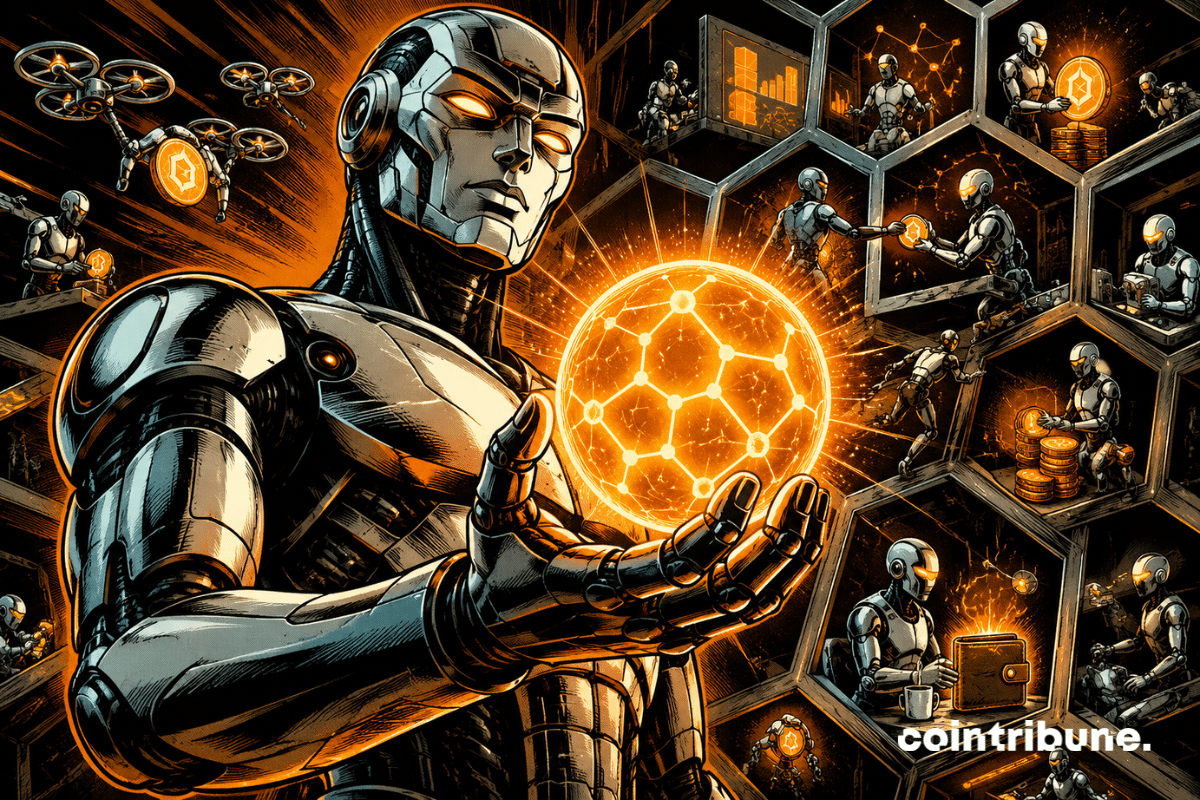
Artificial intelligence no longer just responds, writes or analyzes. She is also starting to pay. And in this new economy driven by autonomous agents, crypto is emerging as an almost natural infrastructure. According to Keyrock, these agents settled more than $73 million on 176 million transactions between May 2025 and April 2026. A signal that is still discreet, but impossible to ignore.
In brief
- Crypto is becoming a key infrastructure for autonomous AI agents.
- Stablecoins facilitate microtransactions between machines.
- But USDC dominance creates a risk of systemic dependence.
AI agents open a new front for crypto payments
The rise of autonomous agents confirms an already visible trend: stablecoins are becoming a natural payment layer for AI. It's no longer just a laboratory experiment. It is an economic mechanism that takes shape, transaction after transaction.
The figure may seem modest compared to the gigantic volumes of Visa, Mastercard or the traditional banking market. However, he says something else. It shows that a machine economy begins to function with its own needs, its own rhythms and its own constraints.
An AI agent that purchases an API call, reserves computing power, or pays for a microservice does not need a traditional credit card. It needs rapid, programmable and inexpensive settlement. This is precisely where crypto finds very concrete use.
The novelty is therefore not only technological. It is economical. Autonomous agents do not consume like humans. They are multiplying microtransactions, often less than a dollar. In this tiny area, but massive in volume, traditional payment systems become cumbersome, expensive and sometimes absurd.
Stablecoins become practical machine currency
Keyrock emphasizes that stablecoins have established themselves as the default settlement layer for these machine-to-machine payments. The reason is simple: they allow very small amounts to be processed without overwhelming the transaction with fees. A payment of a few cents makes no sense if the fixed cost is already approaching 30 cents.
This is where USDC takes a dramatic lead. According to the data relayed, more than 98% of settlements made by AI agents were in USDC, Circle's stablecoin. It's no longer just a technical preference. It's almost a structural dependency.
This domination validates the use of stablecoins in the automated economy. But it also reveals a weakness. If a large part of the ecosystem relies on a single issuer, the risk becomes systemic. A regulatory problem, technical interruption or loss of confidence around USDC could disrupt an entire part of this new economy.
Behind innovation, an infrastructure battle is brewing
This market is not yet huge. But large companies are already looking at it as a future economic highway. Coinbase, Stripe, Google, Visa and others are developing or exploring infrastructure that can handle autonomous software-to-software payments. The race is not just about AI agents. It concerns the payment layer that will keep them alive.
In this logic, crypto no longer only seeks to replace traditional finance. It becomes a technical building block for a more automated Internet. AI agents can interact with Web3 protocols, launch tokens, execute transactions, pay for services and manage wallets according to predefined rules.
But this development poses a delicate question: who is responsible when an autonomous agent pays, trades or interacts with a protocol? The user? The developer? The platform? The smart contract? The more agents gain autonomy, the more the boundary between tool, economic actor and operational risk will become blurred.
However, adoption will not be about speed or cost alone. It will also depend on security, compliance and trust. Recent work on the vulnerabilities of autonomous AI agents reminds us that these systems can become powerful, but also exposed to manipulations that are difficult to anticipate.
Maximize your Tremplin.io experience with our 'Read to Earn' program! For every article you read, earn points and access exclusive rewards. Sign up now and start earning benefits.


