
The use of digital assets is entering a more mixed phase, after several quarters marked by dynamic global activity. According to a study by TRM Labs, the adoption of cryptocurrencies slowed in the first quarter of 2026, especially in developed economies. This development shows a more selective crypto market, where local needs, digital payments, economic conditions and geopolitical tensions further influence user behaviors.

In brief
- Cryptocurrency adoption slowed in the first quarter of 2026, especially in developed economies.
- Global retail volumes reached $979 billion, down 11% year-on-year.
- Stablecoins still support uses in several emerging markets, particularly for payments and transfers.
- Regulations, geopolitical tensions and investor caution are making the crypto market more selective.
Crypto market slows down in developed economies
According to the latest global index from TRM Labs, retail activity linked to cryptocurrencies declined in the first quarter of 2026. Global volumes reached $979 billion, a drop of 11% compared to the same period in 2025. This decline also confirms a second consecutive quarter of contraction.
Bitcoin also fell about 22% over the quarter, to around $68,000. A movement which, according to the report itself, reflects its increased sensitivity to macroeconomic conditions and global phases of risk aversion.
However, the major economies remain at the center of the market. The United States still dominates the ranking with $212 billion in activity. They are ahead of South Korea, which totals 69 billion dollars, then Russia with 48 billion. India follows with 46 billion, while Turkey reaches 40 billion.
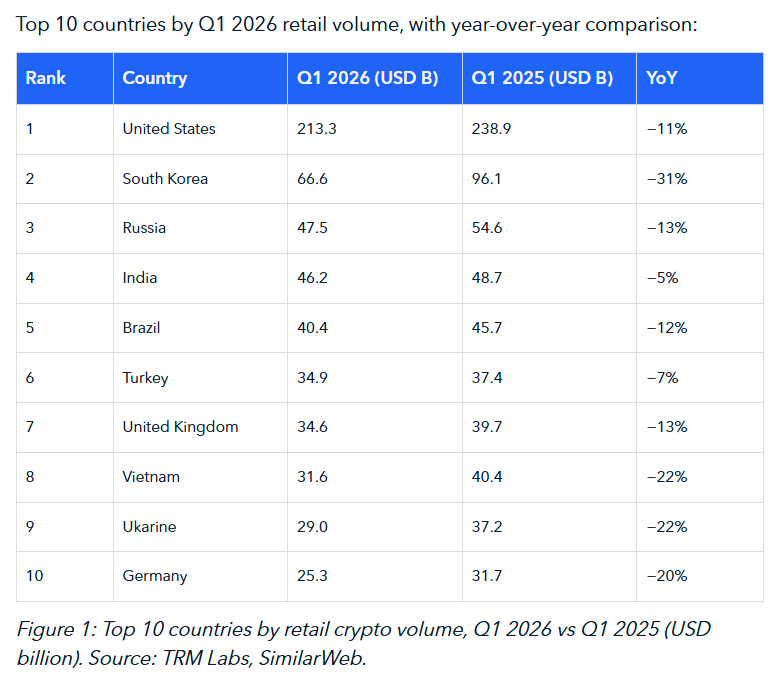
However, the crypto slowdown appears more marked in developed countries. L'analysis indicates that these markets already have solid financial systems, varied investment products and more structured rules. Therefore, users can more easily switch to stocks, bonds or precious metals.
South Korea illustrates this trend with an annual decline of 28%. Germany also shows a considerable decline, estimated at 25%. These contractions show weaker demand for risky assets. They also reflect increased caution among individuals in the face of volatile markets.
Stablecoins and digital payments support uses
The slowdown does not affect all regions with the same intensity. In several emerging economies, adoption remains more resilient. India recorded a limited decline of 6%, placing it among the strongest markets of the quarter. Turkey, for its part, grew by 7% over one year and entered the top 10 in the world.
This difference mainly comes from uses. In these countries, crypto is not only used to speculate on prices. It also helps transfer money, store value and facilitate certain payments. Stablecoins therefore play a central role in this dynamic.
These digital assets, often indexed to the dollar or the euro, meet concrete needs. They enable faster exchanges between individuals and support cross-border payments. In some markets, they also serve as an alternative when the local currency remains unstable.
Venezuela offers a notable example. THE country ranks 17th in the world with $17.9 billion in activity. Local usage is mostly focused on stablecoins, rather than speculative trading. P2P payments, particularly via Binance, occupy a notable place in these exchanges.
Euro-backed stablecoins are also making progress in the crypto landscape. Their use increased twelvefold between January 2025 and March 2026. They now reach $777 million in monthly volume. This development shows a search for more diversified liquidity, beyond just assets linked to the dollar.
Geopolitical risks and regulation are redrawing the map of crypto adoption
The differences between regions can also be explained by geopolitical tensions. Sanctions, conflicts and local restrictions may limit access to the platforms. They therefore influence uses, especially in countries subject to strong economic pressure.
Iran illustrates this fragility. The use of cryptocurrencies in Iran slowed down in the first quarter of 2026, due to sanctions and difficulties affecting certain platforms such as Nobitex following American and Israeli strikes, as well as sanctions imposed on Zedcex and Zedxion. This situation shows that adoption remains sensitive to political decisions.
In developed economies, regulation also weighs on the market. A clearer framework can reassure institutions, but it can slow down certain retail uses. The crypto sector is therefore moving towards a more regulated and more selective phase. Thus, what happens next will depend on economic conditions, local rules and the real needs of users. Uses linked to payments and stablecoins could remain stronger in emerging markets.
Maximize your Tremplin.io experience with our 'Read to Earn' program! For every article you read, earn points and access exclusive rewards. Sign up now and start earning benefits.