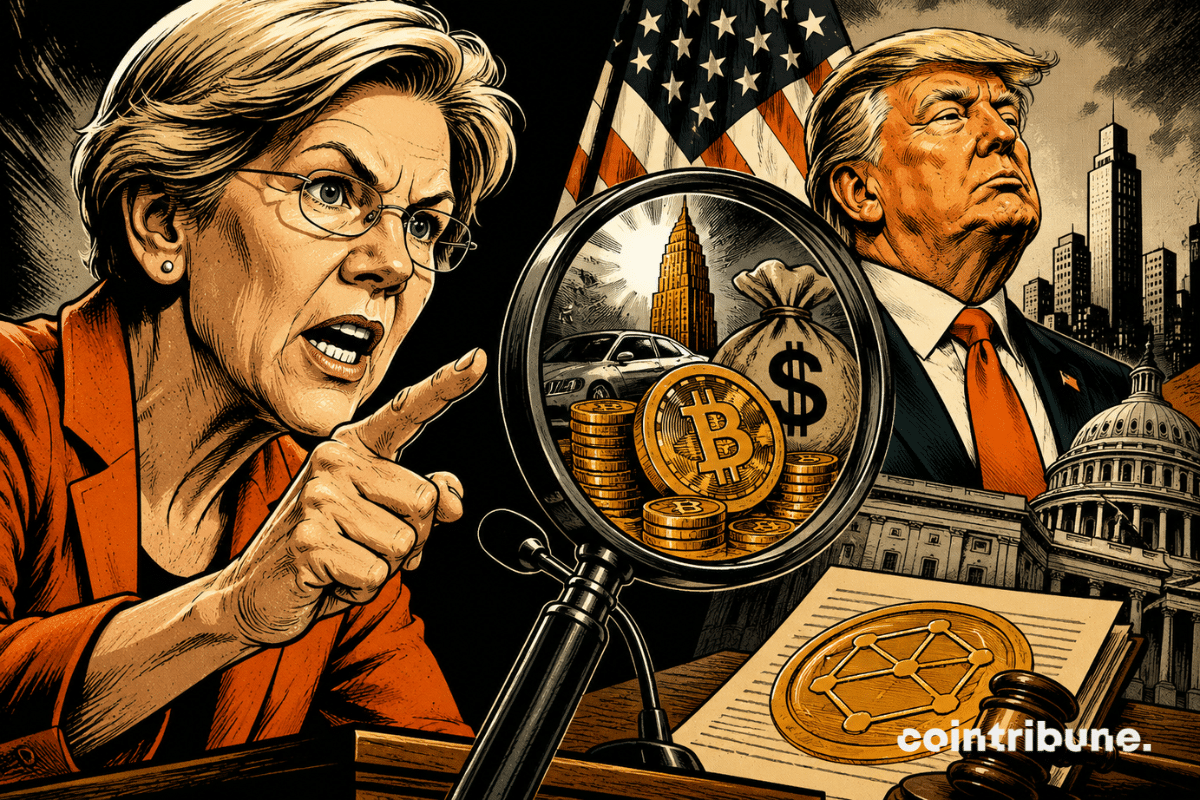
Senator Elizabeth Warren asked Donald Trump to publish his crypto-related income before the legal deadline, after revealing gains of $1.4 billion in 2025. The request comes a few days before a crucial Senate vote on a market-structuring law. Will regulatory democracy hold up against the White House’s crypto empire?
In brief
- Donald Trump reported $1.4 billion in crypto revenue in 2025, via his memecoin Official Trump (TRUMP) and World Liberty Financial.
- Elizabeth Warren is calling for a voluntary report covering the period from January 1 to July 15, 2026, by July 23.
- The Senate must pass the CLARITY Act before its August recess; many Democrats condition their support on ethical safeguards.
Washington faces presidential crypto revenue dilemma
We have already seen American presidents criticized for their family affairs, but rarely a conflict of interest so directly linked to a market in the midst of legislation.
Elizabeth Warren, critical voice of Democrats on the risks of digital assets, has taken a new step by demanding early transparency from Donald Trump. The senator relies on the in-depth article that we devoted to the CLARITY law and its ethical blind spots to frame her request.
In a letter sent Thursday, she asked the president to voluntarily publish a report on his crypto-related earnings between January 1 and July 15, 2026. The initiative follows the 2025 declaration, filed on June 30 under the mandate of the US Office of Government Ethics, which revealed $1.4 billion in earnings from crypto projects, including the Official Trump memecoin (TRUMP) and the family company World Liberty Financial.
Warren warns that this raises a fundamental question about whether elected officials and their relatives are profiting from the industry, just as the Senate is debating legislation that could drive up the value of these assets.
The president was not required to file his 2026 annual report until May 2027, but the senator asked him to do so in advance, by July 23, while the upper house considers the Digital Asset Market Clarity Act. His letter sums up the fear:
Without adequate safeguards, [CLARITY] would supercharge the president’s major conflicts of interest and almost certainly increase the value of his and his family’s crypto assets.
The CLARITY Act at the heart of a partisan battle
The bill does not just spark debate: it crystallizes an open divide between Republicans and Democrats on ethics. According to Senate Majority Leader John Thune, the chamber is expected to vote on the bill before its August work break.
But many Democrats have publicly stated that they would not support any legislation without clear ethics provisions, with some directly citing Donald Trump’s potential conflicts of interest.
Cointelegraph contacted the White House and Warren’s office for reaction, with no immediate response. During an interview on July 2, the president for his part affirmed that there was “nothing illegal” and “nothing wrong” in profiting from his crypto investments in office.
On Friday, the Digital Assets Subcommittee of the House Financial Services Committee held a field hearing in New York on the CLARITY Act. The text, already adopted by the House in July 2025, will have to return to it if it passes the Senate with 60 votes.
Rep. French Hill, who chairs the full committee and was in attendance Friday, called CLARITY a “bipartisan priority” of Congress. However, no Democratic representative appeared present at the hearing, a sign of an opposition which is not resolved on the question of safeguards.
Ethical safeguards, the breaking point of the text
Financial transparency is not just an administrative formality: it becomes the political condition for the adoption of the law. The CLARITY Act aims to clarify the division of powers between the SEC and the CFTC over the crypto markets, a multibillion-dollar issue.
For Democrats, authorizing a framework without regulating the personal interests of the executive would amount to legitimizing a structural conflict of interest. Warren’s statement is part of a line of warnings already formulated on the text, when three Democratic senators denounced the absence of safeguards.
On the executive side, the strategy consists of presenting crypto revenues as a lawful private activity, which the president summarized on July 2 by ruling out any illegality. The outcome of next week’s vote will depend less on the technique of the text than on the ability of the Senate to impose, or not, an ethical barrier on a president who has become a major player in the crypto market.
In short, the confrontation goes beyond the simple disclosure of figures: it pits a demand for democratic transparency against the rise in power of a president invested in digital assets.
Three converging factors will weigh on the future: the voluntary report that Trump could publish before July 23, the Senate vote before August, and Democratic intransigence on ethical safeguards. The CLARITY Act, designed to structure the market, risks above all becoming a revealer of the conflicts of interest of the first pro-crypto administration in American history.
Maximize your Tremplin.io experience with our ‘Read to Earn’ program! For every article you read, earn points and access exclusive rewards. Sign up now and start earning benefits.