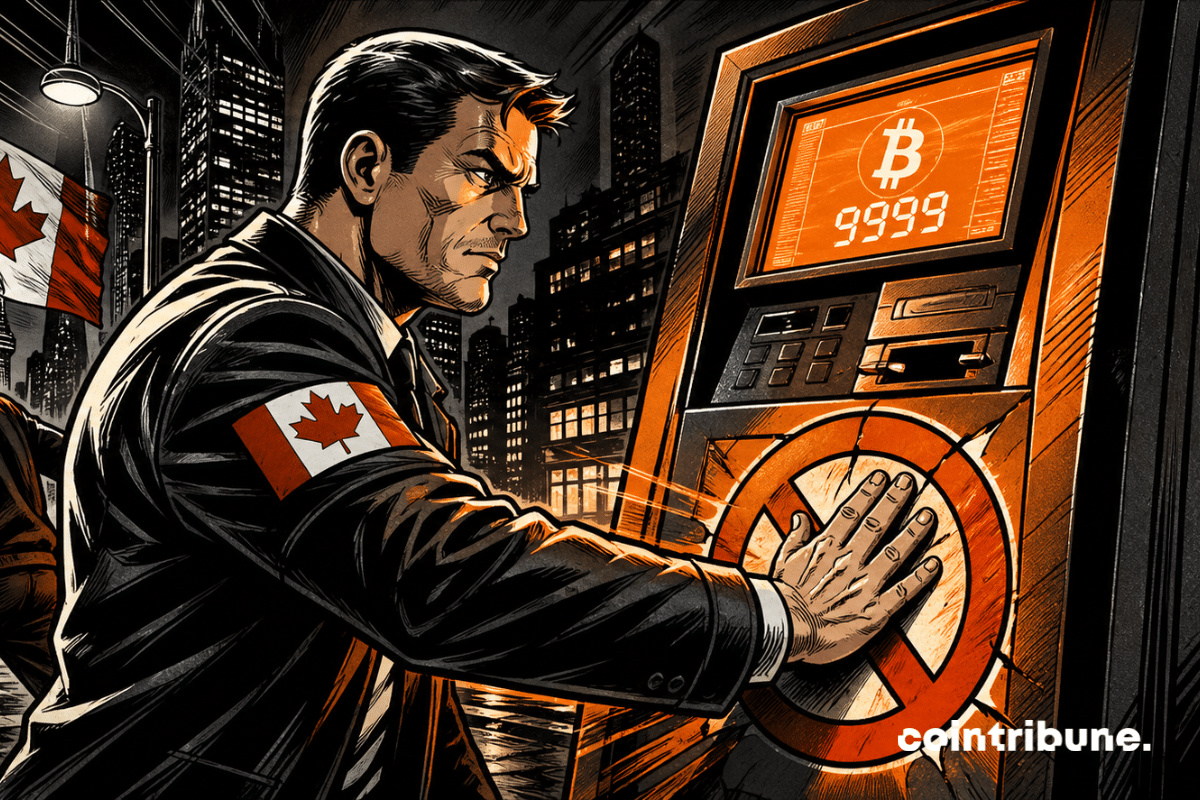
Ottawa has just launched an unprecedented regulatory offensive against crypto ATMs. The Canadian government accuses them of having become real tools for fraud and money laundering. A decision which is debated in a country which nevertheless invented the concept.
In brief
- Canada is considering banning crypto ATMs, deemed too risky for individuals.
- The proposal is included in the 2026 Spring Economic Update, published on April 28.
- Canada accounts for 10.1% of crypto ATMs in the world, just behind the United States.
The announced end of crypto ATMs in Canada
In a Vancouver café in 2013, a bitcoin ATM was installed for the first time in the world. A small, almost innocuous machine that would nevertheless change the way millions of people access cryptos. Canada had just written a page of history. Thirteen years later, he may be getting ready to tear her apart.
In its spring economic update, published on April 28, 2026, Ottawa explicitly designates these ATMs as “a method favored by crooks to defraud their victims and by criminals to deposit the proceeds of their crimes”. The government is simply considering banning them.
The paradox is striking. The country that invented the concept now accounts for 10.1% of crypto ATMs in the world, according to Coin ATM Radar, just behind the United States. These machines have proliferated everywhere: shopping centers, gas stations, convenience stores. An omnipresence which, in the eyes of regulators, now exposes Canadians disproportionately to scams.
On the ground, law enforcement officials provided CBC with an alarming picture. Victims are regularly manipulated into inserting cash into these machines under trumped-up pretexts: repaying an imaginary tax debt, protecting a romantic relationship online, or unblocking a supposedly hacked account. Simple, almost crude, but extremely effective scams.
A regulatory offensive on several fronts
The crypto ATM ban is just the tip of the iceberg. Ottawa is simultaneously carrying out an in-depth restructuring of its regulatory framework for digital assets.
The same economic update strengthens the powers of FINTRAC, the Financial Transactions and Reports Analysis Center of Canada. The body will now be able to refuse or revoke the licenses of non-compliant money services businesses, including in the crypto sector.
On stablecoins, Bill C-15 lays a solid foundation. The Bank of Canada becomes supervisor. Issuers backed by fiat currencies will have to register, fully guarantee their reserves and ensure redemption at par. Entry into force is expected in 2027.
Bill C-25 goes even further: it aims to ban crypto donations in federal policy, citing risks of traceability and foreign interference.
Canada draws a clear line: firmly regulate risky uses, while integrating essential infrastructure into the federal regulatory perimeter. An approach that contrasts with American laissez-faire under the Trump era, and which could inspire other democracies seeking to protect their citizens without stifling innovation.
Canada closes a historical parenthesis. Pioneer of the bitcoin ATM, it became one of the first countries to want to eradicate it. This strong signal shows that global crypto regulation is entering a new phase: that of maturity, where consumer protection takes precedence over technological enthusiasm.
Maximize your Tremplin.io experience with our 'Read to Earn' program! For every article you read, earn points and access exclusive rewards. Sign up now and start earning benefits.