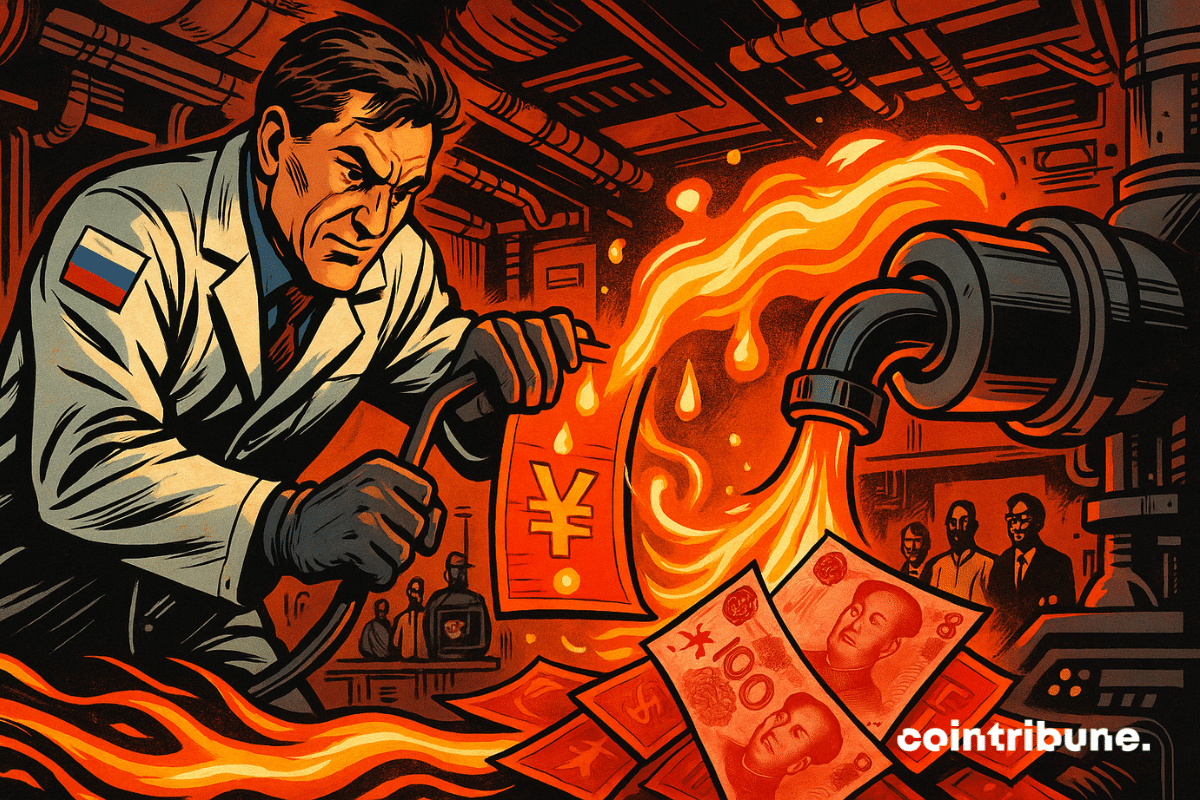
Faced with a colossal budget deficit and stubborn Western sanctions, Moscow is preparing to take a historic step: issuing sovereign bonds denominated in yuan for the first time. More than a simple financial maneuver, this decision marks a strategic turning point towards assertive dedollarization and strengthened monetary integration with the BRICS. By banking on the Chinese currency, Russia intends to both stabilize its public finances and structure a new channel for its energy revenues outside Western channels.
In brief
- Russia is set to issue yuan-denominated government bonds in its domestic market for the first time.
- The move aims to close a massive budget deficit estimated at 5.7 trillion rubles, well beyond initial forecasts.
- The country's main tax revenues are collapsing, including revenues from oil, gas, customs duties and VAT.
- Moscow seeks to attract a wide range of local investors, against a backdrop of still active Western financial sanctions.
Sovereign debt in yuan to curb a spiraling budget deficit
As the BRICS Pay project moves forward despite tensions and technical hurdles, the Russian Finance Ministry plans to issue yuan-denominated sovereign bonds domestically for the first time.
For an amount of up to 400 billion rubles (approximately $4.9 billion), this unprecedented operation is scheduled for December 8, 2025, with maturities spanning between 3 and 7 years. This choice is not trivial. It comes in an extremely tense budgetary context for Moscow, with a public deficit forecast at 5.7 trillion rubles (nearly 63 billion dollars), or almost five times the initial objective for the year.
“Previously, payments were made in dollars and euros, through Western banks which could suspend payments at any time”has recalled Finance Minister Anton Siluanov.
This initiative is also a direct response to the fall in tax revenues. The ministry was faced with a significant collapse of the main sources of state revenue:
- -20% drop in oil and gas revenues year-on-year;
- -19% on customs duties;
- -1.19 trillion rubles missing from planned VAT collection;
- -167 billion rubles in corporate tax deficit;
- -440 billion rubles of negative difference on eco-taxes.
Faced with these difficulties, the government has stepped up efforts to attract a wide range of domestic investors. They target the widest range possible, from banks to management companies to mainstream brokers.
Orders should begin to be registered on December 2, ahead of formal issuance. This offensive on the domestic market fills a strategic void left by Russia's inability to access international capital, under the effect of Western financial sanctions.
A monetary strategy serving the geoeconomic interests of the BRICS
Beyond the budgetary necessity, the issuance of bonds in yuan responds to a new monetary reality imposed by the reconfiguration of energy exchanges within the BRICS.
More and more Russian strategic players, such as Rosneft and Lukoil, receive their income in yuan, a direct result of energy contracts concluded with China. These large companies are now seeking to repatriate these currencies into the domestic economy before new US sanctions come into force. The issue therefore aims to offer these exporters a local investment solution in yuan, in line with their cash surpluses.
The Russian market is not its first attempt at debt in yuan, even if this has so far been limited to the private sector: 166 billion rubles of corporate bonds denominated in Chinese currency were already circulating before the announcement.
This first state bond therefore marks a decisive step in the creation of a parallel financial ecosystem, where the dollar and the euro are absent. In 2024, Sino-Russian bilateral trade reached a record $245 billion, with 99.1% of transactions settled in ruble or yuan. The Russian government has even expanded the room for maneuver of public companies, now allowing them to invest directly in the domestic bond market, thus strengthening local absorption of surpluses.
The great shift towards local currencies has begun, driven by political as well as structural choices. The Russian initiative marks another step towards a global monetary realignment, where the use of the dollar is no longer a given, but one option among others.
Maximize your Tremplin.io experience with our 'Read to Earn' program! For every article you read, earn points and access exclusive rewards. Sign up now and start earning benefits.