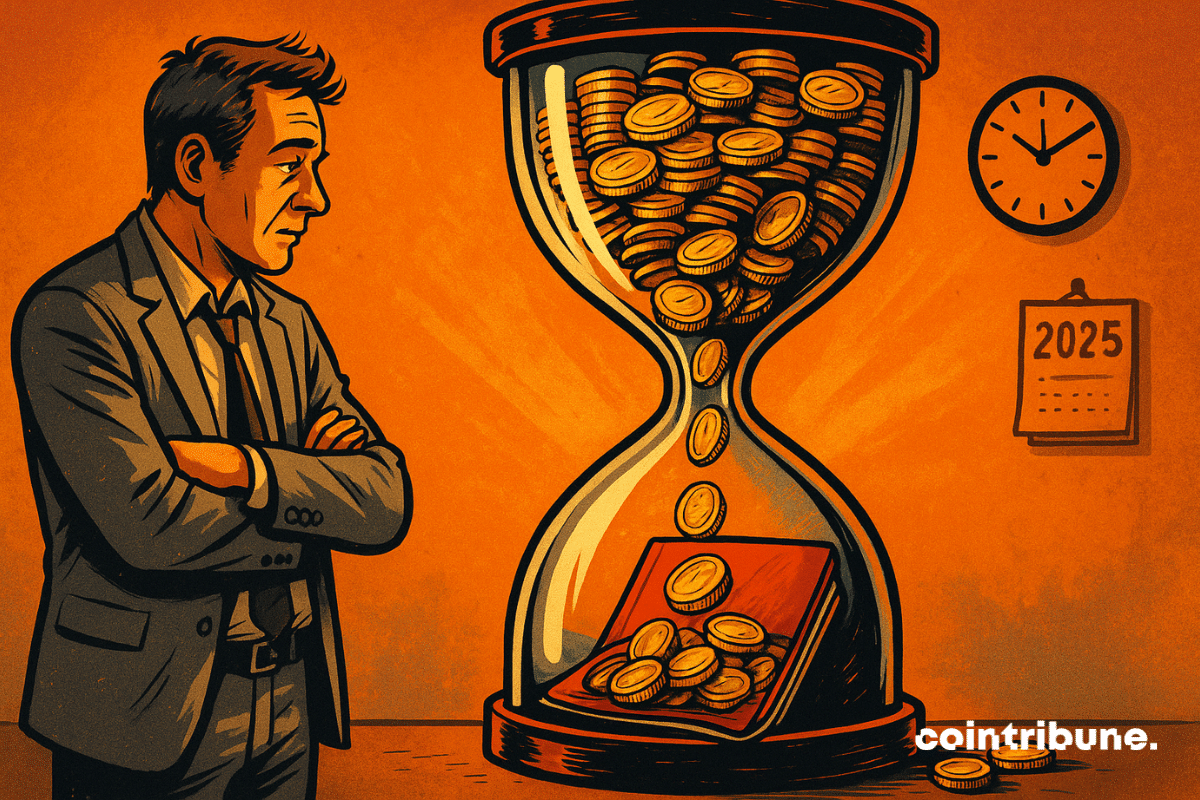
The rate of the booklet fell to 2.4 % this year, which still extends the expectation for savers. At this rate, it will take almost 30 years to double capital. Behind this apparently technical figure, a reality is essential: the remuneration of secure savings is crumbling. This new adjustment questions the relevance of continuing to place its liquidity on a product whose yield no longer follows the pace of projects or that of real inflation.
In short
- The Livret A rate was lowered to 2.4 % in February 2025, against 3 % the previous year.
- At this rate, it now takes 30 years to double its capital, according to the 72 rule.
- Despite its advantageous taxation and the guarantee of the State, the booklet A becomes an ineffective savings product.
- In this context, diversification towards alternative solutions such as crypto or deffi could be envisaged, with discernment.
Livret A: slowness as guaranteed
In February 2025, the Livret A rate was revised downwards to 2.4 %, compared to 3 % the previous year, which led to withdrawals exceeding deposits of 200 million euros in April.
This apparently technical decision has very concrete consequences on the savings of millions of French people.
With this new rate, It will take 30 years to double its capitalaccording to the 72 rule, a tool used in finance to estimate the time required for an investment doubling. This period remains much more favorable than that of the past, where at 0.5 %, it took more than 130 years to see your money double. If the gap seems to be reassuring, it remains revealing of the slowness inherent in this product, however massively acclaimed in France.
The booklet A, in the same way as the LEP or the PEL, benefits from a total exemption from tax and social security contributions. This tax protection constitutes its main force. However, the decline in regulated interest rates also recalls the structural limits of these products. Low yield, long investment horizon.
Here are some factual benchmarks from the official data of 2025 as a reminder:
- The rate of booklet A: 2.4 %;
- The duration required to double the capital: 30 years;
- At 0.5 % (rate of 2022), it took more than 130 years to double savings;
- Taxation: 0 % tax, 0 % social contributions;
- Capital security: guaranteed by the French State.
In short, the booklet has a safe refuge in an uncertain economic landscape. However, for those who aims to actively grow its heritage, the performance promise is now measured in decades.
Banking yields and life insurance: double-edged alternatives
In this context, some savers are turning to alternative banking products. Classic banking booklets, although long considered symbolic in terms of yield, saw their average rate from 0.09 % in 2022 to 0.92 % in 2025.
This very real progression is not enough to change the situation in France. Even at this rate, the deadline to double savings increases to 109 years. Such a rise remains modest in the face of boosted booklets which, for a limited period, can offer yields greater than 5 % gross.
These promotional booklets therefore constitute a more remunerative opportunity in the short term, but their accessibility remains conditioned on ceilings, restricted durations, or the holding of other products in the banking establishment.
Life insurance in France, on the other hand, retains its role of medium-term medium placement. This year, the average performance expected on euros in euros is estimated at 2.5 %. This is a performance close to that of booklet A, but engaged by applicable taxation.
This return, combined with less advantageous taxation due to social contributions of 17.2 %, now makes it possible to double its capital in 34 years. A figure certainly improving compared to the 66 years necessary in 2022, but which questions the real efficiency of these funds in the face of inflation which remains, despite everything, not zero.
In this context, some savers are turning to more volatile, but potentially more remunerative assets, such as Bitcoin, whose scheduled rarity and past performance continue to feed interest during a negative real performance.
In the medium term, these adjustments question. If the regulated booklets ensure a certain security in France, their slowness makes any enrichment strategy difficult. And banking or insurance, although slightly more dynamic, are still struggling to offer a truly incentive return. In this landscape, diversification towards non -traditional supports, such as cryptos or decentralized finance products, could impose itself as a track, provided that it is fully aware of the associated risks.
Maximize your Cointribne experience with our 'Read to Earn' program! For each article you read, earn points and access exclusive rewards. Sign up now and start accumulating advantages.