The crypto market moves, but not always in the expected sense. If we often associate the universe of blockchains with dazzling increases, September 2025 calmed the ardor. Less noise, less speculation, but also less income for networks. An lull which, instead of announcing a decline, could point out a deeper transformation. Less shine, more maturity? This is what Vaneck's latest report suggests, which radiography of the Blockchain sector's health.
In short
- Blockchains revenues dropped 16 % in September according to Vaneck.
- Tron generated $ 3.6 billion over the year thanks to Stablecoins.
- Ethereum is preparing an update to speed up transactions and lower costs.
- The Token Aster explodes by +1667 %, carried by the farming on Binance Chain.
Less volatility, less cash: blockchain digests its growth
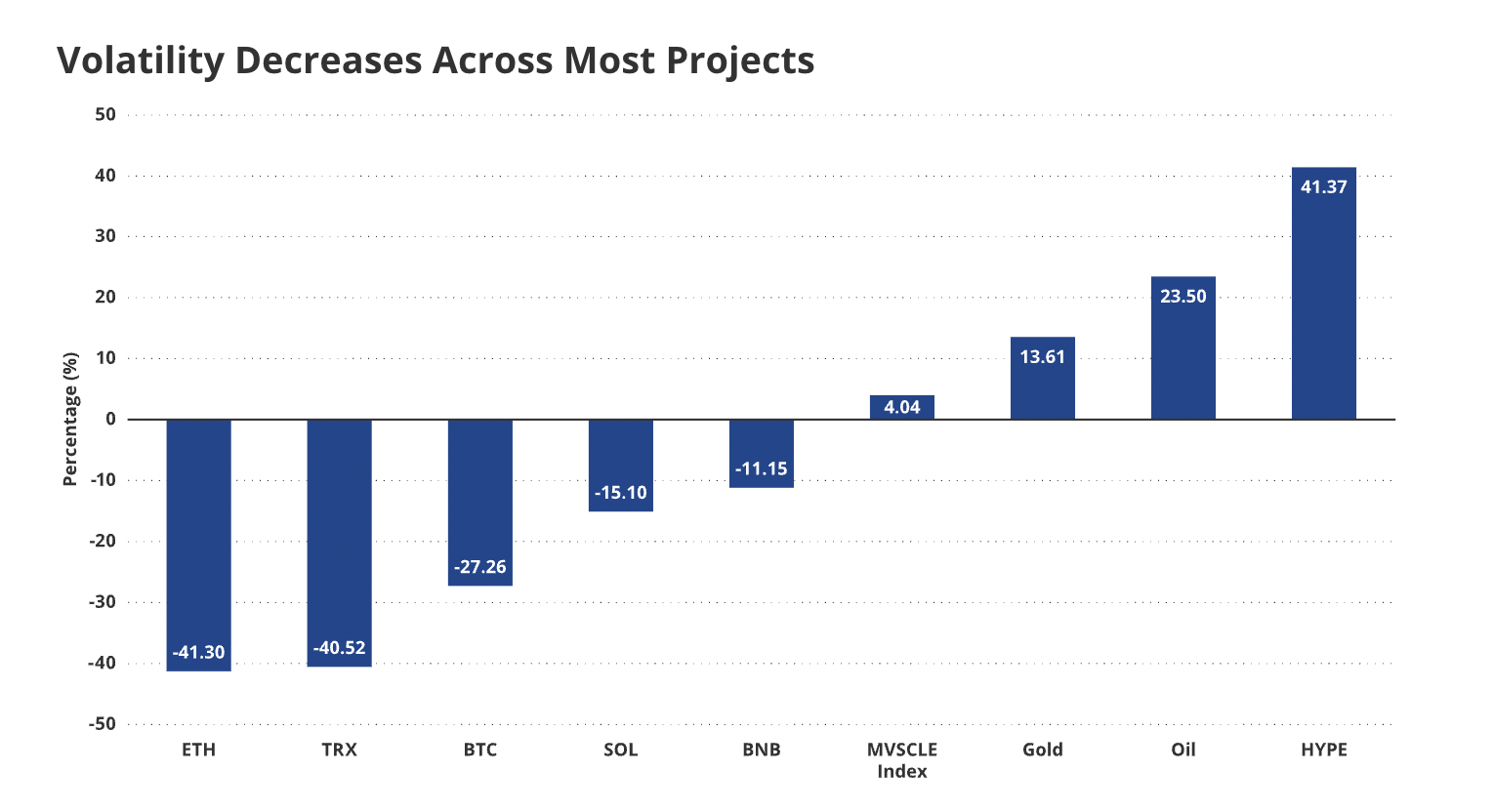
According to Vaneck's report, the cumulative income from the main blockchains dropped by 16 % in September. Ethereum, Solana and especially Tron saw their performance melt, in a context of drop in the volatility of tokens. An example: Ether's volatility fell by 40 %, that of Bitcoin by 26 %.
Result ? Fewer arbitration opportunities and therefore less high fees paid by traders.
Vaneck explains it as follows:
With lower volatility of digital assets, there are fewer arbitration opportunities encouraging traders to pay high priority costs.
Vaneck Crypto Monthly Recapseven. 2025
This decrease Is it disturbing? Not necessarily. It can also mark a passage from the speculative crypto to a crypto of use. This is what some analysts call “economic normalization of blockchains”.
Tron and stablecoins: the hidden side of blockchain success
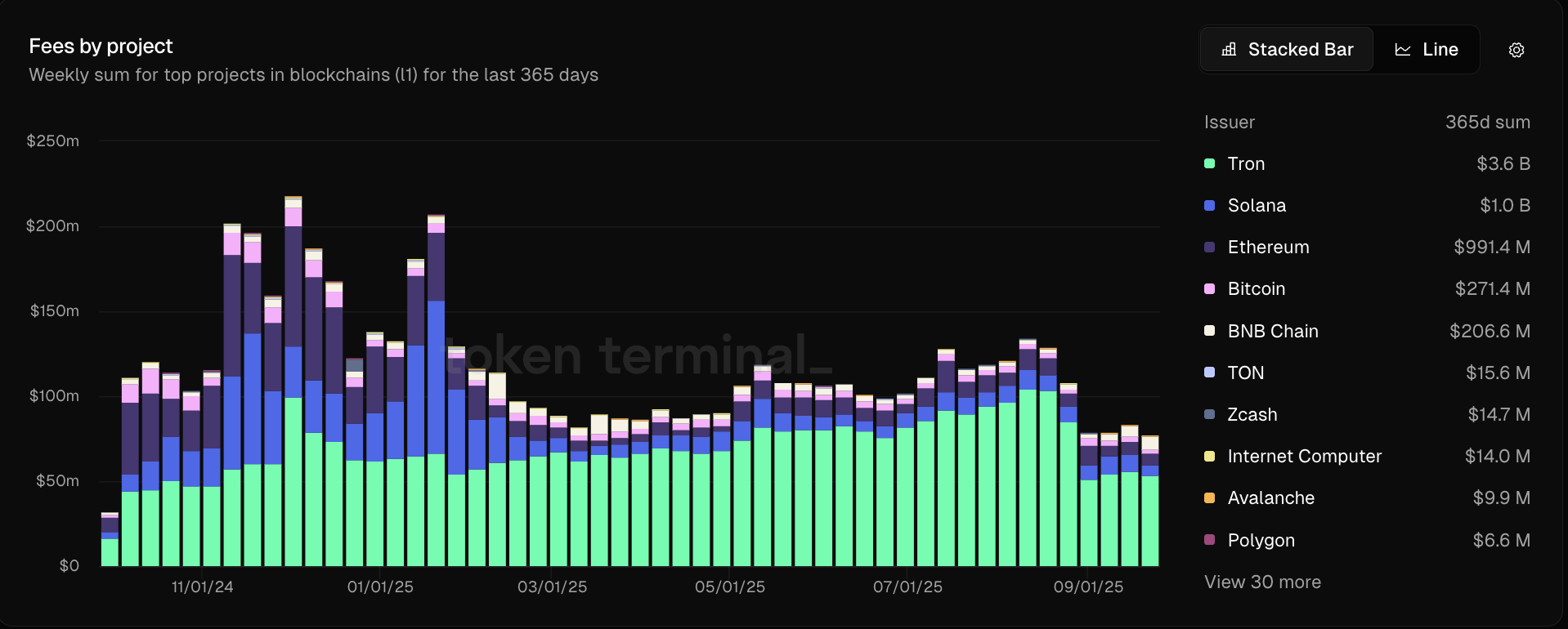
If most networks have suffered, Tron stands out. Despite a fall in income of 37 % this month (following a drop in costs imposed by governance), the blockchain displays annual figures stunning: $ 3.6 billion in revenues in one year, more than the 1 billion generated by Ethereum. And this, with a capitalization 16 times smaller.
The reason? The Stablecoins, which today represent a massive part of Crypto activity. TRON hosts 51 % of all USDT in circulation. Used for fast payments, inexpensive and without bank intermediaries, Stablecoins have transformed Tron into a financial logistics hub.
This central role in the stablecoins regulations gives Tron a certain strategic advantage, especially in areas where access to banking infrastructure remains limited. While other blockchains are looking for their model, Tron capitalizes on a concrete use, anchored in the real needs of an economy in transition.
The boom in Stablecoins shows one thing: the blockchain is no longer limited to speculation, but is woven in everyday uses, from cross -border payment to informal finance.
Ethereum, Layer 2, companies: crypto restructures its foundations
Faced with this transformation, the giants like Ethereum or Solana reorganize. Ethereum is preparing “Fusaka”, an update that will facilitate the scalability of Layer 2, thanks to a new method of light validation. Objective: to lower costs, speed up transactions, attract activity.
Solana, for her part, deployed the Alpenglow Upgrade, dividing the time of purpose by 80 (from 12 seconds to 150 milliseconds). Another innovation: the transition to a new token format, the P-Toke, which reduces the computer load by 95 %.
What about companies? They come back, but differently. After the unfinished experiments of the years 2018-2020, actors like JP Morgan, Société Générale, Circle or Openai revive private, targeted blockchains, and connected to public blockchains.
The figures that redraw the landscape
- Tron generated $ 3.6 billion in a year, compared to $ 1 billion for Ethereum;
- 51 % of circulating USDTs are issued on the TRON network;
- The Stablecoins exceeded $ 292 billion in capitalization in October 2025;
- The Token Aster has climbed by +1667 % since its launch in September;
- Coinbase recorded an increase of 10.8 % over the month, according to Vaneck.
This overall income decline does not sign the end of the blockchain era, but its reshaping. Adoption is diversifying, infrastructure adapts. However, a recent technical file reveals that Ethereum is undermined by invisible flaws at the very heart of its architecture. An additional proof that, in the crypto, nothing is ever definitively acquired.
Maximize your Cointribne experience with our 'Read to Earn' program! For each article you read, earn points and access exclusive rewards. Sign up now and start accumulating advantages.