

Exchange-traded funds linked to bitcoin are going through a period of withdrawals in the United States. Last week, these products lost $1.79 billion, according to SoSoValue data. This move comes as the market remains under pressure and investors reduce their exposure to risky assets. This is the fourth consecutive week of releases, in a climate marked by economic concerns and the decline in stock markets.

In brief
- US Bitcoin Spot ETFs see $1.79 billion in net outflows in one week.
- BlackRock is concentrating withdrawals with $1.37 billion in outflows for its IBIT fund.
- Bitcoin ETFs have a fourth consecutive week of negative flows.
- Analysts are seeing more structural pullbacks, amid extreme fear and macroeconomic tensions.
Bitcoin ETFs record their biggest weekly outflow since June
US spot Bitcoin ETFs saw approximately $1.79 billion in net outflows last week. This is the largest weekly withdrawal since the week ended June 26, 2026. data from SoSoValue confirm a negative series which has lasted for four weeks. Investors are therefore further reducing their positions in these listed products, despite their role in providing traditional players with access to the cryptocurrency market.
The iShares Bitcoin Trust (IBIT) fund, managed by BlackRock, accounts for the majority of withdrawals. He alone lost $1.37 billion during the week. Since the start of the month, American funds have recorded approximately $4.14 billion in outflows. This amount remains lower than the monthly record for net withdrawals recorded in June.
The drop in outstandings confirms the extent of the movement. As of Friday, total net assets of Bitcoin ETFs reached $71.35 billion, up from around $110 billion in mid-September. Funds dedicated to Ether are also experiencing a difficult period, which broadens the movement beyond just the BTC market. They lost $314 million over the week and have had an eighth week of negative flows.
Bitcoin’s decline accompanies a general decline in risk appetite
In a statement attributed to The BlockRick Maeda, head of markets at Laevitas, believes that the withdrawals mainly reflect a reduction in risks.
Current net capital outflows mainly reflect a reduction in risk among investors. Profit taking usually follows a rise, but these exits come in a bear market, with BTC having fallen from around $80,000 at the start of the month to just over $60,000.
Rick Maeda, Head of Markets at Laevitas. Source: THE BLOCK.
According to him, profit taking usually occurs after a rise in prices. However, the current outflows are occurring in a bear market, as BTC has fallen from around $80,000 at the start of the month to just over $60,000.
BTC hit a cycle low near $55,700 over the weekend. This decline comes in a climate of risk aversion, marked by macroeconomic tensions and the decline in stocks linked to artificial intelligence, which weigh on speculative assets. Last week, the Nasdaq Composite lost about 10%, while the S&P 500 fell 8.6%. Concerns surrounding Nvidia have also weighed on the AI sector.
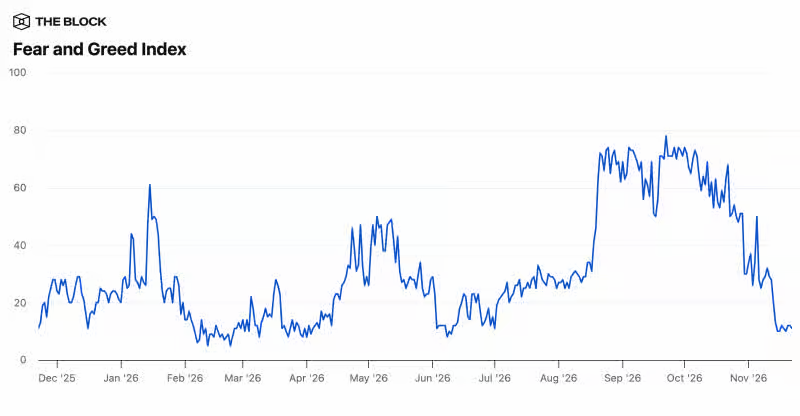
L’bitcoin fear and greed index calculated by The Block displays 11, a level associated with extreme fear. Maeda points out that cryptocurrencies are among the riskiest assets. They also face their own concerns, particularly around quantum computing and hacking.
More structural exits and new macroeconomic data expected
Dan Khus, chief analyst at LVRG Research, said the current withdrawals appear more structural than in previous episodes. The current sequence rather accompanies lasting pressure on prices, high liquidations and a change in institutional positioning. The stakeholders concerned would now favor the preservation of capital.
Expectations regarding US rates also weigh on investor decisions. Some investors fear another rate hike from the Federal Reserve in December. The Personal Consumption Expenditures Price Index, or PCE, is due out in the United States on Wednesday. Jeff Mei, director of operations at BTSE, believes that this indicator will inform the central bank’s choices.
Dominick John, an analyst at Zeus Research, warns that Bitcoin and Ether ETFs could face further drawdowns if rate hike fears persist. However, he believes that BTC could resist better than Ether. A lasting recovery will depend, according to him, on an easing of macroeconomic concerns and a return to capital flows.
The next inflation figures will remain decisive for financial markets and digital assets. Investors will also monitor the reactions of institutions after their publication. The evolution of BTC will therefore depend on these factors and investor confidence in the coming weeks on global markets as well.
Maximize your Tremplin.io experience with our ‘Read to Earn’ program! For every article you read, earn points and access exclusive rewards. Sign up now and start earning benefits.